Portuguese hospital lets pets visit owners on wards: a new model?
In northern and central Europe, pets stay outside hospitals. São João's flexible model unites clinical benefits and safety, with no infections yet. "There is too much fear," says the doctor who helped draft the project's rules.
Since 9 July, São João, one of Portugal's leading public university hospitals, has been opening the doors of its wards to visits from pets.
The "Pets and Company" project brings together different professionals from the One Health São João (source in Portuguese) programme, as well as from the Infection and Antimicrobial Resistance Prevention and Control Unit and the hospital's Humanisation service. The initiative is part of a strategy aimed at breaking isolation and relieving the exhaustion of prolonged hospital stays.
The therapeutic potential of animals is far from a recent discovery. Countries such as the United Kingdom and Germany have used them in psychiatric and physical rehabilitation treatments for humans since the 19th century. The term "pet therapy" (animal-assisted therapy) was scientifically recorded in the 1960s by a US psychologist who fortuitously discovered the healing benefits of these interventions.
In Portugal, trained and certified dogs for emotional support sessions have been working in hospitals for several years, including at São João, in partnership with volunteer handlers from associations.
On 30 May 2023, a 77-year-old patient admitted to Cascais Hospital, recovering from a haemorrhagic stroke, received a visit from her own dog, in a reunion that took place in an outdoor area of the health unit.
This unprecedented experience is now being expanded by São João through a comprehensive protocol created from scratch, which goes a step further and normalises the practice of bringing pets into inpatient areas, recognising them as part of the patient's immediate family and giving those who have been away from home for a long time moments of comfort under safe sanitary conditions.
What does the protocol say?
Visits are requested by the health professional (doctor or nurse) in charge of the patients, who is responsible for flagging each case, and they are not available to everyone in hospital. A tailored assessment is always made of the risks and benefits.
Once informed, the team responsible for the programme assesses whether there is a clinical need and whether the infection-control conditions at the chosen location allow the visit to go ahead. Other patients in the ward are also asked whether they feel comfortable with the presence of animals.
Once authorisation is given, the patient's family must submit a veterinary medical certificate proving that the animal's vaccinations and deworming are up to date and that it has behaviour compatible with the demands of remaining in a hospital setting.
"Any professional, from security staff to a doctor or nurse, who sees that something is not in line with the protocol can interrupt the visit," said Filipa Ceia, spokesperson for the One Health São João Group, to Euronews.
If the animal is "anxious" because of the "noise on the ward", appears "aggressive" or is "visibly dirty", the visit is "immediately called off", the infectious disease specialist and vet warns.
Dogs, cats and even "more exotic species" are allowed, as long as "all the conditions are met", says Filipa Ceia. While in hospital areas, the animal must be accompanied by an adult.
Each patient can enjoy these half-hour meetings once every seven days. The project gives priority to those who are terminally ill or in long-term hospitalisation.
To the team's surprise, it is male patients who have most often requested that their four-legged companions be allowed into the hospital, although the small sample does not allow for definitive conclusions. "Men may be more fragile when they are ill. They realise that there are things that really matter in life and want to have them close during their hospital stay," notes Ceia.
Benefits for patient and animal
Studies on interventions assisted by trained animals report clear improvements in patients' clinical condition: blood pressure falls and the production of hormones linked to stress and anxiety is inhibited. When the family pet is involved, there is "an even greater benefit", stresses Filipa Ceia.
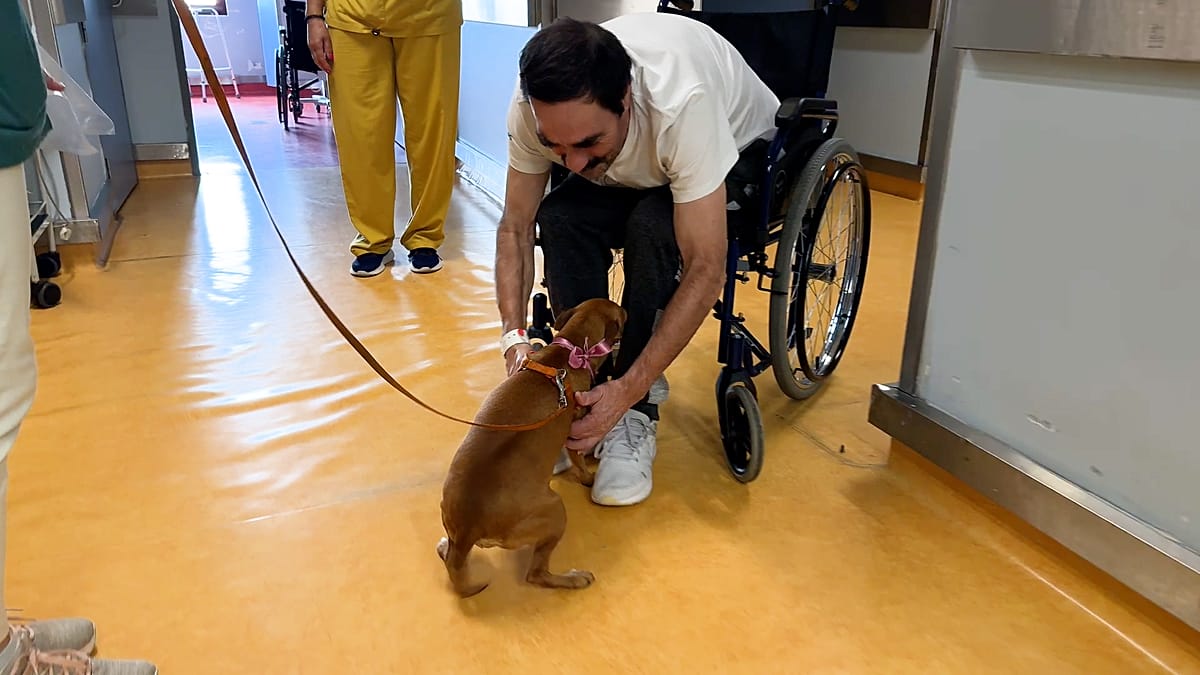
Euronews followed the visit of Princesa, who went to São João for the second time in 15 days to ease the longing for her owner, António, who has been in hospital for three months. The dog was taken to the hospital by the patient's wife, who led her on the lead to the ward.
As soon as the lift doors opened, Princesa could not contain her excitement – and neither could António.
"My heart was pounding with joy. She is like family. She is like a daughter to me," confessed the 65-year-old man, who is undergoing rehabilitation because of balance and walking difficulties.
The diagnosis is still not confirmed, but doctors suspect he suffers from a rare blood disease. The reunion with the dog, who was given to him five years ago after being rescued from the street, is a balm for the soul.
"It makes me feel I want to walk better and everything. This is the joy a person gets," he said. These reunions bring "smiles, cooperation with treatment and an incentive to leave hospital", notes Filipa Ceia, who also identifies benefits for the animal itself and even for health professionals.
"Residual risk"
This initiative was launched at the beginning of July and, so far, no infections have been recorded.
The team behind the project wants to review the protocol at a later stage to correct any shortcomings. Given the procedures in place, a scenario involving "incidents" is nevertheless "highly unlikely", points out Filipa Ceia.
In northern and central Europe, infection-control and public-health rules are stricter. Assistance dogs are prioritised and, when visits by patients' own animals are authorised (usually for patients in palliative care), they take place in isolated facilities, namely in open courtyards or gardens adjoining the main building.
Take the example of Sint-Trudo Hospital in Sint-Truiden, Belgium. In July 2023, this health unit opened an independent pavilion (source in Portuguese), connected to but separate from the main building, so that terminal patients or those in long hospital stays could interact with their pets. The access (source in Portuguese) for the animals is via the outside, through a courtyard, and they are strictly forbidden, under any circumstances, from passing through the interior of the hospital.
Instead of erecting physical barriers with secondary structures, São João has drawn up a set of rules which, while maintaining clinical rigour, are part of an agile protocol shaped by scientific evidence.
"There is an excessive fear of zoonotic transmission which is not borne out by the studies," says Filipa Ceia. In fact, the infectious disease specialist notes, "it is easier for most diseases to be transmitted from human to human than from an animal to a human".
"Because we do everything we can to preserve safety and because, once they go home, patients will be living with their animals, the risk really is residual. We have to ask whether, in trying to mitigate the risk, we are not depriving patients of the benefit," she adds.
The boldness of São João lies not only in the balance between empathy and sanitary control, but also in its autonomy and ability to humanise care without waiting for lawmakers, unlike in Italy, for example, where the move was driven by decrees from regional governments.