Taiwan's Asus unveils 'AI City' and Nvidia-powered laptops at Computex
When the Taiwanese tech company ASUS took to the stage of the Computex conference this year, the conversation quickly moved beyond laptops. The company’s co-CEO, Samson Hu, told Euronews Next about a future...
When the Taiwanese tech company ASUS took to the stage of the Computex conference this year, the conversation quickly moved beyond laptops.
The company’s co-CEO, Samson Hu, told Euronews Next about a future in which the East Asian island nation becomes more than just the semiconductor hub and transforms into an "AI city" and a model for the rest of the world.
"Taiwan's ecosystem across semiconductors, systems, infrastructure and manufacturing really positions it to lead the shift — not only in cloud AI but also in edge AI streaming computing," he said.
“We see Taiwan becoming the AI city and the AI ecosystem hub. And ASUS will play a key role in connecting infrastructure, devices, and real-world application experiences."
At the Smart City Summit & Expo in Taipei this March, ASUS unveiled its official AI City framework, which brings together solutions spanning smart transportation, healthcare, public security and sustainable governance under a single, exportable blueprint.
"With AI City, governance becomes predictive, not reactive. That changes everything in traffic, health, energy, and public safety," Hu said.
The alliance has partnered with city governments across Europe and is collaborating with the European Bank for Reconstruction and Development (EBRD) and Paris on smart infrastructure initiatives. "The [international] response is quite good," he said.
Asus' latest technology: AI agents run on Nvidia
Asus also showed off its latest hardware — but not fully.
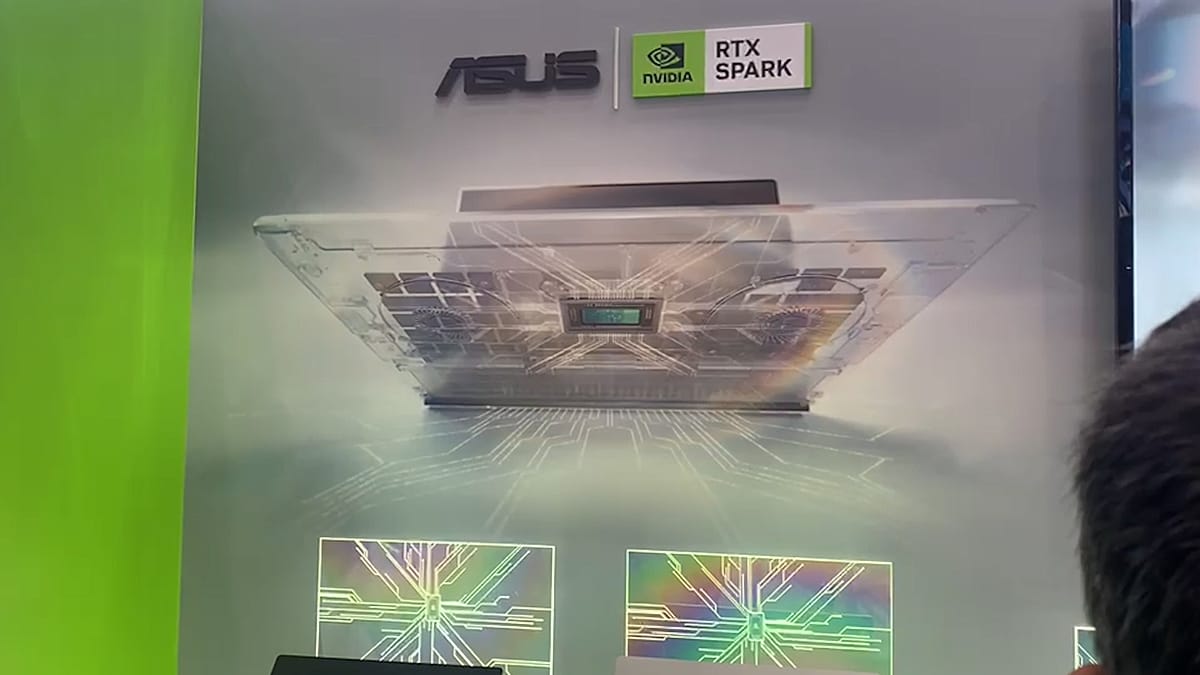
An endless crowd gathered around Asus’ laptops embedded with Nvidia’s RTX Spark chip, which delivers up to ten times the performance-per-watt of its predecessor, Hu said.
“The RTX Spark from NVIDIA is really an exciting achievement, especially since it brings much more powerful AI computing performance so that we can easily deliver agentic AI experience much more smoothly on the PC side,” he said.
No price has been announced for the ProArt P16 and P14 laptops, which carry the AI chip, and no one, not even the media, is allowed to look at the screen.
Asus is not the only computer company to use Nvidia’s chip. Dell, HP, Lenovo, Microsoft Surface and MSI, Acer and Gigabyte will all be using it.
Asked on how Asus will differ in its use, Hu said it would develop in-house AI application tools called Muse, Story Cube and Muse Tree, which the executive said would help with creativity.
Another unveil at Computex was Asus’ unified AI ecosystem called Asus Zenni Claw.
The company says it offers safe, controlled and reliable end-to-end AI experiences across consumer, commercial, creator and gaming hardware. AI agents will also play a big role in this.
For Hu, he is excited about agentic AI, which refers to an automated AI system that can accomplish tasks with limited human supervision.
He also sketched out a roadmap for AI's evolution and said that after agentic AI, physical AI, referring to robots that can perceive, understand and act in the real world, “would be a very exciting trend”.
Video editor • Roselyne Min