Industrial tourism: a different kind of holiday experience
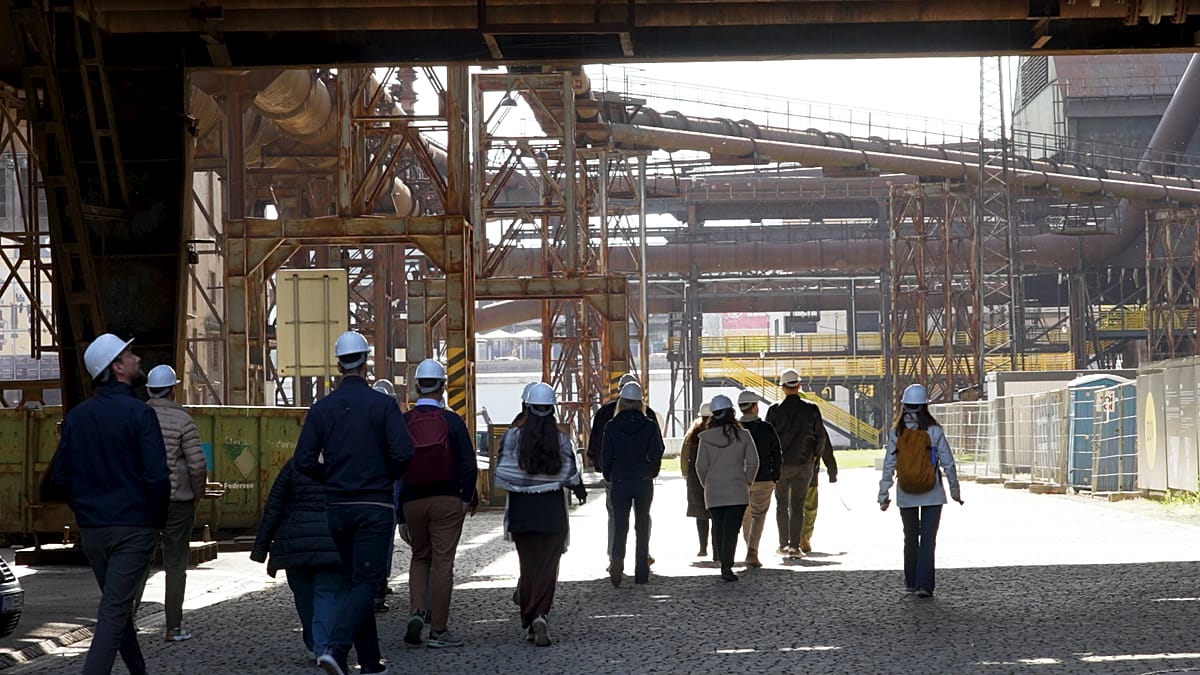
What do an old steelwork, a 17th-century mill and a car factory have in common? All three are industrial sites... and tourist attractions! Six regions from six European countries are promoting tourism in industrial areas through the IndusTour project.
Published on 08/06/2026 - 15:00 GMT+2
What can be done to prevent tourist overcrowding in Europe? Industrial tourism could be the answer. Six regions in six European countries have launched IndusTour, a project promoting a more mature tourism, linked to the local community, to their history in industrial areas.
At the end of April, some thirty representatives involved in this Interreg project – an EU funded scheme - met in Czechia Lucie Ševčíková, from the tourism department of Czechia’s Moravian-Silesian region, says the practice of visiting business and industrial sites could be an alternative tourist attraction to help reduce tourist overcrowding in cities such as Prague, Venice or Barcelona, to name but three.
The Czech region of Moravia-Silesia, an industrial pillar of the 19th century, is a pioneer in industrial tourism. Hyundai’s European production site is located in Nošovice. This is one of the South Korean carmaker's fourteen production plants worldwide. The Czech plant has more than half a thousand robots, employs 2900 people and is involved in various industrial tourism experiences such as Technotrail and IndusTour. In this company, which occupies more than 200 hectares, 1500 cars are produced every day, under the watchful eye of visitors. They offer free guided tours lasting between an hour and an hour and a half, three days a week, in English, German, French, Polish and Spanish. According to Barbora Hermanová, Public Relations Manager for Hyundai Motor Manufacturing in Czechia, it is usually groups of thirty-five people that tour the facility in a small electric train with a guide. Visits are free of charge.
Dolní Víktovice is the most symbolic place in Ostrava, a city of more than 280,000 inhabitants in the east of the country. The former steelworks closed its doors in 1998 and has since reopened to the public for educational and tourism purposes. Visitors discover the old site, transformed with a futuristic touch, with an offer that includes music festivals, a museum, sports events, a technology centre and the 80 metre high Bolt Tower, with viewing platforms and a bar overlooking the industrial complex, Ostrava and the Beskidy and Carpathian mountains. Lucia Foltínková, who is responsible for the steelworks’ tourist experience, explains that in Dolní Víktovice "last year was our best one because we crossed the border of 1.7 million visitors per year and we are hosting hundreds of kids every month".
The total budget of IndusTour is €1.4 million, 80% of which has been financed by the European cohesion policy. In addition to the Czech region of Moravia-Silesia, the project also involves the French region of Auvergne-Rhône-Alpes, the Voivodship of Łódź in Poland, Tønder in Denmark, Vojvodina in Serbia and Cyprus.
Industry is also about know-how. 30 minutes from Ostrava, the Bartosovice mill, built in 1678, is the only one left in the region and one of the few in the country still operating with original equipment. Today it activates pulleys and the tour guide shares anecdotes with a group of locals and visitors. “We have been shown the different types of grains: barley, oats, rye and wheat. It is the first time I have visited this mill. My husband and I have just moved to this town and we wanted to explore the surrounding area and find out what interesting things there are around here.”