Europe's scorching summer could cost EU economies €180 billion
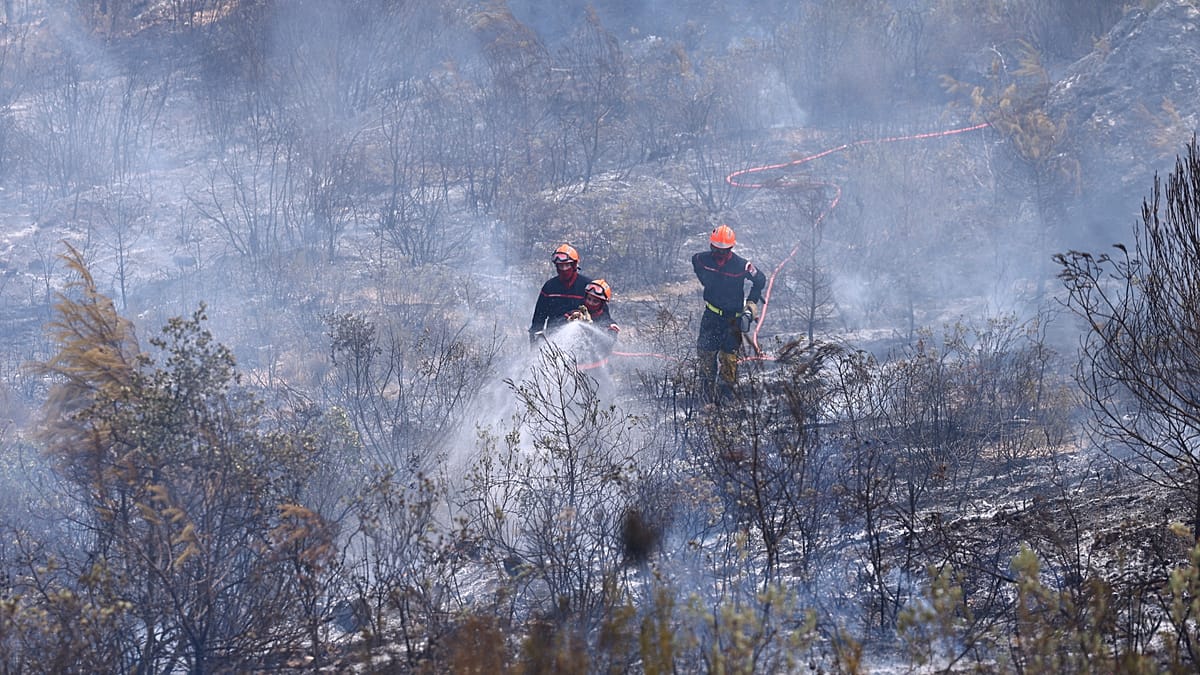
Extreme heat could cost EU economies around €180 billion this year, roughly 1% of GDP and almost exactly the growth the bloc had been expecting for 2026, with France facing the heaviest blow of the big member states.
The prolonged heat gripping Europe this summer is on course to wipe out a year of economic growth, according to research published by Triodos Bank.
The analysis estimates that the damage caused by extreme heat and wildfires will cost a cumulative €180 billion in 2026, which represents around 1% of GDP. Against expected EU growth of roughly 1.1% this year, that would leave the bloc near stagnation.
The bank traces the damage through four channels, three quantified as EU averages.
Lower crop yields and dairy output, plus the food price rises that follow, account for about 0.15%.
Constrained nuclear, hydro and thermal generation, weaker solar efficiency and higher wholesale power prices add 0.12% to 0.15%, while disrupted rail, road and waterway capacity a further 0.15%.
The largest effect, and the hardest to pin down, is labour productivity.
Output per worker falls once temperatures pass roughly 25°C to 30°C, with the sharpest losses in outdoor and physically demanding jobs. Office work suffers too, partly because heat degrades sleep and cognition.
A cross-country analysis by Allianz, cited in the research, puts the loss at about 3% of output per hour worked for each degree above 30°C sustained over days.
France tops the table
The results are not a ranking of the hottest countries. Triodos scores each economy on the share of output in exposed sectors, commute times, air conditioning penetration and acclimatisation, then multiplies that by the excess hot days recorded this year.
France emerges as worst affected, losing an estimated 1.4 percentage points of growth, enough to tip it into a contraction of about 0.6% from an already weak starting point.
The Netherlands loses around 0.8 points, leaving it roughly flat. Spain and Italy have the most exposed workforces and the most hot days, but decades of adaptation blunt the impact of any single one.
Poland, with low air conditioning coverage and little acclimatisation, would be highly vulnerable but has had a cooler summer and should still grow by about 2.9%.
Costs that never reach the GDP figures
The human toll sits largely outside these numbers.
An estimated 20,400 heat-related deaths occurred across France, Germany, Spain and Italy during the June heatwave alone, and valuing the summer's roughly 25,000 deaths in life years lost implies a cost of €1.5 billion to €7 billion.
Wildfires had burned over 490,000 hectares across the EU by last week, against a 20-year average of 197,000 according to the European Forest Fire Information System, with France setting a record.
Lost ecosystem services from the area burned may add anywhere from €100 million to €4.6 billion.
Adaptation could cut productivity losses by around 40%, the research suggests, but not eliminate them, and its authors caution that their estimates rest on conservative assumptions.
The bank argues adaptation alone is not enough and Europe needs stronger action on emissions, pointing to the Commission's move on 17 July to ease the trajectory of its main carbon pricing scheme as the opposite approach.