Photo of bound Palestinian detainee corroborates Israeli torture reports, say rights groups
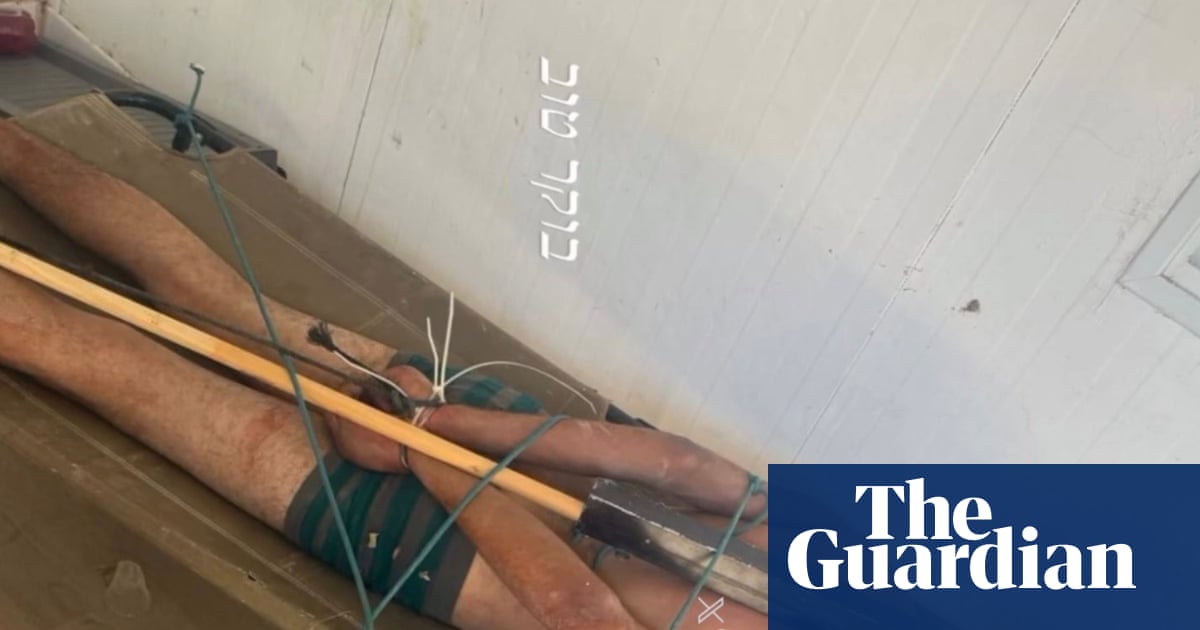
An Israeli soldier’s photo of a Palestinian man from Gaza stripped to his underwear, blindfolded and bound face-down to an iron rod corroborates extensive reporting on Israeli torture of Palestinians in...
An Israeli soldier’s photo of a Palestinian man from Gaza stripped to his underwear, blindfolded and bound face-down to an iron rod corroborates extensive reporting on Israeli torture of Palestinians in detention and itself may constitute a war crime, rights groups have said.
The image was shared on a now-deleted personal social media account, with the Hebrew-language caption “good morning”. It was brought to wider public attention by a Palestinian writer and activist who goes by Tamer.
“Both abusive treatment of detainees and the public sharing of humiliating or degrading images of them can constitute war crimes,” said Oneg Ben Dror from the prisoner and detainees department at Physicians for Human Rights Israel (PHRI).
The photo “confirms what thousands of testimonies from Palestinian detainees have exposed, and what we and other organisations have been reporting for nearly three years now,” she added. “Israeli detention facilities are torture camps for Palestinians.”
Israel’s military confirmed the authenticity of the photo. “The incident does not align with IDF values and regulations,” a spokesperson said, adding that an inquiry was under way.
Holding and photographing the man semi-naked also broke international law, said Sari Bashi, the executive director of the Public Committee Against Torture in Israel. “There is no security justification for holding a detainee in his underwear,” she said. “Forced nudity followed by capturing and sharing sexualised images on social media is a form of sexual violence and also a war crime.”
After the photo was widely shared on social media at least two mothers claimed the bound man as their son, highlighting the painful limbo of Palestinian families searching for loved ones missing since their detention by Israeli forces, Bashi added.
“This is not the first time Israeli soldiers have published humiliating photos of Palestinian detainees while depriving families of information or access to them. It has become a grotesque and unlawful way for families to get information about their loved ones.”
Rana Abu Nasser is sure the photo shows her son Osama, who was seized with his one-year-old son in March, near the shifting “yellow line” that marks the boundary of Israeli military control in Gaza. “I know the details of his body,” she told Reuters. “He has swelling in his foot and scars on his leg – the same swelling on his left leg I saw in the picture.”
Joudeh al-Ghoul wept the first time she saw the photo, instantly sure it was her son Amin, missing since his arrest in November 2023, when he was trying to travel from southern Gaza to the north. “It’s him, his hair and chin. He is my son. A mother’s heart can recognise her son. I hugged the mobile phone and started crying,” she said. “He is my son, my soul, my life.”
The Israeli military declined to comment on whether the detainee had been identified or given medical support, and whether his family in Gaza had been notified.
For seven months at the start of the war the Israeli military refused to provide basic information about the status of people detained in Gaza, in effect implementing a policy of forced disappearance.
From May 2024 Israel provided an email address for enquires about Palestinians from Gaza, but that provided only a partial, limited improvement. Israeli authorities had denied holding hundreds of missing Palestinians whose arrest was confirmed by witness testimony, the rights group HaMoked said this year.