From barbershops to nature courses: How community-driven campaigns are rethinking men’s mental health
At a small barbershop in Brixton, south London, men’s lives are being transformed. Not just through a new haircut or fresh beard trim — but by opening up about their mental health. “People confide in barbers...
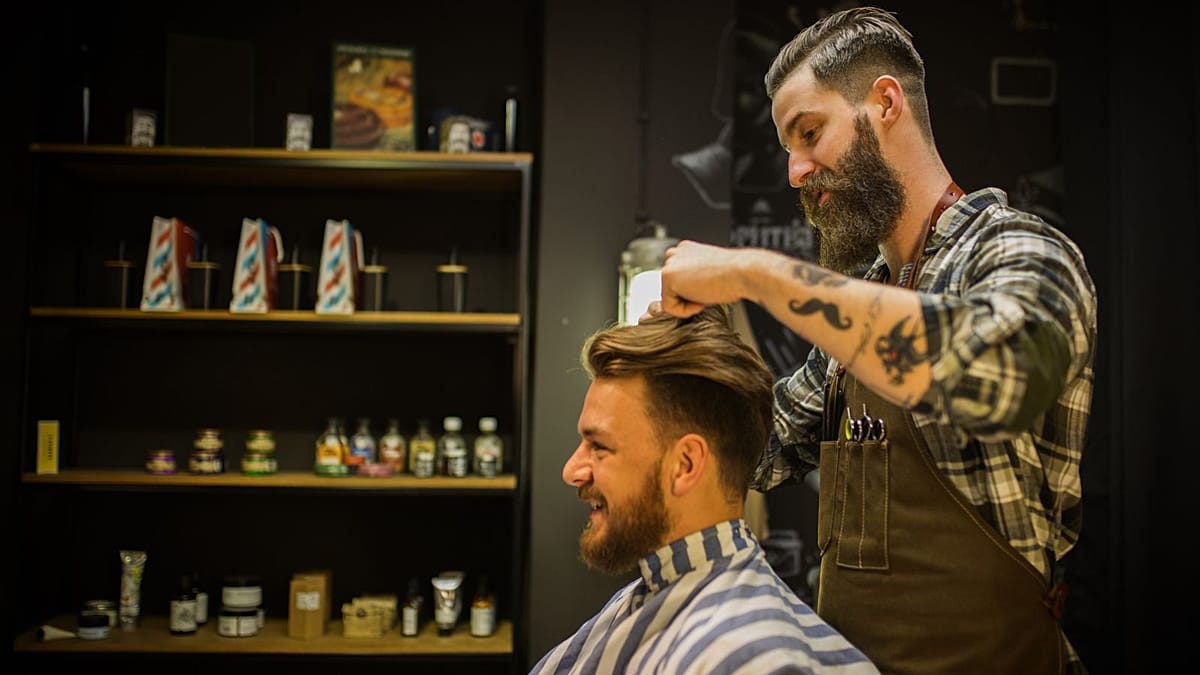
At a small barbershop in Brixton, south London, men’s lives are being transformed. Not just through a new haircut or fresh beard trim — but by opening up about their mental health.
“People confide in barbers and often share things that perhaps they wouldn't with their partners or friends,” Ben Theophanous, owner and co-founder of Curfew Grooming, told Euronews Health.
“The relationship is often strong, but there is an element of superficiality that provides a unique platform for sharing feelings,” he added.
Curfew Grooming is one of more than 100 barbershops across the United Kingdom to receive Mental Health First Aid (MHFA) training through the 12th Man Campaign — a community-driven initiative founded in 2013 by mental health nurse Nick Little and his late friend Oz Osborne.
The campaign takes its name from the football term for a team’s fans and provides support for men by normalising talking about mental health in everyday spaces.
These spaces include barbershops and tattoo studios — places where there’s already a one-on-one dynamic. Employees who volunteer take an online course, which guides them through how to spot signs that a customer might be struggling; how to ask meaningful questions and how to direct them to the right resources if needed.
“We're just handing the responsibility to men in society to look out for their friends and their family. To recognise mental health more in their lives and to talk about it,” Nick Little told Euronews Health.
Nearly 1 in 7 people around the world are living with a mental health condition, but men are still less likely than women to reach out for help — and three times more likely to die by suicide, according to the Office of National Statistics.
Those who are looking for professional help encounter another issue: long waiting times. For example In the UK, people were eight times more likely to wait for over 18 months for mental health treatment on the National Health Service than those waiting for physical health treatments, according to data analysed by the charity Rethink in 2025.
Increasingly, community-led initiatives are stepping in as a way to fill these gaps in the system — not to replace professional services, but to put more preventative measures in place before people reach crisis.
“Let's put trust in society and invest in our community businesses, because that's the front line,” Little said.
Engaging men with nature
Similar community-based and male-focused initiatives are happening all across Europe.
In Denmark, many of these have used the Vildmandsprojektet (Wild Man) project as a blueprint; a 9- to 12-week nature-based rehabilitation program for men in crisis.
Co-founded by nature psychologist Simon Høegmark in 2014, its development was partly inspired by Høegmark’s own personal experiences with mental health.
Over a decade ago, he travelled to Norway to hike and regain his “footing.”
“After several days of heavy thoughts, I reached the summit of a mountain overlooking Lysefjord. For a brief moment, the thought of jumping crossed my mind,” he recalled.
But as quickly as these thoughts took over, the views of Lysefjord became awash with light — and something inside Simon shifted.
“The sun broke through the clouds, illuminating the entire landscape. I experienced a moment of self-forgetfulness, a sense of connection, and a love for life,” Høegmark told Euronews Health.
While the experience did not immediately resolve his psychological crisis, it allowed the beauty of nature to take over — its stillness settling the thoughts in his head and replacing them with a sense of hope.
“I saw my situation more clearly. I decided to investigate why encountering nature can affect people so profoundly, and how nature can be professionally utilised as a framework for recovery and rehabilitation,” he said.
After launching the Vildmandsprojektet project in 2014, Høegmark conducted many studies alongside a team of researchers to monitor its effects. One such study involved 114 men, who showed significant improvements in their physical and mental quality of life, as well as a reduction in self-perceived stress symptoms after taking the course.
“These improvements were evident immediately after the course and — on several measures — six months later,” Høegmark said, also noting a lasting sense of community even after the courses had ended.
“This serves as a vital bridge between a time-limited public program and everyday life, where habits and relationships need to endure,” he added.
The project ran from 2014 for a period of over eight years, during which time around 700 men participated in its courses. Since then, its Nature, Body, Mind, and Community (NBMC) method has been adopted by more than 50 Danish municipalities and adapted for both men and women.
While Høegmark cautions that Vildmandsprojektet was never intended to replace psychiatric treatment, it has proved itself to be an accessible format for men that might otherwise be reluctant to engage with mental health services.
“My professional interpretation is that [the NBMC method] can strengthen participants' sense of agency and ownership regarding their own wellbeing,” said Høegmark.
“However, the method must be used as a supplement within a cohesive health service framework that includes clear referral pathways should a participant require more specialised care,” he said.
The growing importance of community-driven care
Alongside local initiatives, nationwide healthcare systems have also begun looking into community-driven care as a tool to alleviate wait times.
One example of this is social prescribing, which the NHS has been offering as a way to connect patients with activity groups. These can include gardening, walking, art and crafting clubs — anything that encourages reconnection with the outside world.
“The reason I'm so in favour of this more community-driven style of support is that the format can be more relevant to everyday life, more aligned with people's hobbies and things that they normally would do anyway,” Stella Chan, a professor of evidence-based psychological therapies at the University of Reading in England, tells Euronews Health.
“It's less stigmatising and also easier to assess,” she added, which can in turn help ease resistance.
While some have argued that social prescribing is not enough — and avoids addressing more serious underlying societal issues like economic inequality — research suggests it’s become an important way to bridge medical and non-medical support.
“Mental ill-health and mental disorders are among our major global health challenges, and we need both robust treatment and far more prevention,” Høegmark said.