US President Trump rejects global AI regulation as China's Xi calls for cooperation on safety
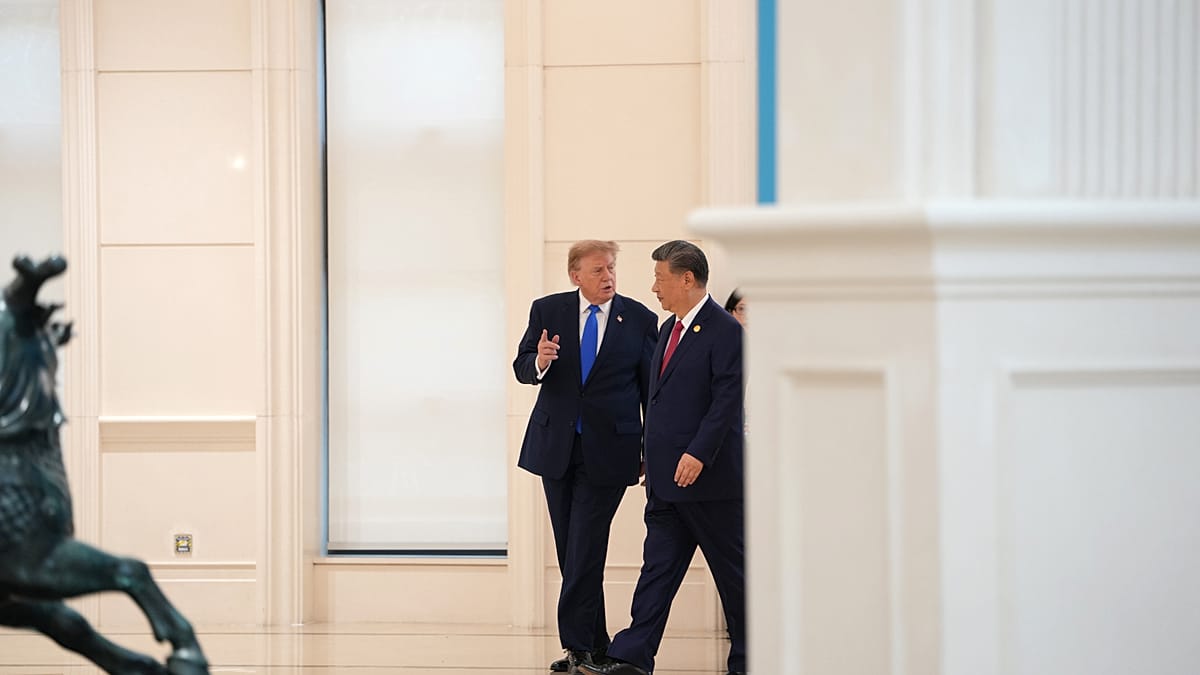
The US and Chinese leaders have set out contrasting approaches to AI governance at talks in Shenzhen, with Trump warning that regulation could hamper innovation while Xi called for the technology to remain under human control.
Published on 19 November 2026 - 12:02 GMT+1
The leaders of the world’s two pre-eminent artificial intelligence powers, the United States and China, are holding meetings to discuss the future of the technology in Shenzhen this week, with Trump and Xi representing two very different approaches to rein in AI.
President Donald Trump said that the United States opposes "globalist regulation" of AI in any form in a meeting with Xi, who responded that the US and China should cooperate to keep “AI under human control”.
Trump has repeatedly rejected calls for wide-reaching international governance of AI, warning it could hold his country back in its race with China.
"It's super intelligence, but we have to watch it," he told leaders at the Asia-Pacific Economic Cooperation meeting in Shenzhen, using his administration's preferred term for AI.
"We have to be careful. We have to cherish it. It's almost completely good, but it's got some bad elements, and we have to be very careful in managing those bad elements," Trump said.
"So we oppose any form of globalist regulation or anything to control and stifle SI, and we won't allow that to happen, frankly," Trump added.
Xi told his US counterpart that the two countries should cooperate to keep AI "under human control", Chinese state news agency Xinhua reported after the presidents met.
"China and the United States should strengthen communication and coordination to guard against artificial intelligence safety risks and ensure that artificial intelligence always remains under human control", Xinhua reported Xi as saying.
Despite the countries' fierce tech rivalry, AI safety risks of shared concern range from infrastructure hacking to people using the technology to help build bioweapons.
Another problem in the spotlight is out-of-control AI agents, tools that complete real-life tasks online with minimal human input, after the ChatGPT maker OpenAI's bots hacked into websites including an Australian government portal and several US government sites, incidents followed by similar reports by other labs.
Military use and mass surveillance are also potential flashpoints for the world's two leading AI powers.
Looming over the talks is Jensen Huang's resignation as boss of US chip titan Nvidia after revelations of an affair with a suspected Chinese spy.
Trump and Xi agreed in September to create a channel for urgent communication on AI incidents, with details to be hammered out on Thursday.
Xi this summer said the technology should be "always under human control" — calling for more "laws and regulations, technological monitoring, early warning and emergency response systems".
At APEC on Wednesday, the Chinese leader said leaders should "deepen cooperation in the digital economy and artificial intelligence", without giving details.
Canadian Prime Minister Mark Carney meanwhile said on Wednesday that the lack of global governance on AI poses an "enormous risk".
"It is past time" to develop international frameworks for reining it in, Carney added.