

How Germany is training medical staff to fight Ebola
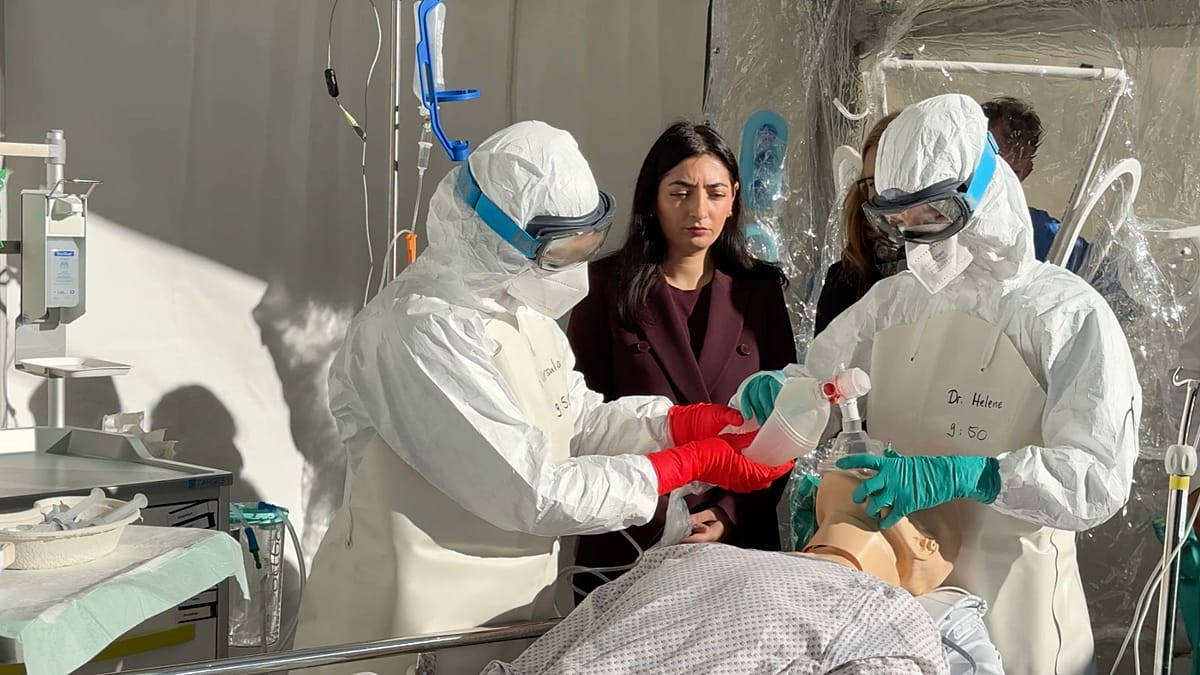
With 9,000 infections and 4,000 deaths, Ebola continues to spread in eastern DR Congo. German experts are training local healthcare workers to treat patients safely and contain the virus.
Just two days ago, Louise Gotze was in the Ugandan city of Entebbe with her team, sharing her knowledge with around 30 doctors and nurses. She spoke to healthcare professionals about how to care for Ebola patients without becoming infected themselves.
"These training sessions are absolutely essential to ensure that staff do not become infected and that they know how to work safely when they are in the red zone, meaning the area where patients are being treated," Gotze told Euronews.
Around 200 healthcare workers are currently known to have become infected as a result of their work.
According to Charité doctor Maximilian Gertler, between 800 and 1,000 patients are currently infected or receiving treatment at medical facilities in the Ituri and North Kivu regions.
Gotze has travelled to the Ebola crisis region seven times this year to train local healthcare professionals. In Berlin, she works as an intensive care nurse in the special isolation unit at Charité hospital. Another trip is being planned.
The ultimate goal is to establish a network of trained healthcare professionals across East Africa who can, in turn, pass on their knowledge to others.
How the international community is fighting Ebola
Germany is sending teams to several countries, including the Democratic Republic of the Congo, Kenya and Uganda, as the virus does not stop at national borders.
"We are currently training a group of around 120 doctors from the partner states of the East African Community," explained epidemiologist Gertler from Berlin's Charité hospital.
"Graduates of our programme from the Democratic Republic of the Congo have also started conducting training sessions themselves in Kinshasa to prepare for the possibility of cases emerging in the capital."
Epidemiologist Maximilian Gertler confirmed that the situation in the Democratic Republic of the Congo is still not under control.
The number of infections has now risen to 9,000, with 4,000 deaths reported. According to Gertler, the fatality rate in this outbreak stands at 50%.
Simulation in Berlin: How Ebola patients are treated
He stands in front of a tent containing a height-adjustable hospital bed and other equipment needed to treat Ebola patients. But here in Berlin, in the courtyard of the Federal Ministry for Economic Cooperation and Development, there is no real patient.
Instead, a mannequin is being used to demonstrate how people with Ebola are examined and treated in the Democratic Republic of the Congo.
Germany's Development Minister Reem Alabali-Radovan and the Secretary-General of the East African Community, Stephen Patrick Mbundi, are also present.
The climatic conditions in the country, which lies close to the equator, make the work more difficult. Protective clothing can only be worn safely for around 45 to 60 minutes.
More than 10,000 protective suits are used every day and must then be burned to prevent contamination. Only protective goggles, rubber boots and aprons made from more durable materials last longer.
Plastic walls with openings for arms also offer a solution.
"An innovative concept that the WHO and its partners have increasingly developed in recent years involves fitting the walls of these often tent-like structures in treatment facilities with transparent screens. This allows staff to care for and monitor patients without the need for protective equipment," Gertler explained.
Behind these walls, healthcare workers do not need to wear full protective gear and can still monitor the condition of several patients at the same time.
"This can significantly reduce the number of staff who need to remain in protective clothing continuously," Gertler said.
€21 million for protective equipment and training
Since the Ebola outbreak began in June, Germany's Development Ministry has increased its support by €21 million, including funding for protective equipment.
Germany's commitment is important for global health, according to Development Minister Reem Alabali-Radovan (SPD).
"We cannot prevent outbreaks of infectious diseases and pandemics unless we take active measures. That means it remains important that we continue to invest in global health," Alabali-Radovan said.
The outbreak in eastern DR Congo has already spread to other countries. Kenya has so far recorded one death, while Uganda has reported several dozen infections.
"Ebola has broken out in regions that are also affected by crises and conflicts. This means medical staff sometimes have to treat patients under life-threatening conditions, if they are even able to reach the affected areas," Alabali-Radovan stressed.
"We are trying to take the necessary measures to ensure that the outbreak does not spread across the entire region," Ambassador Stephen Patrick Mbundi, Secretary-General of the East African Community, said.
Gertler explained that the international campaign to prevent the further spread of the Ebola virus focuses on patient isolation and treatment, as well as public awareness.
According to Gertler, trust in "all kinds of state institutions" is relatively low in the "civil war-torn region". The population is not accustomed to a functioning healthcare system. Every year, 50,000 people die from infectious diseases such as malaria, cholera and measles. Some people are sceptical about the increased focus on Ebola, as fewer people have died from the virus so far.
"Awareness-raising is needed within communities, and these efforts must reach the people," Gertler stressed.
Alabali-Radovan thanked German personnel for their efforts and called for continued international cooperation to contain the outbreak.
Ebola outbreak in the Democratic Republic of Congo
The Ebola outbreak began in the Democratic Republic of the Congo in mid-May this year. By July, the number of confirmed cases had already exceeded 2,000, with 754 deaths reported. The total number of infections has now risen to more than 9,000, and according to WHO figures, the virus has killed over 4,000 people.
Some 2,269 people have survived Ebola. The outbreak is considered the most severe and fastest-growing in the country's history.
In May 2026, the World Health Organization declared a public health emergency of international concern.
During an international aid operation, two US citizens became infected and were brought to Germany for treatment in specialised isolation units.
Both doctors were later discharged in good health. According to the Robert Koch Institute (RKI), whether an infected person recovers depends "to a large extent on how good the medical treatment is."
There are still no approved vaccines against the Ebola Bundibugyo virus, although one vaccine candidate is currently undergoing testing.