From Almaty to the skies: Kazakhstan tests Central Asia's first air taxi
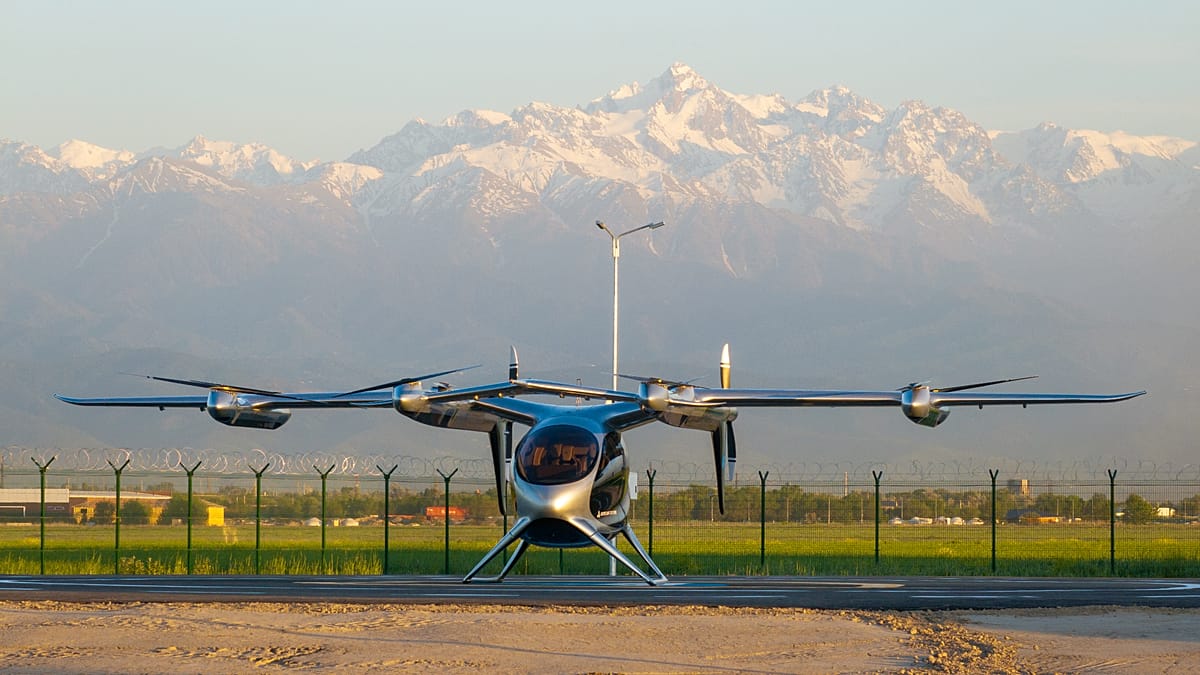
Central Asia's first air taxi test flight has taken place in Kazakhstan, as authorities and private partners work to develop a new urban air mobility network. Commercial trial operations are expected by early 2029, subject to certification and regulatory approval.
Central Asia's first air taxi has taken to the skies in Kazakhstan. The V2000 Prosperity model lifted off from Alatau City in the Almaty region before a crowd of spectators, completing a ten-minute unmanned test flight monitored from the ground.
The test marks Kazakhstan's effort to join a small group of countries exploring urban air mobility through electric vertical take-off and landing aircraft, known as eVTOLs. The project is being developed by Kazakhstan's Alatau Advanced Air Group in partnership with companies from China, South Korea, Italy and the United States.
Total investment in the development of urban air mobility infrastructure in Alatau City is expected to reach around €260 million.
“For us, this is more than a demonstration of new technology,” says Alisher Abdykadyrov, chief executive officer of Alatau City Authority. “It represents a transition toward a new model of urban development, where innovation, digital transformation and advanced mobility solutions become a new economic sector.”
Testing the technology
The aircraft used in the test was developed by Chinese manufacturer AutoFlight. The V2000 Prosperity can carry one operator and up to five passengers and reach speeds of up to 200 kilometres per hour. Powered by 13 electric motors, the aircraft can be fully recharged in around an hour.
According to the company, a single charge provides a range of up to 250 kilometres, making the aircraft suitable for urban transport as well as connections to nearby destinations.
One of the advantages highlighted by developers is the aircraft's relatively low noise level compared with conventional helicopters.
“If we are 100 metres away from the eVTOL during take-off and landing, the noise level will normally be below 70 decibels,” said Kellen Xie, senior vice president of AutoFlight. “And if the aircraft is cruising about 250 metres above the ground, we cannot feel anything.”
The aircraft is designed to operate in temperatures ranging from minus 20 to 55 degrees Celsius. However, Kazakhstan's extreme weather conditions will require additional testing before commercial operations can begin.
Creating an urban air mobility network
Unlike conventional aircraft, eVTOLs take off and land at dedicated sites known as vertiports. These compact facilities can be built on the ground or on the rooftops of buildings, allowing them to be integrated into urban environments.
Italian infrastructure developer UrbanV is leading the construction of the vertiport network. The first facility is already under construction in Alatau City and will eventually become part of the Eurasia Urban Air Mobility Centre.
Three additional vertiports are planned in the near future, while the broader network will include locations at Almaty International Airport and several sites across Almaty. In total, six vertiports are expected to be operational by 2028. The company says the network could eventually expand to ten vertiports across the region.
Alatau City, a new urban centre initiated by President Kassym-Jomart Tokayev and currently under development, is expected to become the hub of Kazakhstan's urban air mobility ambitions. Designed with digital infrastructure in mind, it offers planners the opportunity to integrate emerging transport technologies from the outset.
Developers envision connecting Alatau City with nearby Almaty and destinations across the wider Almaty region, one of Kazakhstan's most popular tourist areas. According to Kazakhstan's Ministry of Transport, a journey of around 50 kilometres between Almaty Airport and Alatau City could take approximately ten minutes by air taxi, significantly reducing travel times compared with road transport.
Beyond passenger transport, developers see additional applications for the aircraft. AutoFlight says a dedicated emergency-response version can carry firefighting equipment capable of tackling fires across an area of up to 800 square metres in a single operation.
The aircraft can also deliver emergency supplies and deploy life-saving rafts, each capable of supporting up to ten people.
The road to launch
Before air taxis can begin carrying passengers, Kazakhstan must first establish the legal framework for urban air mobility. According to the Ministry of Transport, government officials and project partners have spent the past year preparing a package of legislative amendments aimed at regulating air taxi operations and the wider development of urban air mobility.
The proposed changes have already passed several stages of interagency review and are currently under discussion. Authorities say the new regulations could be adopted in the near future.
Certification remains another major hurdle before commercial flights begin. Aircraft manufacturers must first certify their vehicles and obtain the necessary flight permits in their home countries before submitting the documentation to Kazakhstan's aviation authorities for recognition.
“Only after that will we be able to launch commercial services using this new mode of transport,” said Daniyar Uteulin, project manager at Alatau Advanced Air Group.
According to Deputy Prime Minister Kanat Bozumbayev, passenger fares are expected to be set at “around one US dollar per kilometre” travelled. The first commercial trial operations are currently planned for late 2028 or early 2029.
If the project succeeds, Kazakhstan could become one of the first countries in Central Asia to integrate air taxis into its transport network, linking cities, airports and tourist destinations through a new form of urban mobility.
“This marks a major milestone that reinforces the success of the work carried out to date and establishes the foundation for initiatives such as the Low Altitude Economy, a high-tech sector that will help shape the future of the global economy,” said Vyacheslav Kim, shareholder of Alatau City Bank and partner of Alatau Advanced Air Group.
The longer-term ambition is to use the experience gained in Alatau City as a foundation for expansion to other cities across Kazakhstan before a broader rollout across Central Asia.