Sabre-rattling to ‘tremendous love’: erratic Trump dominates final hours of Nato summit
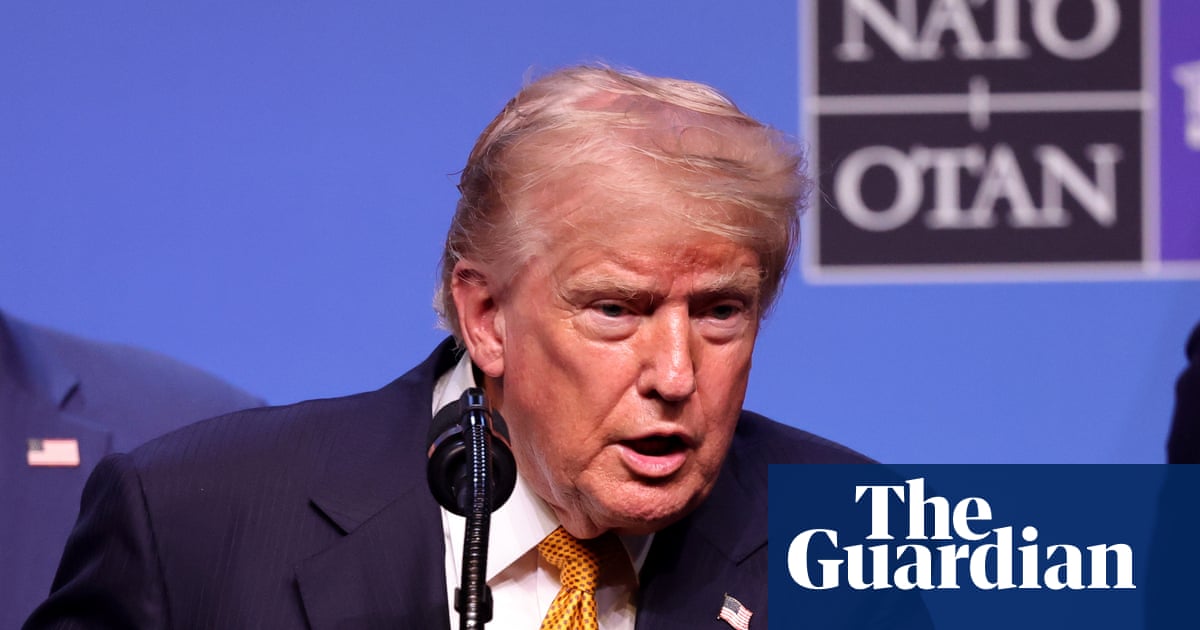
An erratic and at times irascible Donald Trump has said he felt a “tremendous love” from western leaders at the Nato summit, only hours after lambasting them over their defence spending and not helping the US...
An erratic and at times irascible Donald Trump has said he felt a “tremendous love” from western leaders at the Nato summit, only hours after lambasting them over their defence spending and not helping the US in attacking Iran.
The US president’s mixed messaging dominated the final hours of the two-day gathering in Ankara, Turkey, beginning with him publicly calling Iran’s leadership scum and renewing his demand for control of Greenland.
He then adopted a softer tone in a private meeting of 32 Nato leaders in the late morning, where he did not mention Greenland or other earlier criticisms, and instead told allies that “we want to remain with you”.
“It was a great meeting, there was a lot of love in that room, a lot of unity,” Trump said soon after at a bilateral meeting with Ukraine’s Volodymyr Zelenskyy, which included a surprise offer to licence the manufacturing of Patriot air defence missiles to Ukraine.
Trump concluded by hosting a rambling press conference that barely addressed Nato topics, but where he praised Turkey’s strongman president, Recep Tayyip Erdoğan, talked up the US economy and said he was “No 1 on TikTok”.
Nevertheless, the shift from angry critic to Nato supporter – “if there’s one word that comes out of today it’s unification,” Trump said at the end-of-day press conference – will be hailed as a victory for the alliance whose stability been called into question.
The final summit declaration, signed off by Trump and 31 other alliance leaders, affirmed the countries’ “ironclad commitment” to article 5, which declares that an attack one Nato member is an attack on them all.
But there was also no announcement of the date for the next leaders’ summit, due to happen in Albania, where anti-Trump and anti government protests are taking place, amid hints it would not happen until 2028.
Nato summits have not always taken place annually but the overwhelming concern in parts of Europe is that Trump’s grandstanding at such events risks giving hope to the Russian president, Vladimir Putin, undermining deterrence and alliance unity.
European leaders were concerned Trump was in a bad mood after a dinner on Tuesday night at the Turkish president’s compound in Ankara, and had agreed not to mention the 4-1 loss suffered by the US team against Belgium earlier this week.
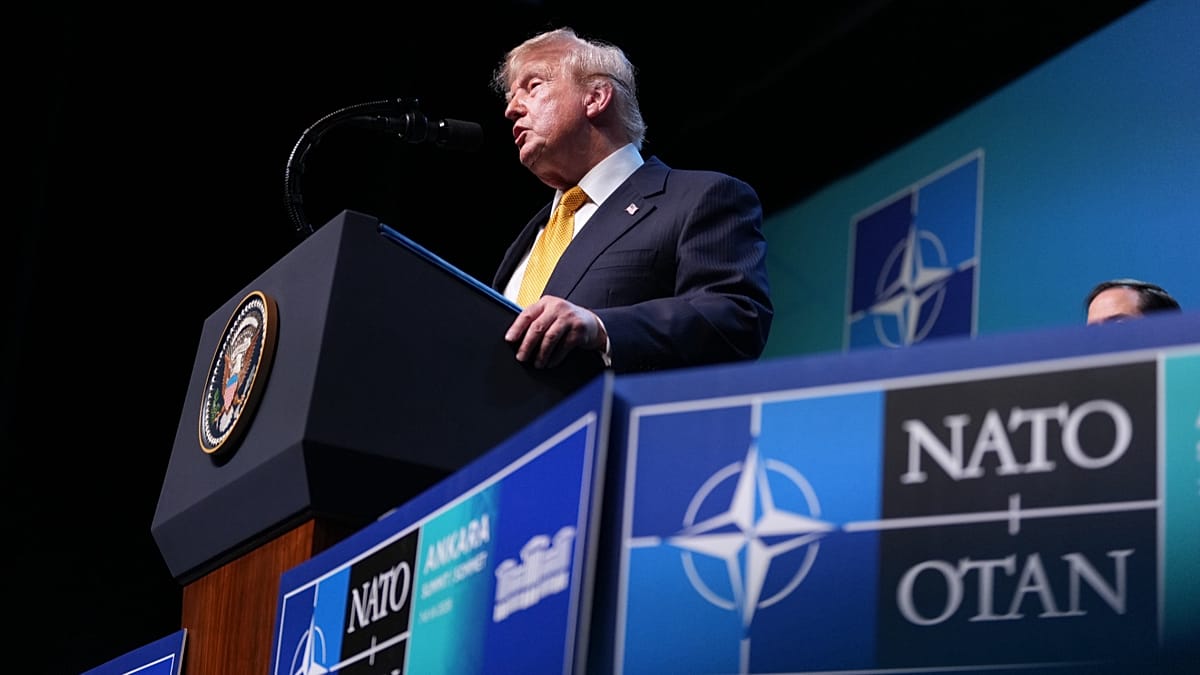
It appeared that their worst fears were being realised when Trump appeared on Wednesday morning with the Nato secretary general, Mark Rutte, and began with a lengthy monologue airing a string of grievances with Nato and several individual members, as well as attacking the leadership of Iran.
Trump said he was “very upset with Nato” and complained that alliance members “didn’t want to help us with the number one state sponsor of terror, that’s Iran”, a reference a refusal by European countries apart from the UK to allow the US to publicly carry out bombing missions from Europe’s airbases.
There was a specific jibe aimed at the UK, which did not initially allow the US to use RAF Fairford in Gloucestershire for bombing missions in Iran before the British prime minister, Keir Starmer, changed his mind and allowed limited attacks on Iranian missile sites.
“The United Kingdom wouldn’t let us use the island for two weeks, so we had to fly back,” Trump said, reiterating complaints he made against Starmer and Britain in the spring as the Iran war continued without the regime in Tehran collapsing.
The introduction next to Rutte became a litany of complaint. “Greenland is a big problem for us,” Trump said as he renewed his claim the self-governing Arctic territory “was very important for the United States, but it’s not important for Denmark”.
Earlier, the Danish prime minister, Mette Frederiksen, said as she arrived that Denmark would defend “every inch” of its own territory and emphasised that Greenland was “of course not for sale”.
There were familiar comments about Nato defence spending from Trump, despite last year’s agreement by all members, with the exception of Spain, to lift national defence budgets to 3.5% of gross domestic product by 2035 – and so bring spending by Europe and Canada in line with the US.
“I’m very upset with Nato, that we pay far, far too much,” he said. “Billions and billions of dollars, too much, because it’s unfair, because we’re protecting them, so we protect them, but they’re not there for us.”
Fresh ire was reserved for Madrid given its decision to reject the 3.5% target. “Spain doesn’t agree to anything, and you shouldn’t carry them,” Trump told Rutte. “I don’t want to do any trade with them, all right?” the president said, turning to Scott Bessent, the US treasury secretary, who replied: “Yes, sir.”
Rutte for his part tried to contain Trump through a mixture of flattery and occasional determined interruption. It was a strategy that appeared to calm him down as he praised Trump for persuading European Nato members to increase defence spending and match the US as a proportion of economic output.
“You did what [President Dwight] Eisenhower tried to do,” he said. “It’s your win.” Trump, interrupting, responded: “That’s why I like him.” Soon afterwards, however, he was asked if he considered the ceasefire with Iran ot be over, prompting him to say he believed it was: “I don’t want to deal with them any more. They’re scum.”
Itovershadowed what Nato had hoped would be billed as a “delivery summit” following last year’s 3.5% spending pledge. More than $50bn of international arms contracts were announced during the summit, including a 12 country commitment to develop deep strike missiles with ranges from 300km to more than 2,000km.