Thursday briefing: Is this the final whistle for Gianni Infantino at Fifa?
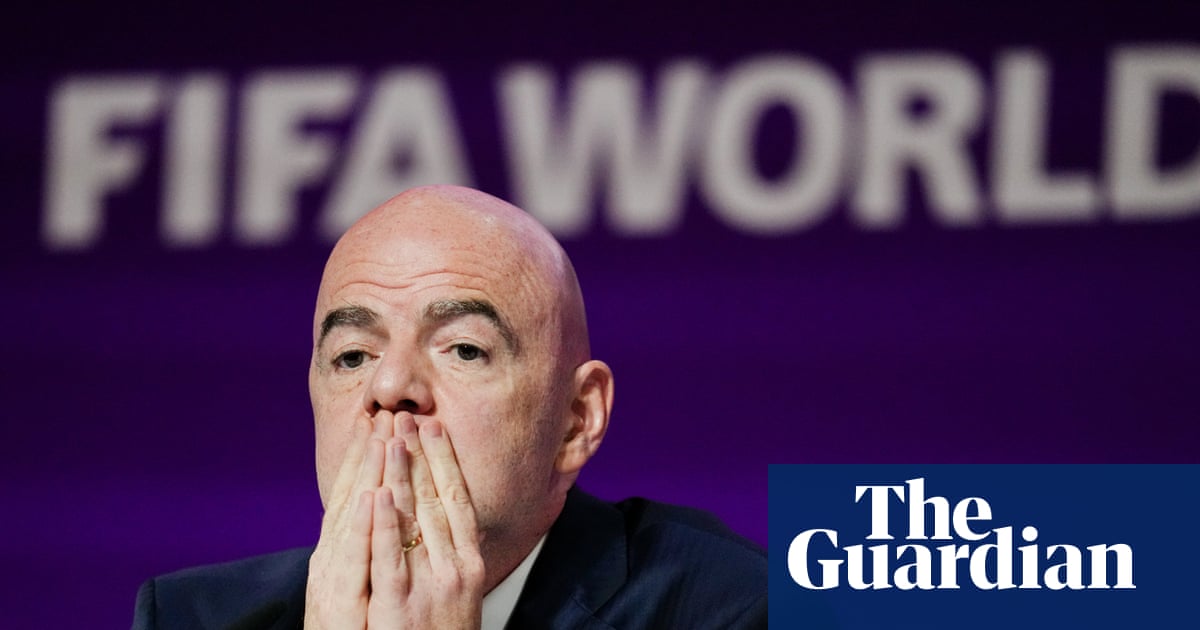
In today’s newsletter: Global football’s governance crisis is exposing a long history structural flaws, and as federations revolt and officials resign the sport faces a reckoning at the highest level
Good morning. In every pub where I watched this summer’s World Cup unfold, two motifs were shared by supporters. Yes, football was coming home, and also the (frankly more firmly held belief) that Gianni Infantino was a wrong’un. As in matchday stadiums, boos would routinely erupt when cameras cut to the Fifa boss; a proper panto villain.
Regardless, he looked poised to cruise to victory in next year’s vote for Fifa president, despite this competition’s controversies – Fifa’s jaw-dropping, unprecedented overturning of US striker Folarin Balogun’s red card after Donald Trump’s lobbying chief among them. Undeterred, more than 200 of Fifa’s 211 member associations still backed his fourth term.
Then last week, his Fifa Forward Enterprise plans were revealed: Infantino’s scheme to flog a stake in Fifa competitions to profit-seeking investors. World football has reacted with revolt, resignations and strongly worded statements. A growing chorus wants Infantino out. Yesterday, he gathered Fifa bigwigs for crisis management.
But how did the gatekeeper of the beautiful game make things so ugly? That’s the topic for today’s First Edition, answered with the help of Guardian reporter Paul MacInnes, who has closely followed Infantino’s tenure. First, this morning’s headlines:
Five big stories
-
UK news | A woman has been arrested after four men were stabbed in Covent Garden, central London, police said.
-
Education | Jason Arday, the Cambridge professor accused of plagiarism and embellishment, has resigned after the university announced he was to face new investigations into his qualifications and career.
-
Ukraine | Nato is working to get Ukraine the air defences it “urgently needs”, its secretary general has said, after Kyiv failed to shoot down a single Russian missile in an attack on Wednesday.
-
Middle East crisis | Iran and Oman have reached an understanding on the geographic coordinates for a shipping route through the strait of Hormuz, and a joint announcement is being finalised provided certain third parties do not interfere, Iran’s foreign ministry spokesperson said.
-
US news | Abdul El-Sayed won the Democratic primary for US Senate in Michigan, becoming the latest leftwing candidate to capture the party’s nomination ahead of November’s midterm elections.
In depth: ‘It’s hard to dispute that football’s legitimacy is being undermined’
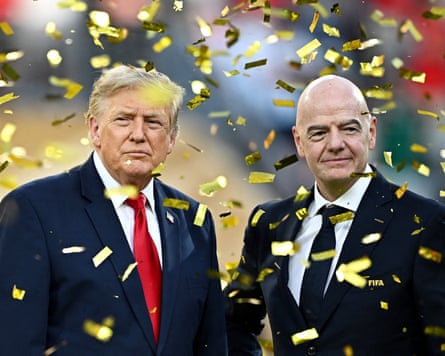
Barely two days after details of Fifa Forward Enterprise (FFE) emerged, came Infantino’s first major blow. Last Thursday, European football’s governing body Uefa announced its members had unanimously voted to boycott all Fifa competitions until FFE was scrapped. Of the six regional federations, two others soon expressed disdain at the proposals.
Carlos Cordeiro, a senior Infantino adviser, announced he was quitting. Fifa chief operating officer Kevin Lamour said staff had been “deceived”. Pressure mounted until the weekend, when Fifa relented and scrapped the proposal.
This backtracking hasn’t dispelled dissent. Uefa says it’s lost confidence in Infantino. Legendary Arsenal manager Arsène Wenger – a key Infantino hire at Fifa – said abandoning FFE was “absolutely necessary and beyond question”. Meanwhile Fifa’s secretary general wrote of “a sad and reproachable series of events” and that individuals “come and go” in a leaked internal memo. Jordan’s football chief has accused Infantino’s administration of “blackmail”. Portugal icon Luís Figo didn’t hold back, labelling Infantino’s actions “the lowest, most deceitful and cravenly self-interested behaviour I have ever witnessed”.
At least four countries have now withdrawn their support for his reelection, with England set to follow suit, and more expected. “Many would like him to resign on principle,” says Paul, “but that hasn’t happened.”
Yesterday, after a meeting in Morocco, Fifa confirmed that Infantino will remain as president. In a statement, which also revealed that Infantino has sent written apologies to the Fifa council and the member associations for failing to consult them over the World Cup sell-off, the world governing body said that he retains the full support of his leadership team.
“Currently, it feels like the pressure has dropped slightly,” Paul tells me. “There’ll be discussions about how the ante is upped again. If he doesn’t fall quickly, nations might assume he won’t go, cut their losses and stick with him. Without a well-established rival and widespread withdrawal of support, he’ll likely win re-election.”
Because, despite the sleaze, when it comes to cold hard cash, Infantino has proven effective. This year’s World Cup generated $15bn – a tripling under his leadership. “Infantino has proven himself an elite executive when it comes to his priority: generating more revenue,” says Paul. In his rhetoric, at least, Infantino talks of boosting funds to footballing nations. And for the lesser-resourced, non-European football associations, this extra cash is gamechanging, even if Infantino’s $40m offer to those who backed his plans looked remarkably bribe-like.
The clean-up candidate
It’s hard to believe that Infantino was elected as a clean-up candidate.
In 2015, after the US Department of Justice indicted 14 Fifa figures for racketeering conspiracy and corruption, Fifa’s last president, Sepp Blatter, announced his resignation. Blatter had been caught up in a long-running corruption case, alongside Uefa boss Michel Platini. The pair were accused (then acquitted, twice) of misappropriating £1.7m of Fifa cash. All of this, and the highly controversial awarding of the 2018 and 2022 World Cups to Russia and Qatar respectively, made Blatter’s position untenable.
There was a gap at the top of world football and with Platini out, no obvious European successor. (Of Fifa’s nine permanent presidents, eight have been European). Enter Infantino, then second-in-command at Uefa. Central to his pitch was World Cup expansion.
He had a message to world football, Paul says. “It’s not our money, it’s yours. And Fifa will make more for you.” It marked a rhetorical shift, with “a sense post-Blatter that execs had been lining their own pockets.”
Looking to Europe, he offered another promise. “We’re going to clean the stables,” Paul recalls, “introduce new governance structures.”
Infantino was perceived as a strait-laced Swiss bureaucrat – an image he projected. On his victory in 2016, he spoke of change. “Fifa has gone through sad times, moments of crisis. But those times are over,” he said. “We enter now a new era. We’ll restore the image of Fifa and make sure everybody will be happy with what we do.”
A quick backlash
Scandal came thick and fast. His election campaign first: Infantino declared spending €500,000 of Uefa funds to drum up support, but sources suggested the figure was closer to €1m. Fifa’s ethics committee began to investigate; Infantino organised the removal of its chair and members. Weeks after taking office, he was named in the Panama Papers, pulled into his own corruption scandal. There was a criminal probe after “indications of criminal conduct” in Switzerland. Swiss prosecutors subsequently closed their investigations, satisfied that suspicions against Infantino had been “invalidated”.
“These stories have been endless,” says Paul. Take the Qatar World Cup, which Infantino inherited. Infantino committed to protecting human rights and remedying failures. These were widely documented, but no compensation fund was created. Fifa refused to act on fan safety in Qatar, where same-sex sexual acts are criminalised. Meanwhile Infantino goaded critics with that monologue: “Today I feel Qatari, today I feel Arab, today I feel African, today I feel gay, today I feel disabled, today [like] a migrant worker.”
“That’s where it properly kicked off,” says Paul. “He became a real antagonist in the eyes of football fans.”
Infantino’s awarding of the 2034 World Cup to Saudi Arabia was widely criticised. His 2022 proposal to make the World Cup biennial (which, he claimed, could stop migrants from finding “death in the sea”) was botched. He invented a Trump-placating peace prize.
In fact, he’d even attempted an FFE style ploy before. His 2018 proposal to fatten up the Club World Cup with private investor cash was “sprung on people with no consultation and little notice,” says Paul, adding that it “saw huge backlash before Infantino backed down.”
The future of Fifa
What incentivised Infantino to try to push through FFE has caused speculation. His multimillion pound salary and ample perks, already come with status that offers him access to the world’s most powerful figures. There were reports that Infantino might have eventually headed up FFE at a basic salary of $30m but Fifa have denied discussions on this have taken place.
But this mess isn’t exclusively of Infantino’s (or Blatter’s) making. Paul has been speaking to academics, lawyers and football officials. “There’s a shared view reform is needed.” Many point to the need to break Fifa up: “Organising the biggest football tournament, while also regulating it, is untenable,” says Paul.
Others see this as a chance to address inequality and elitism in the game.
And European figures are also manoeuvring to push for external Fifa regulation. When doping scandals threatened to delegitimize sport, national governments and governance bodies founded the World Anti-Doping Agency (Wada).
“It’s hard to dispute that football’s legitimacy is being undermined,” says Paul. “Wada proves sporting organisations needn’t mark their own homework.” There are suggestions that the EU, OECD or even the UN should play a role, to “create a body outside football to handle complaints when they arise. So many complaints against Infantino have just disappeared. Someone needs to be able to hold Fifa accountable.”
after newsletter promotion
What else we’ve been enjoying
-
I thought Symeon Brown was excellent in yesterday’s Long Wave newsletter, on Britain’s booming Black bourgeois class and why Brits just can’t seem to acknowledge it. Poppy
-
Five US states held midterm primaries this week, with significant successes for progressive candidates. This explainer from Chris Stein on the Guardian’s US politics team helped me get a grip on the results. Michael
-
I enjoyed Arwa Mahdawi’s take on the Trump officials who won’t just … focus on their actual jobs. Poppy
-
My boyfriend is a real anchovy-head, and cans of surplus fishy oil often float in our fridge for days before eventual binning. No longer, with this salsa verde recipe from Tom Hunt I’m making as I type. Michael
-
I was also thoroughly ruffled by our profile on the Phillipines’ so-called “Cockroach Lord”. Poppy
Sport
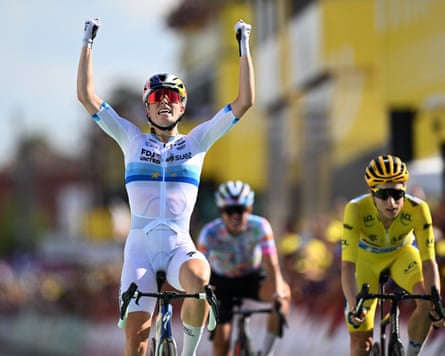
Cycling | Race favourite Demi Vollering won a three-way sprint to claim stage five at the Tour de France Femmes.
Football | Eva Olid has described being appointed as the Manchester United Women head coach as a dream come true, after signing a two-year contract until 2028 with the option of a further year.
Boxing | The former heavyweight world champion Joseph Parker said on Wednesday tnat he had been cleared to fight again after failing a dope test last October.
The front pages
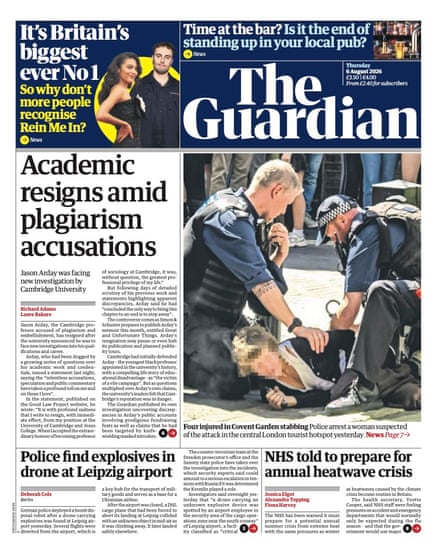
“Academic resigns amid plagiarism accusations”, is the Guardian’s front page today, the Telegraph writes “Cambridge professor quits after false claims”, the Times has “Plagiarism row professor resigns from Cambridge”, and the Mail’s headline is “‘Plagiarism professor’ resigns as Cambridge investigate”.
The Express writes “Early release is a ‘betrayal’ of hero police officer”, and on a similar topic, Metro has “My lad’s still serving time after phone theft in 2005”. Elsewhere, The FT leads with “China begins global tax hunt reaching back decades as fiscal pressure grows”, the Sun has “West End stab rampage”, and the Mirror, on new mental health centres, writes “Help is on the way”.
The Latest
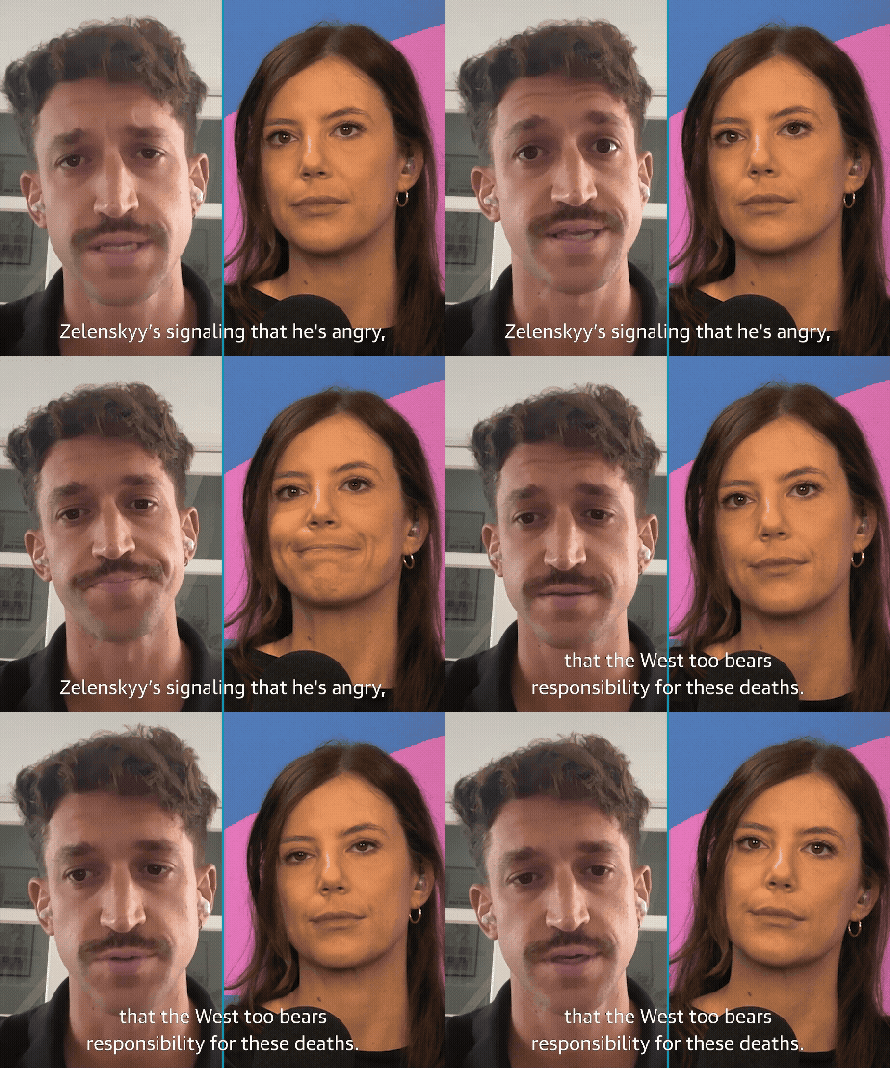
Is Ukraine facing a major anti-missile shortage?
At least 17 people were killed and more than 40 injured in another round of deadly Russian strikes on the Ukrainian capital, Kyiv. Volodymyr Zelenskyy has pleaded for more air defence weapons, saying ballistic missile interceptors ‘could have saved the lives of those killed today’. For months, Ukraine has been warning about shortages after Donald Trump backtracked on his promise to let Ukraine manufacture missiles locally. In response to the attack, the EU’s Ursula von der Leyen said ‘Russia must pay’ – but will it? Lucy Hough talks to the Guardian’s Russia affairs correspondent, Pjotr Sauer.
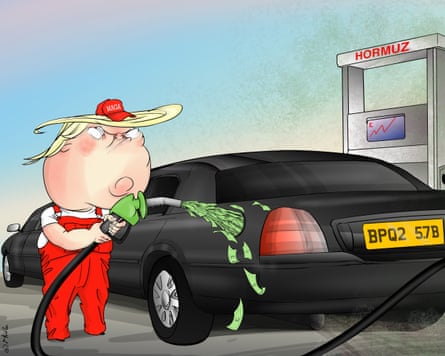
Cartoon of the day | Nicola Jennings
The Upside
A bit of good news to remind you that the world’s not all bad
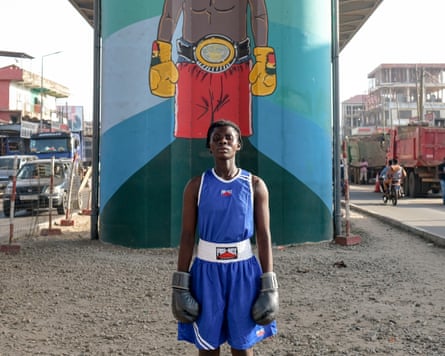
Olaoluwa Olowu photographed amateur boxer Elizabeth Boakye in Accra after noticing that the city’s visual culture of boxing overwhelmingly celebrated men. Wanting to place a woman within that public archive, she returned with Elizabeth and positioned her beneath a mural of a male fighter. The portrait reflects both the visibility of male boxers and the absence of women, while acknowledging Elizabeth’s work with the national team, the Black Hitters. The image forms part of Women Who Fight, Olowu’s project documenting Ghana’s women boxers and ensuring they enter the sport’s visual record.
Olowu says: “Elizabeth’s presence speaks to the women who are also part of the sport but are rarely represented in the same way.”
This piece is part of our Women behind the lens series.
Sign up here for a weekly roundup of The Upside, sent to you every Sunday
Bored at work?
And finally, the Guardian’s puzzles are here to keep you entertained throughout the day. Until tomorrow.