Zendaya's ancient Iranian earrings stir debate over looted artefacts
Experts said the Iranian 3,000-year-old gold disc medallions Zendaya wore at a promo event for Nolan's Odyssey were "likely looted" and constituted "neocolonialism". Separately, a Zoroastrian symbol worn by IShowSpeed at the World Cup final drew its own debate about Persian cultural identity.
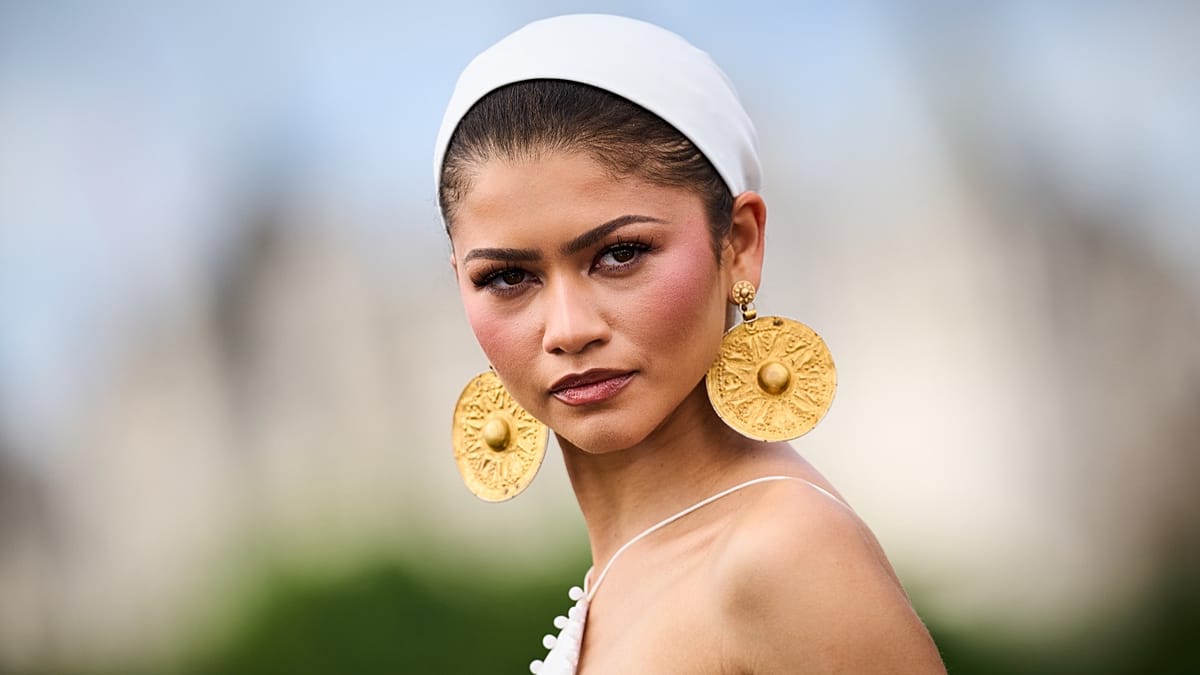
Hollywood star Zendaya came under fire for wearing 3,000-year-old Iranian gold artefacts as earrings at a London photocall for Christopher Nolan's film The Odyssey, which critics called a misappropriation of one of the ancient world's most significant collections of objects.
The earrings — gold disc medallions dating to the first millennium BCE and attributed to the Ziwiyeh hoard, a collection discovered in northwest Iran in the late 1940s — were remounted with diamonds and 18-karat gold by London jeweller Glenn Spiro as part of his Materials of the Old World series. They are owned by Barron London, a Mayfair-based gallery and art collection.
"You can wear something around your neck that dates back thousands of years but is still contemporary and cool," Spiro told Galerie magazine in 2025.
Zendaya wore them at a photocall promoting the film, in which she plays the goddess Athena.
The backlash from experts and social media users was swift. An Instagram creator known as Dr Z the Archaeologist, with around 43,000 followers, was among the first to draw attention to the provenance issue, stating that "black market antiquities are super uncool."
"As an archaeologist, I'm hoping celebrities and stylists avoid amplifying neocolonialism in the future," she said.
She called the choice to wear them "gross" and said the point was not to celebrate ancient artistry but to treat cultural heritage as a status marker or "class signalling" and "fetishise the past," in her words.
"These pieces are likely looted from Iran, and they are gracing the ears of an American actress from a country that just bombed Iran," she said.
"It honestly never even crossed my mind that someone might be wearing original ancient artefacts on a red carpet," ancient historian Dr Carla Ionescu wrote on Substack. "I spend so much of my life walking through museums and archaeological sites where the first thing you learn is that you don’t touch anything."
"If I were Zendaya, I wouldn’t put an ancient artefact on my body unless I knew its provenance, and its intention," Dr Ionescu added.
"I would want to know its history, or where it had been found, and I would certainly want to know whether it had once been placed in a sanctuary as an offering to a deity, or laid beside someone in death, or hidden away during a time of war."
One social media commenter drew a parallel with the 2022 Met Gala controversy in which Kim Kardashian wore Marilyn Monroe's original dress, which was subsequently found to have sustained damage.
"To me this is the same as letting Kim K wear the dress that was Marilyn Monroe's and then it breaking," the user said, suggesting that the earrings should have been represented by a replica rather than the original object.
Barron London said in a statement that the earrings "are responsibly stewarded in accordance with their documented provenance and all applicable legal requirements," adding that lending them was "never for commercial purposes" and that the aim was "to honour the remarkable artistry of ancient Iranian goldsmiths."
The Ziwiyeh hoard was discovered in 1947 near the village of Ziwiyeh in what is now Kurdistan province in northwest Iran, after shepherds came across gold, silver, bronze and pottery objects during earthworks.
According to a 2015 research paper, the remaining pieces were removed from Iran in the 1960s and sold on the antiquities market. They are now scattered across museums and private collections.
Iran's cultural heritage everywhere but at home?
Persian artefacts are held by major Western museums and private collections on a scale that dwarfs most other displaced cultural heritages.
The Louvre holds items excavated under concessions given to French archaeologists by the Qajar court in the 19th century, including key pieces from Persepolis and the Achaemenid period.
The Metropolitan Museum of Art, the British Museum, and collections in Germany, Austria and Australia all hold Iranian material of disputed provenance.
The Oriental Institute at the University of Chicago held several thousand cuneiform tablets from Persepolis for more than eight decades before negotiations produced a partial return.
Iran's efforts to reclaim objects have produced limited but concrete results. In 2019, nearly 1,800 Persepolis tablets were shipped back to Tehran after legal proceedings that stretched over many years.
Three years later, a collection of ancient glazed bricks dating back roughly three millennia — looted during the Iran-Iraq war and sold through private channels into a Swiss bank vault — was returned to Tehran's National Museum following a Swiss police seizure and a protracted dispute with the private owner who had refused repatriation. Earlier returns had come from Vienna.
Iran maintains an active repatriation working group and ongoing discussions with counterparts in the US and Australia, though the current state of US-Iran relations has made formal diplomatic channels effectively inoperable.
Tehran has not publicly claimed the specific gold discs worn by Zendaya.
Football influencer and Zoroastrian pin
Meanwhile, US streamer IShowSpeed performed at the closing ceremony of the 2026 World Cup final between Spain and Argentina at MetLife Stadium in New Jersey, appearing in a jacket bearing what numerous viewers identified as a Faravahar pin.
The Faravahar is a winged disc with a human figure at its centre, originating in Achaemenid-era Persia and among the most enduring symbols in Iranian cultural history.
In Zoroastrian theology, it represents the divine element of the human soul. In modern usage it has become an emblem of pre-Islamic Persian identity, widely worn by members of the Iranian diaspora as a cultural statement distinct from the symbolism of the Islamic Republic.
Its appearance before a global audience of hundreds of millions at the World Cup final generated immediate online debate.
Some Iranian and Persian diaspora users expressed pride that a pre-Islamic symbol had been visible on one of sport's largest stages.
Others questioned whether IShowSpeed was aware of its significance, noting that it appeared at a ceremony in a country currently at war with Iran and was worn by a performer with no known connection to Persian culture.
Whether the choice was deliberate or incidental was not confirmed by his representatives.