Moscow uses 'Russian Houses' in Africa to lure recruits into war in Ukraine, investigation shows
Ukrainian military intelligence has revealed that Russia's expanding network of "Russian Houses" functions as a recruitment pipeline for its war, luring young Africans with promises of education and jobs before some are sent to the front lines or into drone factories.
Moscow is waging “a war for the minds” of Africans by rolling out a hybrid network of so-called "Russian Houses" in addition to arms supplies and direct military aid to military juntas in Africa, Ukraine’s military intelligence (HUR) revealed in its recent investigation.
According to earlier research, “Russian Houses” in Africa, targeting above all the youth, are already operating or opening in at least 22 countries, as part of Russia’s strategy to consolidate its influence on the continent.
HUR now revealed that Moscow is currently planning to open centres of influence in eight African countries: Nigeria, Senegal, Liberia, Sierra Leone, Togo, Mali, Mozambique, and São Tomé and Príncipe.
This is being carried out through Russia's federal cooperation agency, Rossotrudnichestvo, in collaboration with the Centre for Public Diplomacy (CPD), an organisation founded in 2024 with the stated aim of expanding the existing network, specifically targeting Africa.
The CPD’s official mission is to convey "accurate" information about Russia to Africans.
Brussels has sanctioned Rossotrudnichestvo, freezing its assets in July 2022 for spreading disinformation tied to the invasion of Ukraine.
Yet it has continued to expand its African footprint despite the penalties, operating more than 85 official branches abroad.
Ukraine's Foreign Intelligence Service said Russia allocated $1.85 billion (€1.6bn) for foreign propaganda operations in its 2026 federal budget, a 54% increase on the previous year — a sum exceeding the entire annual education budgets of several West African states.
What goes on inside Russian Houses in Africa?
According to available information, the centres screen Soviet and Russian films, often on patriotic themes, and distribute ideologically vetted literature.
They also teach the Russian language and coach young people on how to move to Russia as students or workers.
Organisers sell an image of a "happy Russia,” but according to HUR, in practice that promise often curdles: some recruits sign contracts with the Russian military and are sent straight to the deadliest parts of the front lines in Ukraine.
In 2025, then-head of Rossotrudnichestvo Yevgeny Primakov Jr announced that the government would fund more than 5,000 African students to attend university in Russia.
The educational opportunity is often the most salient motivator for locals to engage with the organisation.
Most strikingly, in January of this year, Primakov Jr himself publicly admitted that a "well-known African private military company" — widely understood to mean Wagner Group, rebranded as Africa Corps following the death of founder Yevgeny Prigozhin — had been directly involved in establishing Russian Houses in Mali and the Central African Republic, and that some of its members had since moved into formal Russian state positions.
Ukraine's Centre for Countering Disinformation described the admission as confirmation that the centres function as elements of hybrid operations rather than neutral cultural institutions.
The Bangui Russian House in the Central African Republic is run by Dmitry Sytyi, a figure who also controls Wagner's operations in the country and reportedly uses the centre as a logistics hub for the group's gold, diamond and timber trafficking, according to media reports.
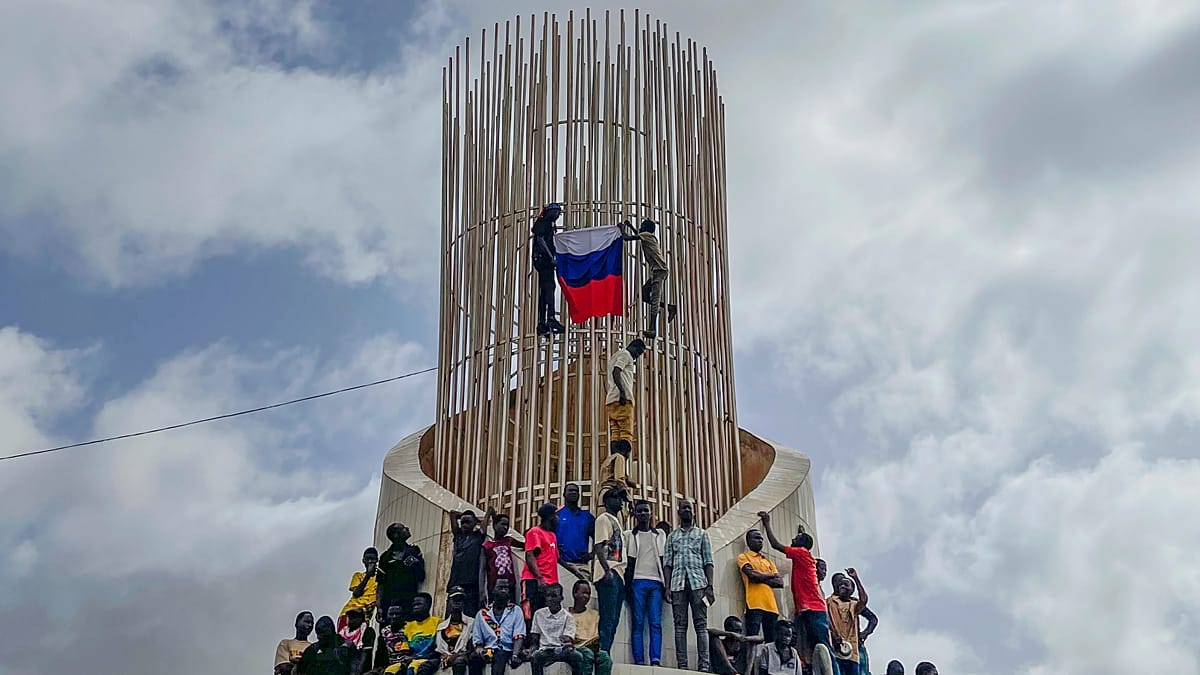
The expansion of Russian Houses has closely followed the rise of pro-Russian military juntas, particularly in West Africa: centres opened in Mali in 2022, Burkina Faso in January 2024 and Niger in October 2024, all following coups in which Wagner or its successor forces became the new regimes' primary security providers.
Wagner and Africa Corps, which is controlled by the Russian Ministry of Defence, are among the most ruthless armed groups on the continent and are directly implicated in mass civilian killings and other war crimes.
In April, three human rights organisations — TRIAL International, the Pan-African Lawyers Union and the International Federation for Human Rights — filed the first case of its kind before the African Court on Human and Peoples' Rights, seeking to hold Mali's government responsible for hosting and failing to prevent abuses by Wagner and its successor force.
Run by friends of Putin
Journalist and former Duma member Primakov Jr is the grandson of former Russian Prime Minister Yevgeny Primakov, who also served as head of the KGB First Chief Directorate, overseeing its transition to Moscow's foreign intelligence service, the SVR.
The elder Primakov was a staunch advocate of the theory of Russian supremacy and one of the main architects of the Kremlin's idea of multilateralism, a thin ideological veneer meant to act as a cover to Moscow's aspirations for control over former Soviet republics and elsewhere and a key cog of Russian President Vladimir Putin's influence machine abroad.
Primakov Jr has direct ties to Putin. He served as one of Putin's official "trusted representatives" during the 2018 presidential campaign and was elected to the Duma that same year on the ruling United Russia party's list before being appointed chief of Rossotrudnichestvo in 2020.
He is under EU, UK, Canadian and Australian sanctions for his role in promoting the annexation of occupied Ukrainian territories.
Putin dismissed Primakov Jr as head of Rossotrudnichestvo in April of this year, replacing him with Igor Chaika, son of Russia's former prosecutor general Yuri Chaika and a figure separately sanctioned by the US Treasury in 2022 for developing plans, reportedly with the assistance of Kremlin spokesperson Dmitry Peskov, to destabilise Moldova's pro-Western government, according to a report by think tank CEPA.
Igor Chaika and his elder brother Artem were the subject of Alexei Navalny's corruption investigation.
In a 2015 film, Navalny's foundation found that the two had used their father's position to amass fortunes through rigged state contracts, the seizure of a state-owned shipping company whose director was later found dead, and undisclosed property abroad, including villas in Switzerland and Greece.
Artem was placed under US Magnitsky Act sanctions in 2017 for using his father's position to "dishonestly obtain state property and state contracts." Yuri Chaika, who served as prosecutor general for 17 years, was never removed from office over the allegations and later joined Russia's Security Council as Putin's presidential envoy.
Recruiting Africans into Russian military
According to a report by the Danish Institute for International Studies (DIIS), Russian information warfare has expanded significantly in the Global South since 2022, particularly in Africa.
DIIS said Russia brands itself in Africa as an anti-colonial partner to sway political elites and publics through “regime survival packages," which include weapons, political advisors and influence campaigns
“Between June and September 2025, the number of Russian military service promotion posts aimed at foreigners on the platform VK increased from 621 to 4,600. This meant that by mid-2025, one in three contract announcements targeted foreigners, compared to only 7% in 2024," the DIIS report said.
According to the Washington-based Africa Centre for Strategic Studies, through a shadowy network of online recruiters, Russia has quietly assembled a pipeline funnelling thousands of Africans from nearly every country on the continent into the front lines and factories supporting Moscow’s war effort in Ukraine.
“These were not the destinations the young Africans thought they had signed up for. Many were looking for jobs, training, or opportunities abroad. Drawn by promises of life-changing salaries, they instead found themselves trapped in a war far from their home countries," the Africa Centre said.
Misled by Moscow’s recruiters, some have been pressed into military service and forced at gunpoint toward the front lines, where casualty rates are exceptionally high, according to the Africa Centre.
Majority Leader of the Kenya National Assembly Kimani Ichung’wah testified in February that once they arrive in Russia, these recruits are “basically just given a gun to go and die."
Others have been trapped in drone factories, like the Russian Alabuga Special Economic Zone (ASEZ) in Tatarstan, a republic in the east-central part of European Russia.
ASEZ is a public-private industrial complex known first and foremost for producing Shahed-136 drones for Russia’s military.
DIIS revealed that Russian recruitment is also increasingly targeting young African women — Nigerian students in particular — to work in drone factories, including Alabuga, supporting Russia’s military war machine.
'Ideological weapon of slow-acting harm'
Ukraine’s military intelligence stated that with more Russian Houses opening in Africa, Moscow’s recruitment on the continent will only intensify.
The final goal, according to HUR, is “to cultivate an entire generation of ideologically loyal Africans in order to conceal its colonial exploitation of their countries while using people as a cheap source of military manpower”.
“An illustrative example is Sudan, where Kremlin-controlled groups polluted water resources with mercury due to predatory artisanal gold mining,” HUR said, pointing out that “pollution of this scale cannot be eliminated for years – it is an ecological weapon of slow-acting harm."
“The local population in this scheme is viewed solely as cheap labour – both at Russian enterprises within African countries, and at the factories in Russia itself, where Africans end up after ‘training’ in the 'Russian Houses.'”
How many Africans have already been recruited?
In April, HUR revealed the Kremlin's plans to recruit at least 18,500 foreign mercenaries to fight against Ukraine by the end of 2026.
Ukraine's Center for Countering Disinformation stated that Russian Houses serve as key hubs within this shadow recruitment infrastructure.
In June, Ukraine's Ministry of Foreign Affairs confirmed that at least 2,965 citizens from 36 African countries had taken part in combat on Russia's side.
Recruitment of Africans escalated in 2024, according to the Africa Centre, which stated that African recruits appear to be assigned to especially expendable battlefield roles.
This was backed by the testimonies of survivors and evidence found by investigators, both of whom showed that Africans were commonly used in high-risk assaults.
Not every expansion attempt has succeeded. In September 2024, authorities in Chad arrested Russian operatives immediately after the opening ceremony of a planned Russian House in N'Djamena, having already detained two others at the airport days earlier, a rare instance of government intervention against Russia's attempts to harden its presence.
Separately, an investigation published in Nigerian outlet TheCable identified 272 Nigerian nationals who had enlisted through associated channels, of whom 55 were reported dead. Russian Ambassador to Nigeria Andrey Podyelyshev dismissed reports of recruitment through these channels as "misleading" in February.
Several African states, including Kenya, Ghana and Nigeria, have repeatedly demanded explanations from Moscow and called for an end to the illegal recruitment of their citizens, but the Russian foreign ministry has continued to ignore those demands**.**
When asked about Russia’s deceptive recruitment of Africans for Moscow’s war in Ukraine, Peskov denied involvement, stating in May that “We are unaware of any such cases.”