Low water levels: EU clears old Nazi warships from the Danube
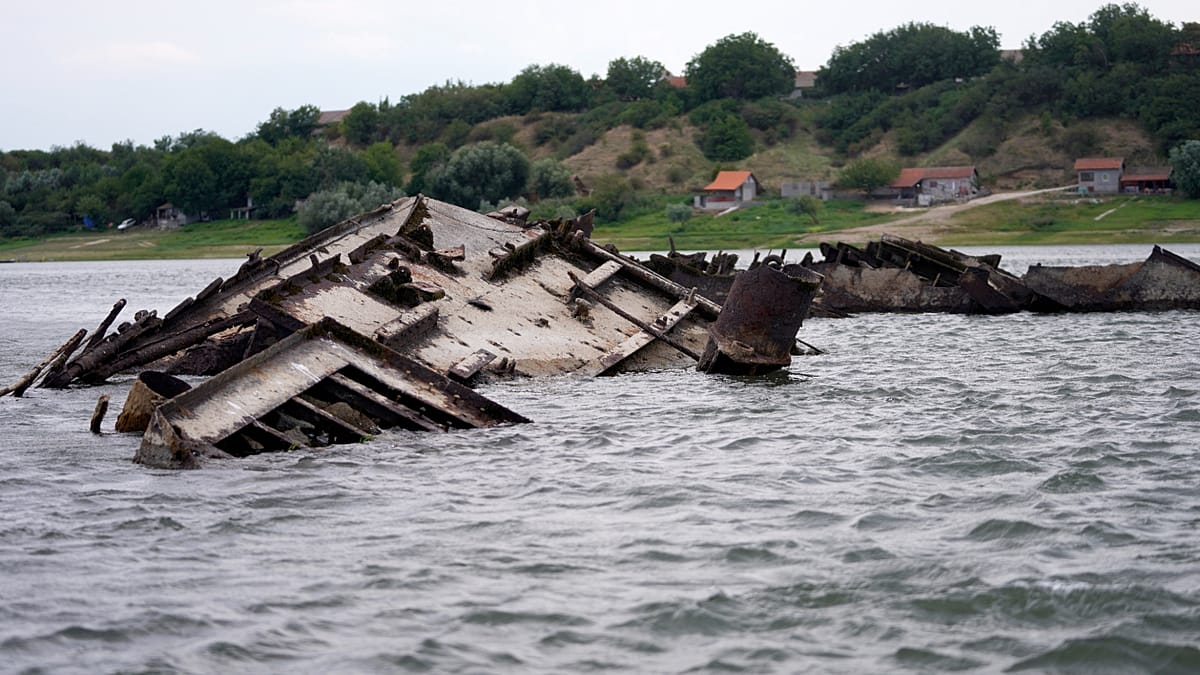
Near Prahovo in Serbia, relics of the Second World War emerge when river levels are low. On the riverbed lie numerous wrecks of German warships scuttled by their crews in 1944 as they retreated from the Red Army.
By Lutz Faupel
Published on 30/07/2026 - 16:07 GMT+2
Persistent heat is causing water levels in the Danube to drop in many places, bringing relics from the past to light. Near Prahovo in Serbia, numerous wrecks of German warships become visible every year; some of them are to be salvaged in the coming years, others have already been hauled ashore. Earlier this week, the magazine "Fokus" was the first to report on this.
Witnesses to the advance of the Red Army
The story of the wrecks begins more than 80 years ago, towards the end of the Second World War. In the autumn of 1944, the Wehrmacht retreated before the advancing Red Army, on land and on water. Hitler's soldiers had orders not to let any usable military equipment fall into enemy hands. That applied to the naval squadrons of the Kriegsmarine on Europe's second-longest river as well. As a result, crews scuttled their ships in the Danube.
The plan was to use the wrecks to block the shipping lane and thus stop the Red Army from moving upstream along the Danube. This blockade is still having an impact today.
In previous heatwave summers, falling Danube levels had already exposed some of the wrecks, for example in August 2022. In response, an EU-backed project under the Western Balkans Investment Framework(WBIF) set about raising 21 of the most obstructive wrecks.
200 wrecks, risky salvage
The European Investment Bank (EIB) is the strategic partner of the investment framework. According to the EIB, some of the remains in a five-kilometre bottleneck of the Danube were already recovered in 2024. They were hauled out of the river with ropes and cleared of mud. In an article published on the EIB website in the same year, Serbia's then deputy minister for construction, transport and infrastructure is quoted as saying:
According to the EIB's information at the time, the work is due to be completed by 2028. Before the salvage operations began, around 200 vessels were thought to lie on the bed of the Danube, including destroyed cargo ships, tugs and barges.
Salvaging armed vessels belonging to different armed forces is considered particularly challenging. According to the EIB, some boats may still have ammunition on board, which could lead to explosions during recovery.
Wrecks caused losses of millions of euros a year
The recovery of the first 21 wrecks also had economic reasons, according to the bank. The debris had caused significant delays in freight transport. As a result, Serbia was estimated to be losing around five million euros a year.
According to Banjac, divers are to be deployed in the salvage of the ships, along with pumps to remove sand and silt. However, he described some wrecks as too large for such a recovery. Some have been left in the riverbed and buried deeper so as not to obstruct shipping.
In July 2024, the EIB granted a subsidy of 16 million euros for the project, with the aim of making inland navigation in Serbia and the region more competitive in future. The project is part of the Economic and Investment Plan for the Western Balkans, worth 30 billion euros, which according to the EIB is also intended to help shift more freight traffic from road to water.