
Next 12 hours ‘decisive’ for wildfire near Madrid, says Spanish PM
The next 12 hours will be “decisive” for a large wildfire burning near Madrid, the Spanish prime minister, Pedro Sánchez, has said, as extreme heat renews pressure on firefighters racing to control blazes...
The next 12 hours will be “decisive” for a large wildfire burning near Madrid, the Spanish prime minister, Pedro Sánchez, has said, as extreme heat renews pressure on firefighters racing to control blazes across southern Europe.
Temperatures pushed higher by climate breakdown are forecast to reach 39C on Wednesday in Bordeaux, where firefighters have kept a monster blaze in nearby pine forests from reaching the suburbs, and 37C in Madrid, west of which Spain’s largest wildfire on record is burning.
Dozens of ground crews managed to contain the Madrid fire overnight, emergency services for the region said on Wednesday morning, but a separate fire near València, where temperatures will peak at a cooler 32C, is still out of control.
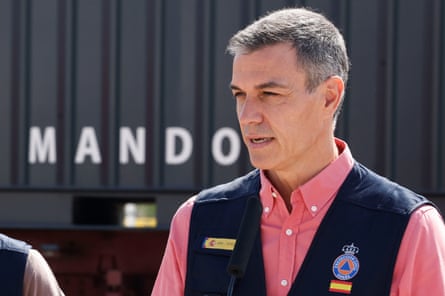
In televised comments from the Navalcarnero command centre on Wednesday morning, Sánchez said the situation near the capital was improving but stressed it was the first time in Spanish history that a wildfire had been raised to “operational level 3”, with the national government taking over the disaster response.
“I believe the next 12 hours will be very important,” he said. “They are going to be decisive in consolidating the work done by the national civil protection system.”
Accompanied by strong winds, the fourth heatwave of western Europe’s scorching summer has alarmed firefighters, who warn it makes blazes harder to quell and raises the risk of fires restarting in areas that have been stabilised. The recent fires have been particularly troubling as they have burned so close to major cities.
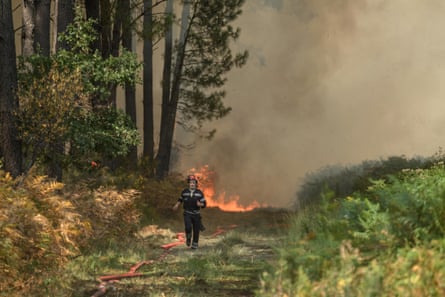
French authorities benefited from a calm night on Tuesday that allowed flare-ups to be swiftly extinguished but warned of “unfavourable” developing weather conditions that could hamper progress. The prefecture of Gironde said 126 firefighters had been injured since the start of the fire but the total burned area remained stable at 42,000 hectares (104,000 acres) on Wednesday morning.
Wildfires have burned a record-breaking area of France, data from the European Forest Fire Information System shows, while both France and Spain have experienced record-breaking numbers of fires for this time of year. More than 330,000 people in southern Europe have been forced to flee their homes and hotels.
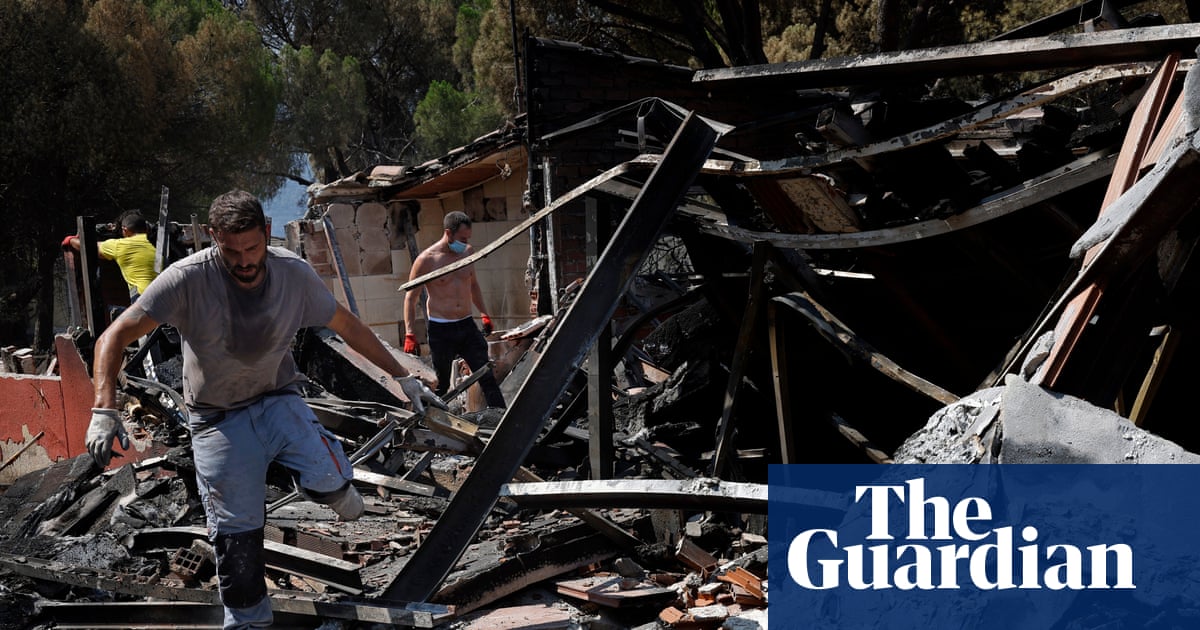
Officials began to lift evacuation orders on Tuesday as fires were brought under control, allowing tens of thousands of people living in towns near Bordeaux, Madrid and València to go back to their homes. Some of them returned to find burnt-out buildings and charred belongings.
José Fernández, a 74-year-old pensioner, told AFP he had “no money, no documents, no home” after he came back to the remains of what used to be his house in Pelayos de la Presa. “This place has been reduced to a total ruin.”
Europe’s wildfire season is growing hotter and longer as carbon pollution heats the continent twice as fast as the global average. Repeated heatwaves this year have dried vegetation and turned forests and shrubland into tinderboxes, alarming EU officials, who have said wildfires could still be burning in November.
Sánchez repeated calls to create a “national pact” to address the climate emergency. “These fires may or may not be caused by humans, but in any case, they increase exponentially as a result of these high temperatures, low humidity, and also the atmospheric phenomena that these fires, these large fires, cause in our forests.”
Earlier this week, the European Commission said it had sent France seven planes and four helicopters from countries as far away as Sweden and Turkey, while in Spain, it said it had mobilised six planes from Greece, Italy and Turkey, along with 134 personnel and 41 vehicles from Portugal. A Super Puma helicopter from Serbia was expected to arrive in Madrid on Wednesday, according to Spain’s interior ministry, with 40 personnel and 18 vehicles to shortly follow.
The European Union’s crisis-management team said on Wednesday it expected difficult weeks ahead, fearing a further outbreak of wildfires in Italy and Greece later in the summer.
Maria Zuber, a senior official at the EU’s emergency response coordination centre in Brussels, which coordinates the dispatch of firefighting planes, equipment and teams to countries that have asked for help, said the next few days would be “very difficult” for France and that “now we see it will go to Greece”.
Moisés Galán Santano, a wildfire expert at the ERCC, said more needed to be done to prevent wildfires and that it would be a task for many years. “The [emergency] response is not only the answer. It’s the last answer. But it’s not all the answer. We need to focus on prevention.”
Officials said prevention encompassed policies from early-warning systems to more animal grazing – to reduce vegetation – and changes to forest management.
Earlier this year, a policy paper from the European Commission set out how countries could better prevent and recover from wildfires that are expected to become bigger and more damaging across the continent. It promoted measures such as more extensive grazing, the restoration of wetlands, rivers and floodplains, better data on forest fires and raising public awareness of risky behaviour and safe evacuation.
Scientists say western Europe’s scorching summer has been deadly, costly and exacerbated by fossil fuel pollution. Rapid analyses have found June’s heatwave would have been “virtually impossible” in a world without climate breakdown, while the recent level of soil dryness in western Europe – a driver of bigger blazes – was made five times more likely. The heatwaves are estimated to have claimed at least 10,000 lives and cost grain farmers €2bn in lost crops.
Vula Tsetsi, co-chair of the European Green party, called on European institutions to take action on Wednesday and noted the European Commission had not yet published its heating and cooling plan, which was expected in April.
“Climate-driven heatwaves and wildfires are already claiming lives, destroying homes and ravaging forests at a record pace,” she said. “There is a widening gap between the scale of Europe’s heatwaves – literally hitting every EU country – and the absence of decisive European action.”