Global Beatles Day: Who was the walrus?
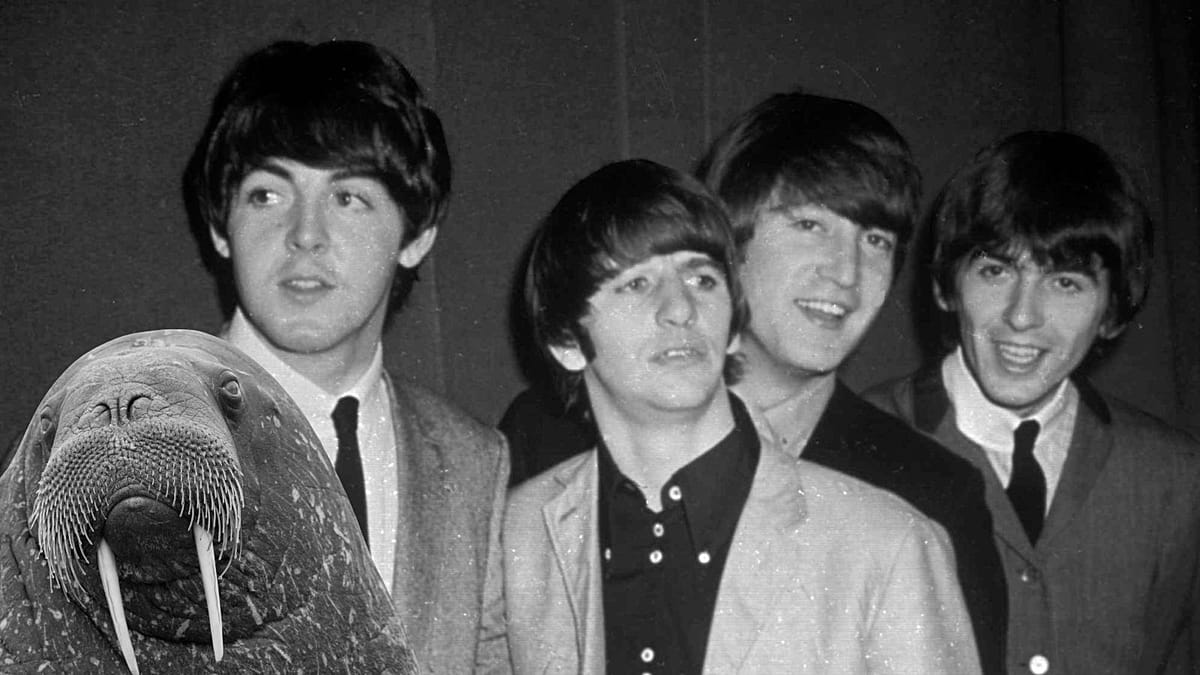
Today is the first official Global Beatles Day, a date finally recognised by The Beatles and Apple Corps Ltd. On 25 June 1967, John Lennon, Paul McCartney, George Harrison and Ringo Starr walked into Studio...
Today is the first official Global Beatles Day, a date finally recognised by The Beatles and Apple Corps Ltd.
On 25 June 1967, John Lennon, Paul McCartney, George Harrison and Ringo Starr walked into Studio One at London’s Abbey Road Studios and performed the first international satellite television broadcast of their beloved song ‘All You Need Is Love’.
To celebrate this official first, Euronews Culture is focusing on one of the most enduring mysteries surrounding the Fab Four, an enigma that keeps many a music lover awake at night: Who was the walrus in their classic 1967 song ‘I Am The Walrus’?
Before the truth is revealed, a bit of background first...
Written by Lennon, the song was partly inspired by Lewis Carroll's 1871 poem "The Walrus and the Carpenter", as well as two rumoured LSD trips. Lennon later expressed dismay upon belatedly realising that the walrus was the villain of the poem.
He did no such thing regarding the mind-altering psychedelics.
It was released on the soundtrack album to their TV film Magical Mystery Tour and has the distinction of having been banned by the BBC for the last two lines of its fourth verse: "Yellow matter custard / Dripping from a dead dog’s eye / Crabalocker fishwife, pornographic priestess / Boy, you’ve been a naughty girl / You let your knickers down."
As you can tell by that short segment, ‘I Am The Walrus’ is chockablock with colourful and surrealist imagery, with mentions of “sitting on a corn flake”, “the egg man”, “elementary penguin singing” and even a cheeky reference to Edgar Allan Poe.
It has been interpreted as containing elements of Indian philosophy, analysed as a criticism of blind religious worship, and explained as a missile against capitalism.
In actual fact, Lennon wrote the song just to confound listeners.
He did so after receiving a letter informing him that a teacher had begun analysing Beatles songs in class and attributing serious and scholarly interpretations to the band’s lyrics. Irked by this, he intentionally set out to confuse those desperately seeking meaning in his words by packing in as many abstract images as he could.
But now we come to the central question: Who was the walrus?
A clue was dropped later in the band’s discography... Their 1968 double album ‘The Beatles’ (also known as the ‘White Album’) features the song ‘Glass Onion’, in which John mischievously sings: "The walrus was Paul".
There we have it. Or so fans thought...
The waters were muddied in 1970 when Lennon released ‘John Lennon / Plastic Ono Band’, his first solo album after the break-up of The Beatles. In the bittersweet song ‘God’, the singer proclaims: "I was the Dreamweaver / But now I'm reborn / I was the walrus / But now I'm John / And so, dear friends / You'll just have to carry on / The dream is over.”
So, was the walrus Paul or John?
And what does it even mean? Is it a good thing to be the walrus? Or an insult, considering the walrus in Carroll's poem duped an innocent cluster of anthropomorphised oysters into following him before shockingly proceeding to gobble up the helpless bivalve molluscs?
The answer bypasses these inquiries, as any attempt to answer them fundamentally misses the point of ‘I Am The Walrus’ and its psychedelic playfulness. As previously stated, it is a purposely nonsensical song, a gobbledygook gem to which literal sense cannot be attributed.
Think of it as similar to that “The curtains were blue: What the author meant / What your English teacher thinks the author meant” meme.
“The curtains represent his immense depression and his lack of will to carry on,” asserts the teacher.
What the author meant: “The curtains were fucking blue.”
Sometimes it’s worth not reading into every word. Instead, try basking in the incredibly freeing realisation that not everything has layers to peel back. Sometimes, it’s just a glass onion.
G’goo goo g’joob.
Happy Global Beatles Day. Check out the video at the top of this article, as we went out to ask music lovers whether they still listen to The Fab Four.