Spanish scientists discover new 'bear-dog' species in Catalonia from 15.9 million years ago
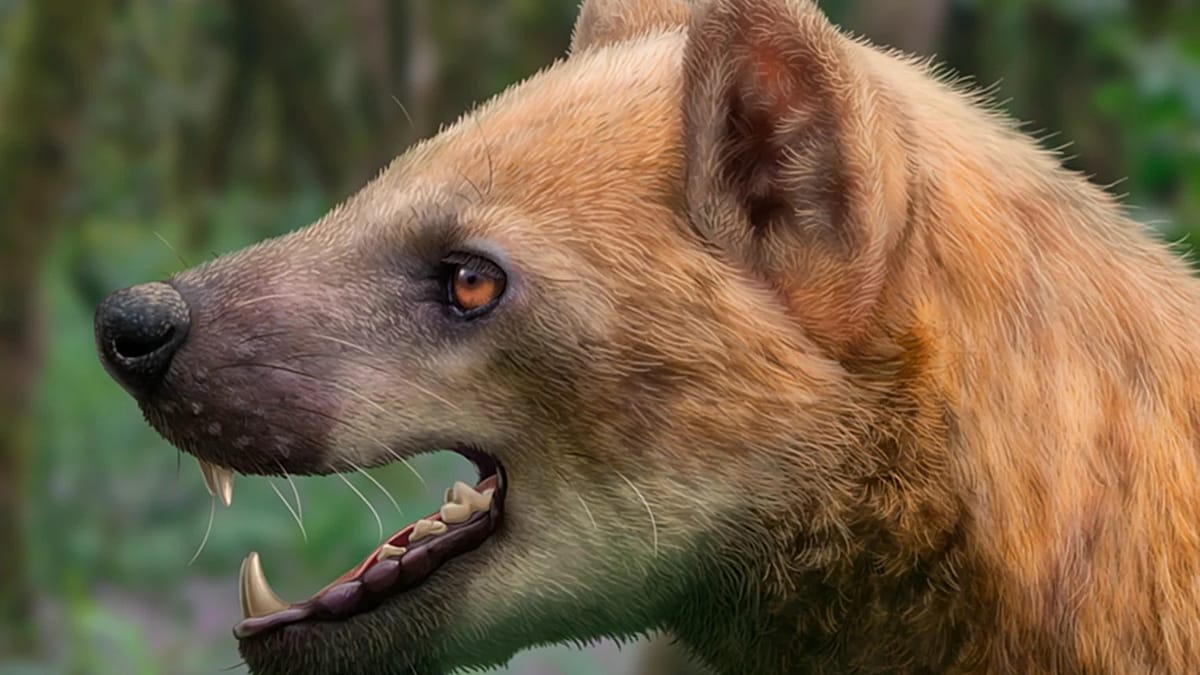
An international team has described a new amphicyonid, Paludocyon moyasolai, from a skull found 30 years ago in Els Casots (Barcelona). The study in Journal of Mammalian Evolution sheds light on Miocene carnivores.
The skull was unearthed in the 1990s, during one of the excavation campaigns at Els Casots, the fossil site in the municipality of Subirats (Alt Penedès) which over time has become one of the benchmark Miocene localities in Europe.
At the time, researchers assumed it belonged to a specimen already known from the genus Paludocyon, of which fragmentary remains had been found in the area and in other countries. With nothing new to study, the piece was put into storage.
It was not until 2014, while a doctoral thesis was being prepared, that someone took another look at that skull and realised something did not quite add up. The species it had been compared with was far more robust, roughly the size of a lion or tiger and with a weight close to 200 kilos.
What they had in front of them seemed smaller and probably less muscular. The team at the Institut Català de Paleontologia Miquel Crusafont spent the last two years confirming their suspicion: it was not a known Paludocyon, but a species that no one had described before.
The new species has been named Paludocyon moyasolai, in honour of palaeontologist Salvador Moyà-Solà, and makes Els Casots the world reference site for this animal.
Alongside the ICP, the study involved the National Museum of Natural Sciences of the CSIC, the University of Valencia, the Autonomous University of Barcelona, the Complutense University of Madrid, Ecuador’s National Biodiversity Institute and the South African museum Iziko.
A medium-sized predator in a tropical lagoon
According to the researchers’ calculations, this amphicyonid, a member of an extinct group of carnivores that combined dog-like and bear-like traits without truly belonging to either, was about the size of a large dog, weighing between 50 and 70 kilos.
The remains recovered include the skull, much of the dentition and an isolated lower molar, enough material to pick up on something that caught the team’s attention: the unusual development of the posterior molars, with an especially broad second upper molar and a third larger than is typical for the genus.
That dentition points to a varied diet, consistent with a mesocarnivorous hunter capable of chasing small and medium-sized prey – primitive deer, bovids, ancestral pigs – without being the most powerful animal in its environment. In fact, the same site yielded a second, considerably larger amphicyonid species, roughly the size of a leopard, which has yet to be formally described.
The setting in which it lived around 15.9 million years ago was very different from today: a shallow lagoon surrounded by tropical forest, with crocodiles, snakes, fish and a notable diversity of mammals sharing the same space.
That aquatic environment, the excavation leaders point out, was precisely what allowed such good preservation of the fossils: the bodies became trapped in the mud after death, which protected them from decay.
Another piece in the map of Miocene carnivores
The discovery adds to broader research into how communities of large carnivores were organised during the Miocene on the Iberian Peninsula. A previous study, involving the Complutense University of Madrid, had already examined slightly more recent sites, Los Valles de Fuentidueña in Segovia and Cerro de los Batallones in Madrid, where an unusually high number of carnivore species lived side by side: bear-dogs, felids, hyaenas and bears.
Using stable isotope analysis on more than 200 samples of tooth enamel, that study, published in Palaeontology, showed that competition between them was intense, except in cases such as the amphicyonid itself or the primitive hyaena, which hunted different prey in more open habitats.
This kind of isotope work makes it possible to reconstruct with considerable precision what each animal ate while barely damaging the fossil: it is enough to remove a few milligrams of enamel with a dentist’s drill and analyse them by mass spectrometry.
Applied to different sites and different moments in the Miocene, this approach is gradually building up an increasingly detailed picture of how fauna responded to the environmental changes of the time – the shift from dense forests to more open, arid landscapes – and what strategies allowed some species to coexist despite such intense competition for the same territory.
Paludocyon moyasolai fits into this story as another piece of the puzzle, slightly earlier in time than the episodes studied at Fuentidueña or Batallones but belonging to the same amphicyonid family that dominated much of Eurasia and North America during the Cenozoic. Each new specimen described, researchers agree, helps to refine the group’s evolutionary tree and to better understand how it became completely extinct a few million years ago.