Wednesday briefing: As the Mandelson revelations continue with no respite, can the public ever trust UK politicians again?
Good morning. I’m Libby, and I’m joining First Edition today as lead writer. Thanks for having me in your inbox; it’s an invitation I won’t take for granted.I’ve reported for the Guardian everywhere from East...
Good morning. I’m Libby, and I’m joining First Edition today as lead writer. Thanks for having me in your inbox; it’s an invitation I won’t take for granted.
I’ve reported for the Guardian everywhere from East Timor to Easterhouse (even a doggy swimming pool in Inverclyde), and I wanted to do this job now because talking directly with our readers has never been more essential. In this climate of “increasing misinformation, AI slop and divisive technology,” our editor-in-chief Katharine Viner recently described Guardian journalism as “the connective tissue that helps fight isolation and sustains democracy”. I want First Edition to play its part in that.
Rest assured, we’ll still provide an early briefing to navigate news overwhelm, digest the story of the day and take you under the bonnet of our reporting. But we’ll be trying out some new formats and ideas to elevate your mornings – please do let us know what you love, what you hate and if you have any ideas by hitting reply. Change doesn’t happen without you.
I’d like to begin by looking at the latest iteration of the (third and counting) Peter Mandelson scandal, after the UK government published thousands of messages, emails and other documents relating to his time as US ambassador.
I spoke to Luke Tryl, UK director of the research agency More in Common and a man who knows more about the inside of British voters’ heads than most folk, about how and why this story reaches beyond the Westminster bubble. But first the headlines.
Five big stories
-
UK news | Politicians and community leaders have called for calm amid fears that the populist right is using the murder of Henry Nowak by a Sikh man to whip up racist resentment against minority ethnic Britons.
-
Middle East crisis | The US and Iran have exchanged fresh missiles and drone strikes, further jeopardising efforts by Washington to secure a new ceasefire agreement with Tehran.
-
Health | Weight-loss drugs can cut the risk of developing or dying from cancer by 30%, doctors have said.
-
UK news | South West Water has been fined £1.85m for supplying water unfit for human consumption after a parasite outbreak made hundreds of people sick.
-
World news | A British couple jailed on spying charges in Iran have lost an appeal against their convictions, their family has said.
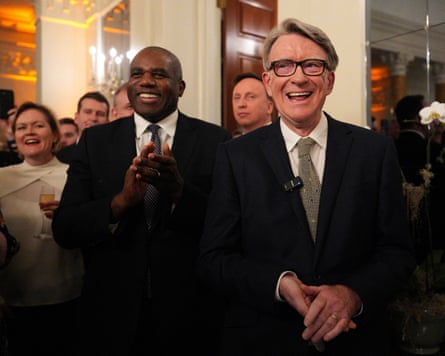
MPs voted in February to force the Labour government to release files relating to Mandelson’s appointment as US ambassador, from which he was sacked last year after revelations about the extent of his relationship with the late convicted sex offender Jeffrey Epstein.
The second batch of documents was released on Monday afternoon and comes after the Guardian revealed in April that the Foreign Office overruled a decision by officials to deny Mandelson security clearance for the role.
Done in the name of transparency, it was nonetheless entirely unhelpful for prime minister Keir Starmer – reminding the nation of his glaring misjudgment in appointing a crucial diplomatic role to a man forced to resign in disgrace twice previously (and despite Mandelson’s incurious friendship with Epstein).
The absence of key documents on vetting and security mitigations from the latest batch meant the focus was squarely on gossipy WhatsApp messages that revealed how little confidence some of Starmer’s closest counsels had in his leadership.
In one, Mandelson complained that the PM was “not leading from the front”, in another that Starmer was trapped in a cycle of “advance/buckle/advance/buckle”, while he described No 10 policy and staff as “rubbish in, rubbish out”.
And it prompted his main rival, Andy Burnham, to warn – for reasons that very much suit his Makerfield byelection campaign – that “the revelations will further damage people’s confidence in our political system”.
A long history of dashed hopes
But it’s not just the Mandelson scandal that does damage to public trust, says Tryl. “It’s that it compounds what people already thought they knew, which is this sense that the system is rigged, it’s one rule for politicians and other rules for themselves”.
Certainly people have specific issues with Mandelson’s appointment: I remember at a More in Common focus group in Glasgow at the turn of the year, where previous Labour supporters spoke about “people who feel they’re beyond sanction”, and pointed out that in any other line of work you don’t get a third shot when you’ve messed up twice before.
But this erosion of trust has been decades, and many governments, in the making. I caught up with our political editor Pippa Crerar as she navigated the Euston rush hour yesterday, and she reminded me of the recent history of disappointment and dashed hopes: the Iraq war, MPs’ expenses, austerity, then the wave of misplaced optimism about Brexit getting done that accompanied Boris Johnson’s victory in 2019. That was only to be brought low again by Partygate and the mis-selling of PPE contracts, what Pippa describes as “a crystallising moment, particularly for a new generation that hadn’t directly experienced the expenses scandal”.
There’s been plenty of discussion about Labour’s difficult inheritance, she adds, in terms of public services, or the economy: “But there was another inheritance, which was as profound, and that was the lack of faith in the political system”.
Government by WhatsApp?
Starmer pledged to do things differently: instead disillusionment festered over prime ministerial freebies, Angela Rayner’s initial failure to pay the correct stamp duty, (assisted along by some wildly classist reporting from right-wing media) and now the never-ending Mandelson saga.
The messages released at the beginning of the week are ripe for cut through, says Tryl: WhatsApp is a familiar medium and there’s a chattiness that voters remember.
Its debatable how long Mandelson’s mockery of “hysterical” Wes Streeting and his “early mid-life crisis” will linger in the public consciousness. (Mandelson was criticising Streeting for raising Israeli human rights violations in Gaza with the cabinet. When people show you who they are, believe them), but Tryl sounds a loud alarm bell about Pat McFadden’s comments about tax and welfare, on which much of the right-wing press splashed yesterday. McFadden, who worked closely with Mandelson under Tony Blair grumbled: “Every meeting I have is: ‘Who can we tax in order to pay benefits to others?’ They’re asking the wrong questions.”
“That has the potential to really cut through,” says Tryl, “because it chimes with public mood”. Indeed, he puts it on a par with the former Labour Treasury minister Liam Byrne’s notorious “there’s no money” note after the party lost the 2010 general election. You can at the very least expect Tory leader Kemi Badenoch to raise it at PMQs later today.
“There’s a profound sense that the people who work hard and do the right thing are essentially paying for those who don’t,” says Tryl. “For some people on the right, that’s people on benefits or illegal immigrants, people on the left, it tends to be that billionaires are getting a good deal while working people don’t. But across the system, there is this sense of the broken social contract.”
Rebuilding the system
Last time I was in touch with Tryl was at the fag end of the Holyrood election campaign, when he notably described the Scottish electorate as the least enthused he’d ever encountered. He predicts the ongoing revelations about the extent of former SNP chief executive Peter Murrell’s thieving from party coffers will only make this worse.
But while the turnout in Scotland last month was down to pre-independence referendum levels, in the Welsh Senedd elections it was the highest turnout on record.
Disillusionment doesn’t always drive voters right away from the ballot box, says Tryl, with people motivated by polarising parties to stop those they don’t support from winning, and vice versa. But it does push people out of the political mainstream, something Guardian reporters heard from voters up and down the country ahead of last month’s local and national elections.
Tryl says people tell him that “mainstream parties have proven themselves incapable of making my life any better”, which inevitably leads them to reach for something new. “It’s not necessarily that people are confident that Reform and the Greens will make things better. But they think ‘we may as well roll the dice because what have we got to lose?’.”
More broadly, the fix is not a simple one. “Part of it is that people’s lives just have to feel better,” says Tryl. But there’s another element that’s often missed, which he describes as “the politics of respect”.
“Politicians need to demonstrate that they genuinely respect the public that they serve, those people who work hard and do the right thing, even if they’re not living in London, or university graduates. It’s the only way to rebuild that sense we have a system that works for everyone.”
What else we’ve been reading
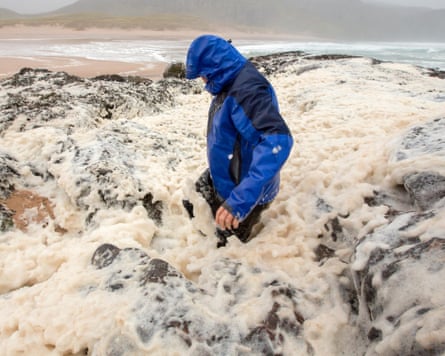
Photograph: Ashley Cooper pics/Alamy
-
High in the North Sea, Fair Isle is one of the remotest islands in Scotland. But scientific testing has found it has one of the highest levels of Pfas in its drinking water. Daniel Shailer finds out why. Patrick
-
I was very moved by this letter from an anonymous reader, who experienced a similar trauma to that in the Fordingbridge case, and asks us to be mindful of how we discuss the lifelong impact of sexual assault. Libby
-
Having spent the weekend with Gen Z cousins, I learned that being ‘cringe’ is one of the ultimate social sins. Ellie Violet Bramley has delved into why it has become such a big fear with that generation. Patrick
-
Marilyn Monroe love goes on all week: the joy dances off the screen in this photo gallery of lookalikes celebrating the triple threat’s 100th birthday. Libby
-
Playa Guiones on Costa Rica’s Pacific coast was barren in the 1970s after it was cleared for livestock farming. But a major community tree-planting effort has seen the landscape recover. Patrick
Sport
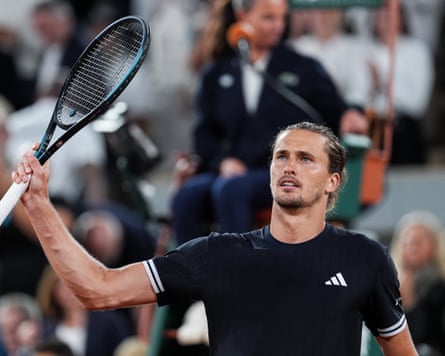
Tennis | Alexander Zverev took another step towards winning a first grand slam title at the French Open in a 7-6 (3), 6-1, 6-3 defeat of Rafael Jódar.
Paralympics | UK Athletics has been fined £350,000 for the “wholly avoidable” death of a Paralympian who was killed during a training session.
Football | Sir Kenny Dalglish has revealed he is receiving treatment for cancer. The Liverpool legend confirmed the diagnosis on Tuesday.
The front pages
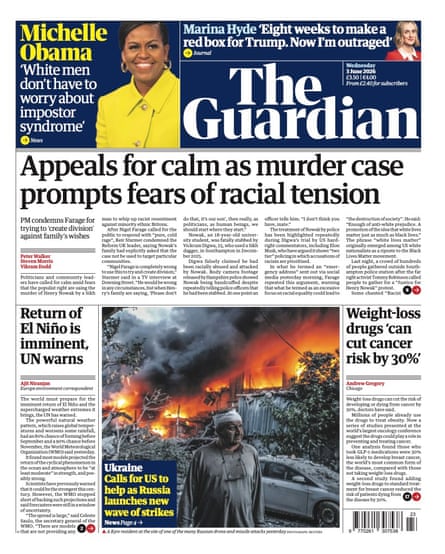
“Appeals for calm as murder case prompts fears of racial tension”, is the Guardian’s front page today. On the same story, the i Paper says “Family’s plea for calm ignored” and the Mirror asks “Why didn’t they listen?”.
The Telegraph writes “Police face call to drop race bias policies”, the Times says “Review of race guidance to end ‘two-tier policing’”, and the Mail’s take is “Kemi: This needs to be a Stephen Lawrence moment”. The Sun says “Never again” and Metro splashes “‘A dereliction of duty’ over Henry killing’”.
In the FT, the top headline is “US calms Nato allies’ fears with talk of extending nuclear umbrella in Europe”.
Today in Focus: The Latest
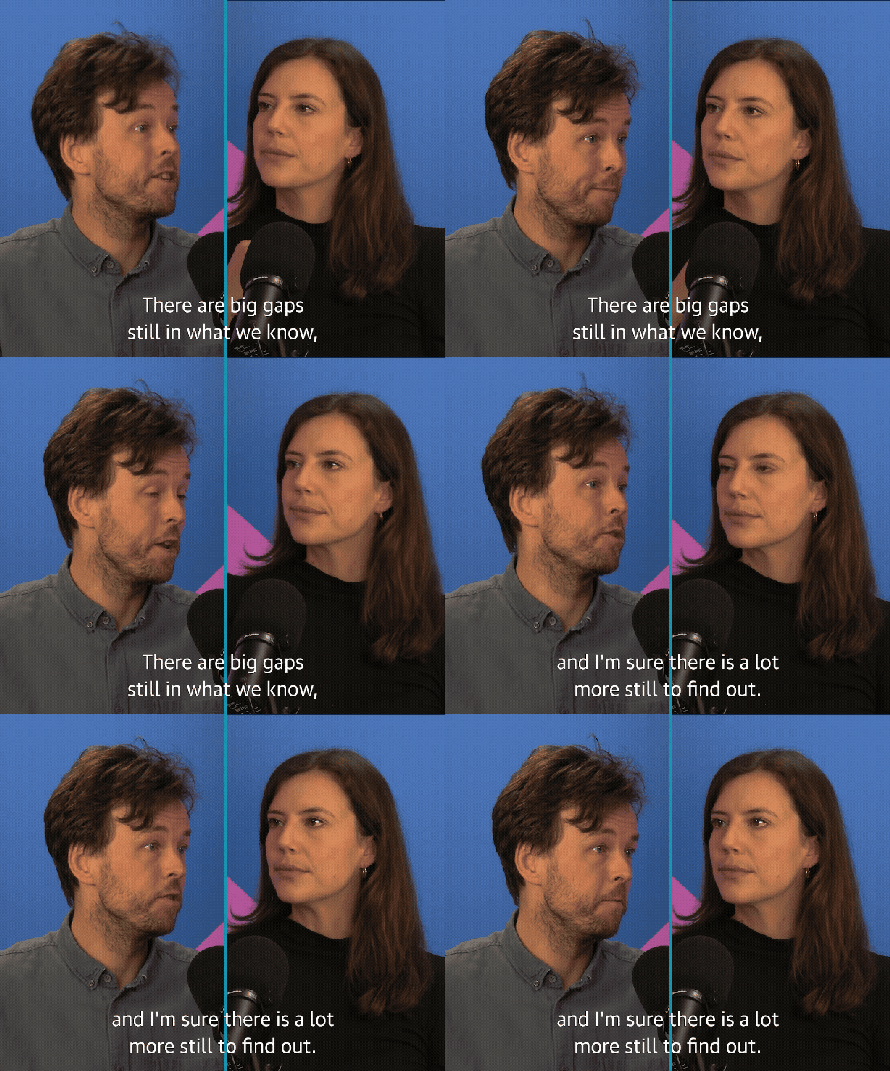
What’s missing from ‘embarrassing’ Mandelson files?
More than 1,000 pages of documents were supposed to reveal what ministers knew about Peter Mandelson’s links to Jeffrey Epstein and the security process to approve his appointment, but instead revealed government infighting and doubts about Keir Starmer. To understand more, Lucy Hough speaks to the Guardian’s head of national news – and former First Edition editor – Archie Bland. Watch on YouTube.
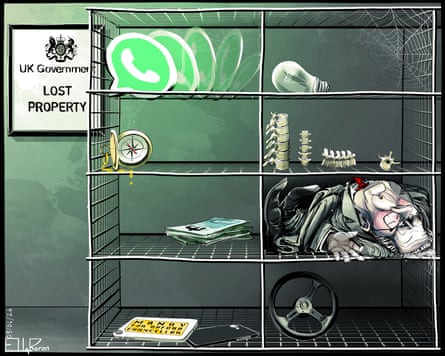
Cartoon of the day | Ella Baron
The Upside
A bit of good news to remind you that the world’s not all bad
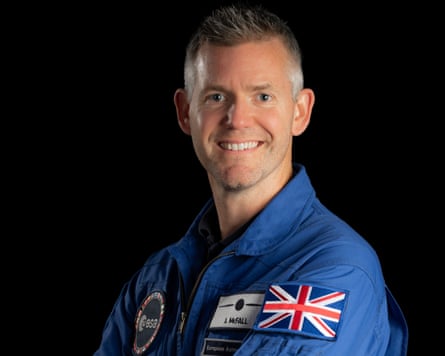
A British man could be the first person with a physical disability to live in space. John McFall is poised to take part in a mission to Haven-1 – a space station being constructed by a US startup.
A space mission wouldn’t be the first groundbreaking achievement for the 45-year-old, originally from Hampshire. McFall won bronze in the 100m at the 2008 Beijing Paralympics, after losing his leg in a motorcycling accident. It’s hoped this expedition will produce research to improve prosthetics.
“We’re saying it’s OK for people with disabilities to be astronauts,” he said. “I don’t want it to be a PR stunt. I don’t want it to be a fad. I want it to be of value, both for space exploration and for wider society.”
Sign up here for a weekly roundup of The Upside, sent to you every Sunday
Bored at work?
And finally, the Guardian’s puzzles are here to keep you entertained throughout the day. Until tomorrow.