Beyond The Streets: Inside London's major exhibition celebrating six decades of street culture
From graffiti-covered subway carriages and underground photography to an immersive recreation of Goldie's legendary Metalheadz record shop, a major exhibition celebrating six decades of street culture has...
From graffiti-covered subway carriages and underground photography to an immersive recreation of Goldie's legendary Metalheadz record shop, a major exhibition celebrating six decades of street culture has returned to London - and there's a lot to get stuck into.
There is a particular kind of energy that comes with street culture. It's rebellious, resourceful and often deliberately confrontational - born out of communities and creative movements that have historically existed outside the boundaries of traditional art institutions.
Now, the Saatchi Gallery is giving all of that a pretty sizeable showcase, with an exhibition spread across two floors and packed with hugely influential artists, photographers, musicians and activists who helped make these movements what they are today.
One of the first things to catch your eye as you step into the gallery is a recreation of a New York City subway carriage, covered in graffiti and paying homage to the movement that helped propel the art form into the international consciousness. Nearby, visitors can explore the history of graffiti through photographs, documents and fascinating ephemera, including crime reports and material documenting how public transport authorities attempted to tackle the proliferation of graffiti across their networks.
But the exhibition isn't just concerned with the origins of graffiti. It also explores the wider cultural ecosystem that grew around it, from the music and fashion to the photography and personalities that helped give the movement its identity.
For anyone interested in the history of British hip-hop, the photography of Normski is a particular standout section. Having documented the scene since the 1980s, his photographs capture a formative period in British music and youth culture, featuring everyone from Public Enemy and Rakim to homegrown artists such as MC Duke.
Among his personal highlights is a miniature exhibition he has constructed on a skateboard deck, featuring tiny reproductions of his own photographs arranged almost like a map through his own archive.
Speaking to Euronews Culture, he explained how he found his way into the scene: "Eventually, I got into editorial work, and hip-hop kind of found me. I found like-minded people in hip-hop and just went crazy taking pictures of all the gigs. Hip-hop has really been my real love because of the energy, the fact that it's real people, street people of all cultures, all coming together. Ultimately, it's about music. I love the music."
He was equally enthusiastic about the exhibition, describing it as "like a funfair" and adding: "I honestly think BEYOND THE STREETS is probably way past what you'd expect."
Another fascinating perspective comes from American photographer and filmmaker Estevan Oriol, whose work documents the streets of Los Angeles, particularly its Latino communities and gang culture.
Oriol, who began his career tour managing with legendary hip-hop groups including House of Pain and Cypress Hill, and spent decades photographing the city's streets and communities. His collection focuses particularly on Latino gang lettering, much of which dates back to the 1990s.
"What got me into it was just seeing the way they would write. It was so much different from regular graffiti or that type of street culture. With gang graffiti, it's not a colourful thing. They just want you to see it. They want it black, they want it bold, and that's kind of why they chose Old English."
Another of the exhibition's biggest draws is an entire room dedicated to British music icon Goldie. Before becoming one of the defining figures of jungle and drum and bass, Goldie made his name as a graffiti artist in the West Midlands.
Growing up in Wolverhampton, he discovered graffiti and breakdancing as a teenager, developing an artistic identity that would eventually take him from Birmingham's streets to the international music scene.
The centrepiece is an immersive recreation of a Metalheadz record shop, paying tribute to the influential drum and bass label Goldie founded in 1994. Visitors can wander through the installation, which is filled with records and music memorabilia, while 30 stacks of vintage TVs show three decades of short films and music videos from his career.
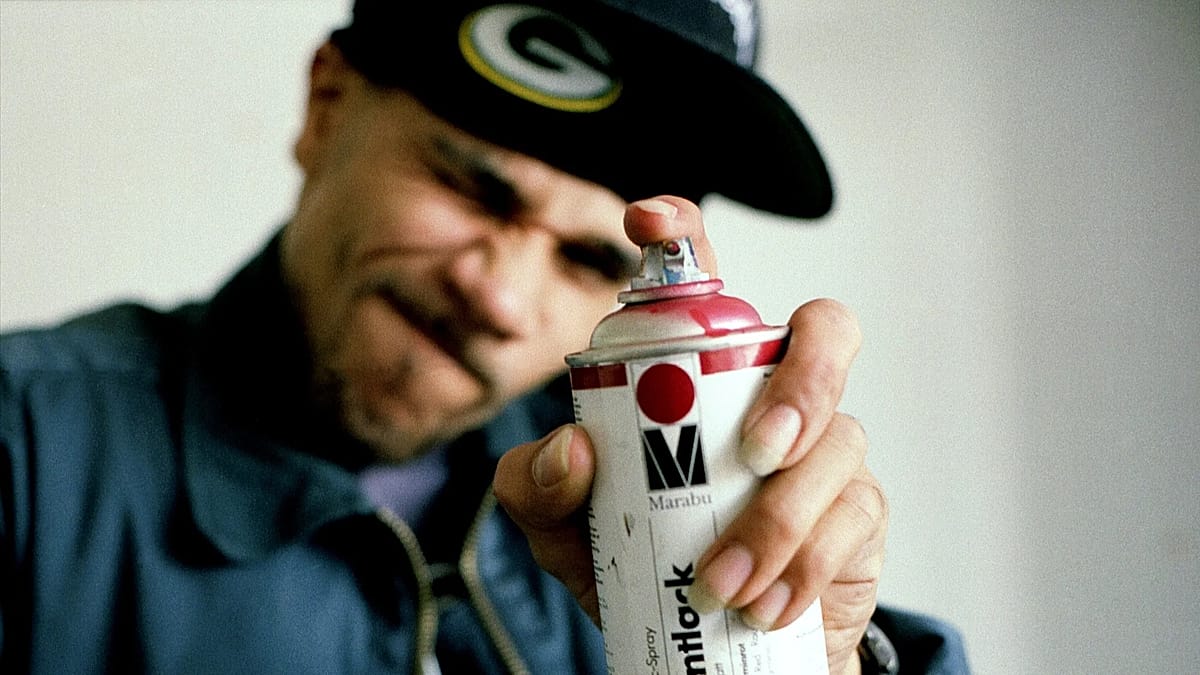
There's also a wonderfully unexpected contribution from British artist Lucy Sparrow, who has recreated a graffiti artist's studio entirely in felt. Set inside a disused Tube station, it's filled with handmade spray cans, graffiti-covered walls, tags and all the usual tools of the trade, only everything has been given Sparrow's trademark soft, stitched treatment.
Sparrow told Euronews Culture that she had spent three months working on the project, followed by four days installing it at the gallery.
A long-time admirer of the graffiti scene, she said she wanted to bring London-based writers like 10FOOT and TOX26 together with international artists, explaining that it was "great turning and interpreting that world into my world of felt."
Elsewhere, you'll find work from some pretty big names, including FUTURA 2000, Damien Hirst, Shepard Fairey, KAWS and Jenny Holzer, alongside the archive of The Big Issue and photographs documenting everything from British punk to the rise of hip-hop.
There's a real mix of things to look at, and that's part of the fun. Some rooms feel like traditional galleries, while others are more like stepping into a different world altogether. And while the exhibition occasionally feels overwhelming in the sheer volume of material on display, that's arguably part of its appeal.
The good news is that the BEYOND THE STREETS exhibition runs until 5 May 2027, so there's plenty of time to see it. And you might even want to go back for a second look.