Inside Amazon’s busiest European warehouse, where robots, lasers and humans deliver the future
Amazon used its Delivering the Future event on Thursday in the United Kingdom to make a series of major announcements for Europe, promising billions in new investment, thousands of jobs and a new generation...
Amazon used its Delivering the Future event on Thursday in the United Kingdom to make a series of major announcements for Europe, promising billions in new investment, thousands of jobs and a new generation of robots that could reshape the lives of consumers, warehouse workers and the wider logistics economy.
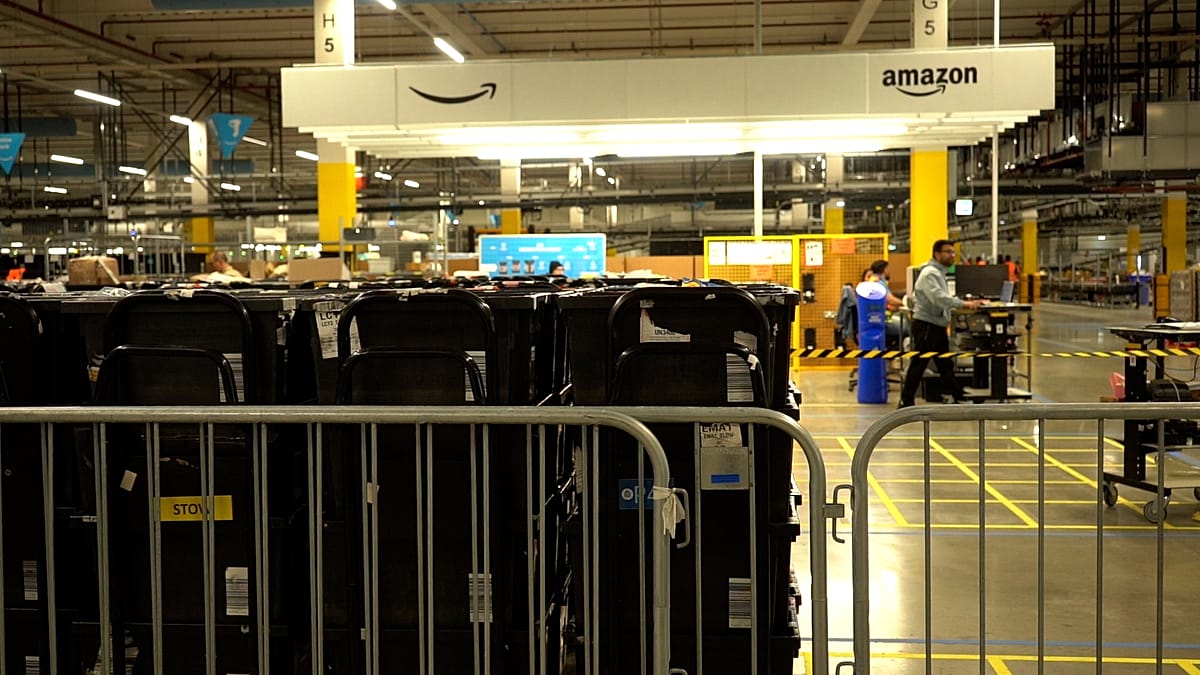
More than a hundred journalists and creators gathered at Amazon’s busiestwarehouse in Europe, LCY3, located in Dartford, to see how technology is already being used to speed up the journey from click to doorstep, and what else the American giant is bringing to the continent.
At more than 216,000 square metres, the facility delivers 4 million units per week, according to the company.
The massive facility gives the impression of an industrial amusement park, with 32 kilometres of conveyor belts carrying millions of boxes and totes above your head at warp speed, with warning and safety signs affixed to scaffolds throughout the building.
The LCY3 facility already uses robotics and AI software that Amazon says has helped employees work faster and safer.
On the second floor, above the conveyor belts, is a floor full of Hercules Drives, a mobile robot built by Amazon. On each floor, 1,660 of them move around 21,700 tall, yellow storage towers known as pods, which human workers have stocked with items following directions from AI software.
Beyond a barrier that journalists were not allowed to enter for safety reasons, a swarm of them dashed around quickly and simultaneously, swapping positions with choreographed precision.
The blue robots, which resemble oversized robot vacuum cleaners, can lift up to 567 kg, using sensors, 3D cameras and a navigation software to move around the warehouse floor.
"[The robot] uses an AI to help navigate the building called Deep Fleet… a bit like going into a city and you have 5,000 cars on the road, and there's no traffic lights to manage all of them. Deep Fleet is there to help coordinate these robots," said Martin Newton, Amazon Tours leader, who took Euronews Next on a guided tour.
The robots can also self-report issues for engineers to look at, the tour guide said.
Amazon says the robotics and software help optimise space and speed, as well as reduce walking distances and improve accuracy.
Once an order is packed by a human, the package passes through a gigantic scanner beaming vibrant neon colours. In the grey, overly lit industrial warehouse, the scanner looks like an unexpected floating disco. Amazon says it is one of the smartest pieces of technology in the entire building.
Amazon says the SICK scanner is used to measure the 3D dimensions of each package, read shipping labels and send parcels into the correct lane corresponding to a specific delivery station.
“All of that in milliseconds. The package never stops moving. Thousands an hour, every hour, with near-perfect accuracy,” Amazon told Euronews Next.
From there, packages move through the shipping sorter, which travels 180 km a day inside the facility.
How new robots will help humans ‘side by side’
Amazon's warehouses in Europe, like LCY3, still rely on human hands. Thousands of employees and associates work at the Dartford site each day. They carry out quality control on items, pick orders from inventory towers and pack them at more than 200 stations across each floor.
With the new investments, Amazon says the next generation of its Proteus autonomous robot will be able to handle heavy lifting up to 400 kg, reduce physical strain on workers and help support site safety.
“You tell it what needs to be done. It figures out the priority, the route, the timing,” said Scott Dresser, vice president of Amazon Robotics. “It becomes your assistant for material movement.”
Euronews saw the previous generation of Proteus, which is currently being used in the United States. But the newer version, which Amazon said would be able to understand conversational prompts from employees, was not presented during the demo.
Amazon said the robot is currently being piloted in Amazon’s labs, with deployment in Europe planned for the first half of 2027.
However, labour organisations and experts have previously warned that warehouse automation can increase pressure on human workers to keep up with machine-driven pace.
“We build our machines in service of people,” Tye Brady, chief technologist at Amazon Robotics, told Euronews Next.
“We build the machines to match the rates of people in their natural movements. We build it as a system of people and machines working together,” Brady added.
Brady said more robotics would allow employees to focus more on critical thinking, such as spotting a leaking pallet of Nutella before a robot moves it through the sortation area and ends up “covered in chocolate”.
“When we have great employees and have great machines working together, we can gain the productivity and efficiency gains that we see inside of Amazon while creating a safer environment.”
For more on this story, watch the video in the media player above.