
If Europe is not around the table, is it on the menu?
Good morning. Angela Skujins penning your Thursday newsletter. On today’s docket: Friends of Ukraine meet in the German capital while a potentially consequential trilateral gets underway in China.
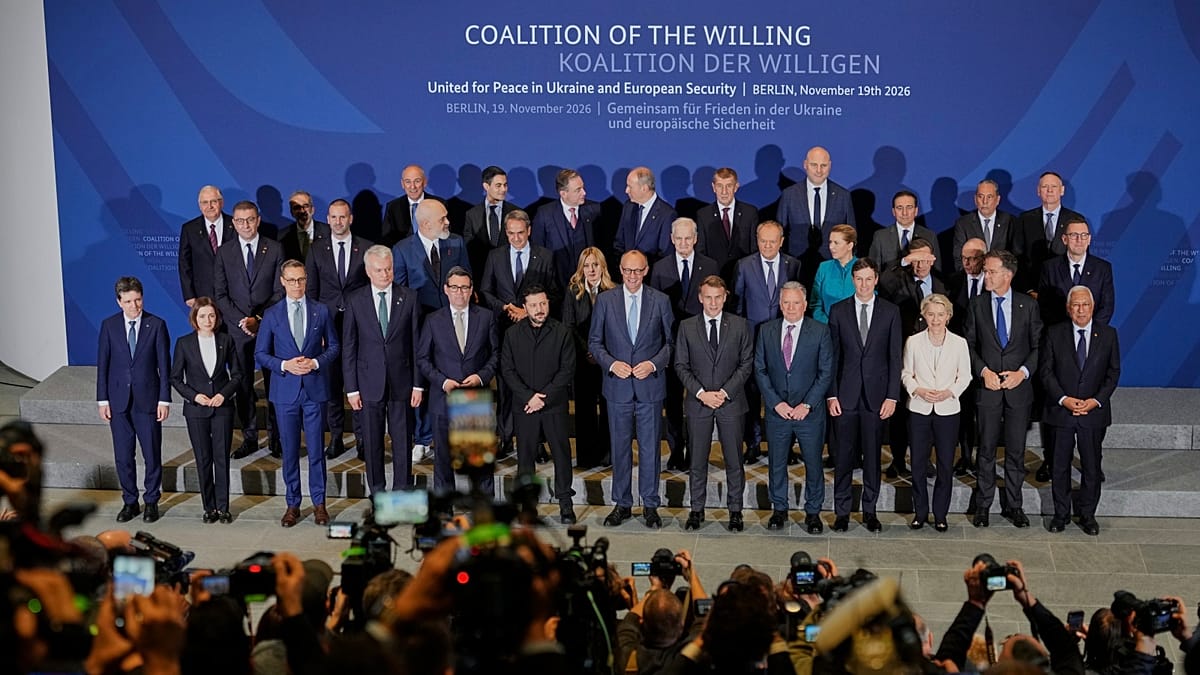
Who’s willing?: At least 40 members of the Coalition of the Willing are set to gather in the German capital for a meeting centred on continued support for Ukraine.
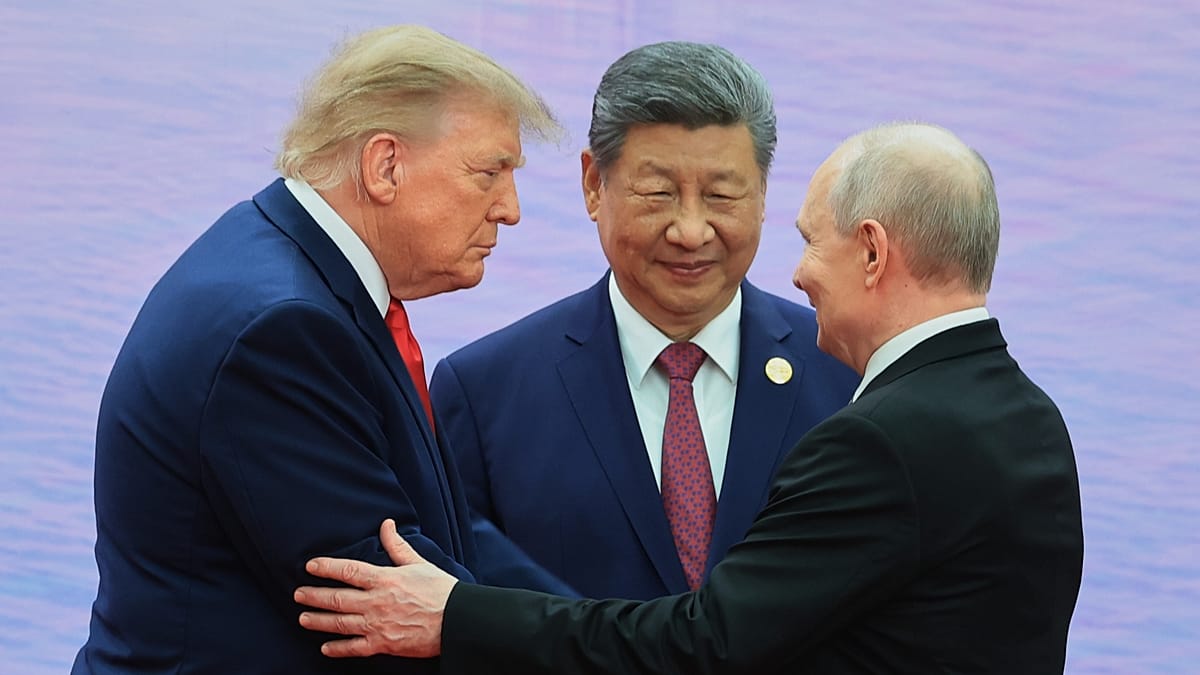
But the assembly is set to be overshadowed by a seismic trilateral occurring on the sidelines of the Asia-Pacific Economic Cooperation (APEC) forum attended by Chinese President Xi Jinping,Russian President Vladimir Putin and US President Donald Trump. According to Chinese media, the meeting was slated to start around 8:10 am CET.
The Xi-Trump-Putin trilateral has drawn comparisons with the 1945 Yalta Conference, immortalised in a famous black and white photograph between Winston Churchill, Franklin Roosevelt and Joseph Stalin in Crimea.
From under thick woollen coats and clutching cigarettes and cigars, the three leaders helped shape the post-world order, including the division of Europe into competing spheres of influence.
For the Baltic states — Latvia, Lithuania and Estonia — the legacy of that settlement was particularly painful, as their Soviet occupation and annexation went unchallenged by the Western Allies.
Yalta 2.0? Norwegian Foreign Minister Espen Barth Eide told me Tuesday night that he doesn’t believe the trilateral will result in new international spheres of power. The last thing anyone desires is an “agreement between great leaders to divide the world between them.”
“I'm not suggesting that's going to happen, but I mean this is something we don't want to see,” he said.
Fredrik Wesslau, senior policy fellow at the European Council on Foreign Relations, believes Putin will probably try to discuss Ukraine and find a conclusion to the full-scale invasion. “He wants Russia, the US and China to decide everyone else's geopolitical fate,” he said. “But in the end it’s impossible to decide on the fundamentals of European security without Europeans.”
Ukrainian President Volodymyr Zelenskyy presciently told the press in November, right before the fresh round of diplomatic overtures recommenced, “We don't want to have Yalta 2.0. We don't want to be divided by Russia.” But Trump has already trumped the talks as an opportunity to find an avenue to end Russia’s full-scale invasion. He declared earlier this week that: “I think it’s very close to getting it done.”
Beijing has billed the historic meeting as “in-depth exchanges on safeguarding world peace and promoting strategic stability in major-power relations” while Putin said that he expected the summit to be “highly useful”.
Back to Berlin: Representatives from Europe’s E5 group – Germany, France, Italy, Poland, United Kingdom – will meet on the sidelines of the Coalition of the Willing meeting to talk about the substance of Europe’s red lines if those ceasefire talks ever occur. These were the countries, alongside Council and Commission officials, tasked with speaking with Russia following the informal European Council summit in Dublin on Friday.
Toomas Hendrik Ilves, former President of Estonia, spoke to Europe Tonight anchor Mared Gwyn about the tenor in which the United States has approached Russia’s invasion of Ukraine under Trump’s leadership.
“(Undersecretary of War) Elbridge Colby came out and started criticising the Ukrainians for their rocket attacks on Russian oil refineries and on data centres, which was kind of bizarre, given what the Russians are doing to Ukraine on a daily basis,” he said.
Ilves also welcomed the swift riposte offered by German Defence Minister Boris Pistorius, who pushed back against Washington’s criticism of Ukraine's deep-strike campaign during a meeting at NATO headquarters on Tuesday.
“For the first time, you saw that Defence Minister Pistorius said, ‘That's really stupid.’ I mean, for once, we saw some backbone on the part of an EU minister standing up to this really Russophilic approach that the US has taken for a while.” Watch.
Re-energising energy policy: Energy Commissioner Dan Jørgensen said the latest EU agreement to accelerate permitting procedures is a step forward for clean power and infrastructure. He told Maria Tadeo the move will revamp the bloc's obsolete power grid and boost electrification — even if financing the power grid remains yet another obstacle.
"This is about making sure that we have the infrastructure to actually electrify our societies, to get the renewable energy into our systems so that we can drive our cars on electricity, we can have heat pumps and so forth," he said.
"Instead of being 27 member states, we are trying to be one energy union." Read more.
In other news: Time is running out for Montenegro to maintain its timeline to close all the negotiation chapters for EU accession by the end of the year. According to my colleague Luca Bertuzzi, Podgorica still has 10 chapters to close before the winter recess, but it will only close two more at the Intergovernmental Conference today, on regional policy and taxation.
The reasons are both technical and political. At the technical level, the Council is busy not only finishing up the work on Montenegro and drafting its accession treaty, but also discussing the tighter safeguards for new member states and the annual political conclusions on enlargement.
The Zagreb puzzle: Politically, the elephant in the room remains the bilateral disputes with Croatia. Despite political pressure from Germany and other EU countries, Montenegro still has to resolve several issues before it can move forward. In practice, Podgorica might still be able to join in 2028 if the negotiations slip into early next year, but the delays risk piling up.
Other Western Balkan drama: The European People’s Party (EPP) will likely suspend the membership of Serbia’s Serbian Progressive Party (SNS) at its next political assembly in December, Vincenzo Genovese writes.
The EPP presidency, led by Germany’s Manfred Weber, is set to propose the suspension following an internal scrutiny process launched more than a year ago, EPP sources told Euronews. The centre-right political family has long been on a collision course with the party of former Serbian President Aleksandar Vučić over its ties to Russia and its violent crackdown on protests. Vincenzo has the story.
EU plans a new €45bn loan to Ukraine. How much will it cost? And will it be repaid?
The European Commission has unveiled its proposal to issue a €45 billion support loan to Ukraine to keep the war-weary country afloat amid Russia’s relentless attacks. The funds will come on top of the €90 billion loan, which is still ongoing.
“This is the best way to give Ukraine a strong hand at the negotiation table,” President Ursula von der Leyen said.
The loan will be raised through joint debt, though four countries (Slovakia, the Czech Republic, Hungary and Bulgaria) say they want to opt out. Asked about this, von der Leyen said she was “very confident” that all 27 member states would back the proposal, which has become dangerously intertwined with the next EU budget.
Complicating matters, the budget talks will have to resolve how the accrued interest is paid. The €90 billion and €45 billion loans are estimated to generate about €6 billion in annual costs. Brussels says it “reserves the right” to use the immobilised Russian assets to pay back the principal.
Jorge Liboreiro has everything you need to know about the new loan.
More from our newsrooms
EU failed to curb harmful 'forever chemicals', auditors warn. EU auditors warn that slow regulation, patchy enforcement and outdated food and drinking water safety limits are leaving Europeans exposed to harmful chemicals, six years after Brussels pledged to phase out their non-essential uses. Marta Pacheco has more.
UK government fights back over bacon crisp and marmalade claims. From smoky-flavoured snacks to ketchup sachets, ministers are pushing back against claims that closer ties with Brussels will mean a new wave of EU rules for British consumers. Saskia O'Donoghue has the details.
Europe cannot 'sleep through the AI revolution': Tech leaders urge EU to take action. Tech leaders, including Yann LeCun, Nobel laureate Philippe Aghion and the CEOs of ElevenLabs and Lovable, call on the EU to secure a dedicated AI allocation in the next long-term budget. Pascale Davies has the story.
We’re also keeping an eye on
- European Commission President Ursula von der Leyen is in Amman, Jordan, for the EU-Jordan Investment Conference 2026.
- European Commission Executive Vice-President Teresa Ribera will speak at the European Business Summit 2026 Gala Dinner in Brussels.
- EU-Montenegro Accession Conference occurs in Brussels, with a press conference scheduled for 4:30pm presided by Irish Minister of State for Foreign Affairs and EU Affairs Thomas Byrne, European Commissioner for Enlargement Marta Kos and Montenegrin Prime Minister Milojko Spajić.
- General Affairs Council starts at 11:30 am CET with a 3:30pm CET press conference delivered by the Irish Presidency and the European Commission.
- European Commissioner for Energy Dan Jørgensen meets Polish Finance Minister Andrzej Domański in Warsaw, Poland.
That’s it for today. Luca Bertuzzi, Vincenzo Genovese and Jorge Liboreiro contributed to this newsletter.