Can bison help prevent forest fires in an increasingly threatened Spain?
Spain is going through one of its worst forest fire crises in history and, with climate change fuelling increasingly intense and hard-to-control blazes, scientists and environmental managers are looking for...
Spain is going through one of its worst forest fire crises in history and, with climate change fuelling increasingly intense and hard-to-control blazes, scientists and environmental managers are looking for new ways to reduce the risk.
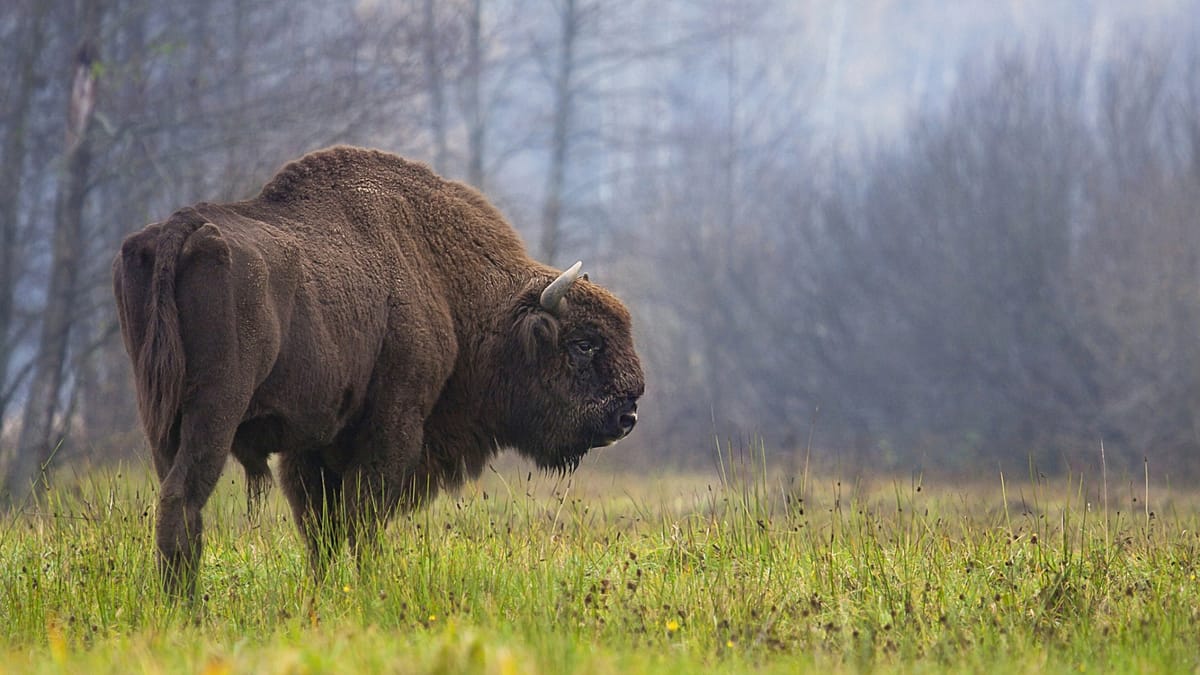
Among them is a somewhat unusual proposal: bringing back large herbivores, such as the European bison, to help keep in check the undergrowth that feeds the flames.
The idea rests on a simple principle: if there is less combustible material in the forest, fires will find it harder to spread. However, researchers warn it is still too early to know to what extent this species can play that role and stress that, in no case, would it replace traditional forest management work.
One of the arguments supporting this hypothesis is the animal’s diet itself. Fernando Morán, a vet and founder in 2008 of the European Bison Reserve and Interpretation Centre, explained to Euronews a few years ago that "One of the animal’s characteristics is that it eats wood, scrub, bushes, tree vegetation, leaves and branches, which are all combustible material... If nobody eats it or removes it, it is liable to burn".
He added: "What it doesn’t eat, it breaks, either by trampling it or hitting it with its head." That is why he argues that "It is a natural firefighter, or 'wild firefighter', appointed by nature".
A pioneering project in Spain and a growing network across Europe
With that goal in mind, Rewilding Spain launched in January this year a pioneering research project in El Recuenco (Guadalajara), in collaboration with the University of the Basque Country, the University of Manchester and the Danish research centre Econovo.
Nine European bison live there in a 400-hectare enclosure of Mediterranean forest, where scientists study how they adapt to the Iberian ecosystem and what impact they have on woody vegetation.
According to the organisation, the study aims to generate new data on the role that this species can play in ecosystem restoration and in the creation of "more resilient forests in the face of fires and other impacts of climate change", said the organisation when it announced the project.
To that end, the animals are monitored using GPS devices and researchers analyse their diet, their stress levels and the changes they bring about in the structure of the vegetation.
In any event, the reintroduction of the European bison is part of a rewilding strategy that is spreading to different parts of the European continent with a dual objective: restoring degraded ecosystems and strengthening their resilience to climate change, while at the same time seeking new development opportunities for rural communities.
Although the projects take different approaches, they all start from the same premise: restoring the ecological role that large herbivores once played in shaping the landscape.
As Rewilding Spain notes, one of the most advanced examples of "rewilding", also known as "renaturalisation" or "resilvestration", can be found in the United Kingdom, where the Wilder Blean project has introduced European bison alongside other species such as ponies, cattle and pigs to restore the natural functioning of an ancient woodland. The initiative combines ecological management with ecotourism, environmental education and job creation, with the aim of ensuring that nature recovery also has a positive economic impact on the area.
In other countries, priorities differ. Germany maintains one of the few free-roaming bison populations in Western Europe, while Poland, the cradle of the species’ recovery after its extinction in the wild in the 20th century, is working to increase the genetic diversity of its herds, expand their range and improve coexistence with farming and forestry activities.
More than just bison: The power of grazing herds
The idea of using animals to reduce vegetative fuel is not unique to Spain. An article published on the World Economic Forum website, based on a study by researchers at the Australian National University, highlights that mammals, birds and even insects can become allies against wildfires by consuming the parts of trees and shrubs that burn most easily.
The article also recalls the case of a herd of 500 goats that helped protect the Ronald Reagan Presidential Library in the United States by clearing the flammable vegetation surrounding the complex.
Beyond fire prevention, the project is part of a broader ecological restoration strategy. Rewilding Spain’s Head of Communications, Lidia Valverde, summed up this philosophy in comments to 'El Salto': "Rewilding is a novel approach, complementary to the classic idea of conservation. It is based on the notion that it is not enough to conserve the nature we still have; we also need to put back the pieces that have been lost from ecosystems so that nature can recover its balance".
The European bison, the largest wild land mammal on the continent, grazed across much of Europe until it disappeared after the First World War. According to the Cabárceno Nature Park in Cantabria, today’s wild population descends from "a few pure-bred specimens preserved in zoos".
The park itself, which can be visited and is home to some of the few specimens of this animal in the Iberian Peninsula, has for years been involved in European breeding programmes designed to preserve the species’ genetic diversity.
What are the challenges of reintroducing bison?
However, the very history of its reintroduction also explains one of the main challenges for any expansion of the species. As the European Bison Reserve and Interpretation Centre points out, all current animals descend from just "12 founder individuals", a limited genetic base that makes it essential to manage breeding programmes carefully to guarantee the species’ viability.
There are other question marks too. The Rewilding Spain study aims to assess both the positive effects and the possible impacts on the territory before drawing conclusions. It also seeks to determine whether the presence of bison can coexist with other traditional uses of the forest, such as timber harvesting, hunting or mushroom picking.
For now, researchers insist there are no definitive answers. The hypothesis is promising, but broader studies are still lacking. In a Spain increasingly exposed to extreme fires, the European bison could become one more tool for safeguarding the landscape, although science is still working to determine the real extent of its ability to help prevent fire.