From empty benches to real debate? Metsola's bid to revive the European Parliament
Starting in September, new rules will reshape debates in the hemicycle, with one goal: keep MEPs in their seats and turn a succession of social media clips into genuine political exchanges.
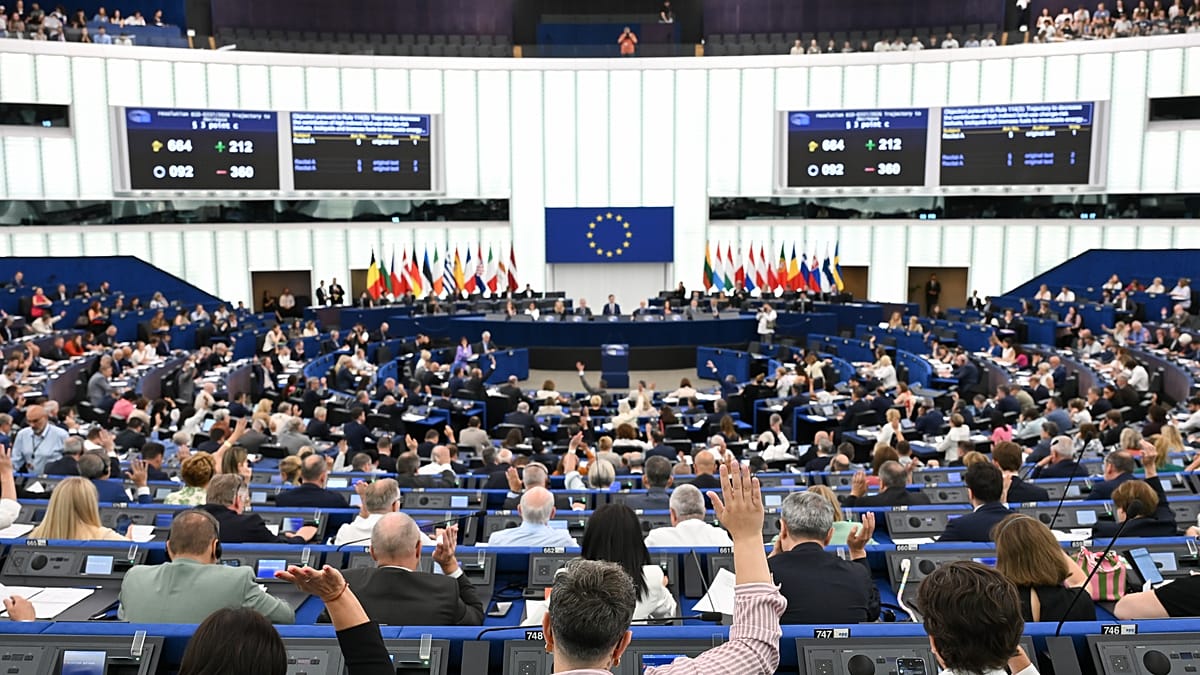
A member of the European Parliament takes the floor, delivering an impassioned speech. Then the camera zooms out, revealing an awkward reality: a nearly empty chamber, with only a few dozen lawmakers scattered across the benches. Many are glued to their phones, while hundreds of seats remain vacant.
For years, this has been a familiar sight in the European Parliament. During Strasbourg's long plenary weeks, many MEPs arrive just before their speaking slot, deliver a tightly rehearsed one-minute speech and leave almost immediately afterwards.
"It is the most expensive backdrop for social media clips in the world," an MEP told Euronews, on condition of anonymity. The real audience, the lawmaker argued, sits hundreds of kilometres away, watching speeches later on X, Instagram, TikTok or Facebook.
As the hemicycle has increasingly become a recording studio rather than a debating chamber, European Parliament President Roberta Metsola has pushed for an ambitious overhaul of plenary business.
The aim is to make debates more dynamic and reduce the rows of empty seats. Metsola believes images of sparsely populated benches undermine the Parliament's claim to embody Europe's democratic centre, an EU official told Euronews.
After pilot tests during the June and July plenary sessions, a package of procedural reforms will become the new normal in September.
The idea has been floated for months with one key objective: keep lawmakers in the chamber during the four-day sessions, encourage genuine exchanges and turn plenary debates from a sequence of isolated speeches into actual political discussions.
New rules for plenary sessions
Time is of the essence in this reform.
Under the current system, debates often overrun, pushing the day's agenda well into the evening and discouraging attendance. As a result, politically sensitive files can end up being debated before almost deserted benches, with only the scheduled speakers left in the room.
The new rules introduce fixed finishing times for plenary sittings, creating a more predictable timetable and putting an end to the marathon evenings that have long defined Strasbourg weeks.
During the upcoming tests in September, deadlines have been fixed to 8:30 pm on Monday, 7 pm on Tuesday and Wednesday, and 4 pm on Thursday.
"If a new topic to debate is added to the agenda, another one has to be taken out," a spokesperson for the Parliament president told Euronews. Under the current rules, new debates are added to an already crowded schedule.
The reform also targets one of the main reasons MEPs skip debates. Political group meetings and other parliamentary activities such as negotiations with member states will no longer run in parallel with plenary discussions.
These meetings are very important for MEPs, because real decisions are taken. Holding them outside debate hours should make attending plenary less costly — and more worthwhile.
The speaker list will also change. During selected high-profile debates, MEPs will no longer know exactly when they are due to speak. Instead of waiting outside until their slot approaches, they will have an incentive to stay in the chamber and follow the debate.
But filling the benches is only part of the challenge. The bigger ambition is to make exchanges less scripted and more spontaneous.
Too often, MEPs write speeches for voters back home rather than colleagues sitting a few metres away. Interventions increasingly aim to produce short video clips for social media and national broadcasters rather than persuade fellow lawmakers.
The new rules seek to change that dynamic. MEPs will be able to make immediate personal statements when another lawmaker refers to them directly. The Parliament also wants MEPs to make better use of "blue cards", a procedure allowing members to ask a speaker a question immediately after an intervention.
Interaction with European commissioners will also become more direct. Current debates often feel disjointed, with commissioners delivering opening and closing statements that barely respond to points raised by MEPs.
Under the new format, commissioners will intervene throughout the debate, responding directly to lawmakers' arguments. Each plenary session will also include a dedicated scrutiny debate with the Commission, using a "question time" format similar to those found in several national parliaments.
Mixed reactions from MEPs
President Metsola wants the changes to become a permanent feature of future plenary sessions. But parliamentary rules require political group leaders to approve the agenda before each session, meaning the reform will ultimately depend on continued political backing.
The first test will come in September, when group leaders decide whether to adopt a revised agenda following an assessment of the June and July pilots. According to Metsola's office, that decision would signal the new format has won enough support to become permanent.
Not everyone is convinced.
Irish Renew Europe MEP Barry Andrews doubts that fuller benches will make Parliament function any better.
"The bulk of legislative work is done in the committees, which are often deserted by MEPs," he told Euronews. Focusing on the plenary is "the wrong answer" if the goal is to improve Parliament's overall effectiveness.
"Sometimes I'm surrounded by 10 other MEPs, looking at their phones when I'm speaking. If you have 30 MEPs looking at their phones instead, I don't think this would make a great difference," he said.
He also argues that pushing committee meetings later into Strasbourg weeks, to avoid clashes with plenary, could result in a drop in committee attendance.
Still, Andrews welcomes parts of the package, particularly the more interactive exchanges with commissioners and the decision not to publish speaking slots in advance for some debates.
"It forces people to actually listen," he said.
Attendance during the June and July pilot sessions remains difficult to measure, as MEPs typically enter the chamber to vote and often leave immediately afterwards.
The overall impression, however, is that debates still took place before many empty seats, Greens/EFA Italian MEP Benedetta Scuderi told Euronews.
"The idea of making debates more interactive is a positive one," she said, while warning that she had already spotted a potential issue during the last session.
"The blue-card system is often exploited by like-minded MEPs from different political groups, who ask each other harmless questions, just to gain extra speaking time," she said, illustrating an old parliamentary truth: where there is a rule, there is usually a loophole.
From September, plenary debates may become livelier and better attended. Few inside Parliament, however, expect a revolution. No procedural reform can change one fundamental reality: for most politicians, the primary audience no longer sits inside the chamber.