‘Paralysed by fear’: Venezuelans tell of escape and loss after huge earthquakes
As a double whammy of powerful earthquakes rattled Venezuela’s northern coast on Wednesday, residents of the capital, Caracas, scrambled out on to the streets from shuddering, fractured buildings.“It was...
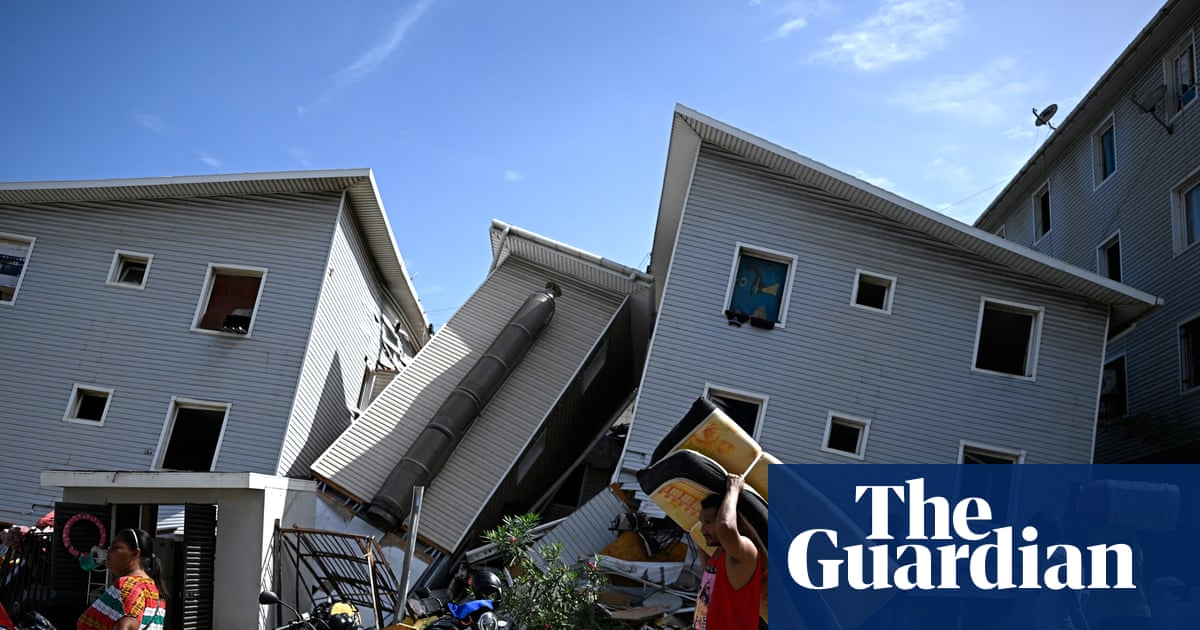
As a double whammy of powerful earthquakes rattled Venezuela’s northern coast on Wednesday, residents of the capital, Caracas, scrambled out on to the streets from shuddering, fractured buildings.
“It was horrible. I felt like the house was moving to a different rhythm to the earth. I had to carry my mum out. She was paralysed by fear,” recalled 18-year-old Sebastian Rodríguez, whose family runs a shop in Centro Plaza, an iconic brutalist commercial centre in the affluent neighbourhood of Los Palos Grandes.
The robust reinforced concrete structure of the shopping mall – an architectural gem built at the peak of Venezuela’s 1970s oil boom – appeared to have been spared major damage, but the surrounding area was far less fortunate.
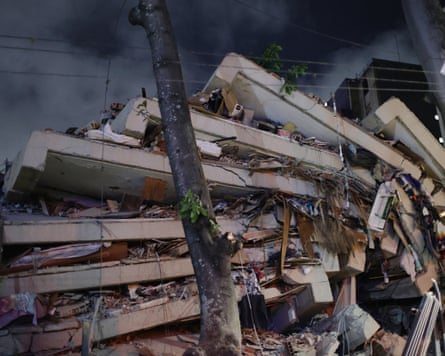
At least three buildings in Los Palos Grandes and neighbouring Altamira collapsed during the 7.2- and 7.5-magnitude quakes, which struck within a minute of each other, shortly after 6pm local time.
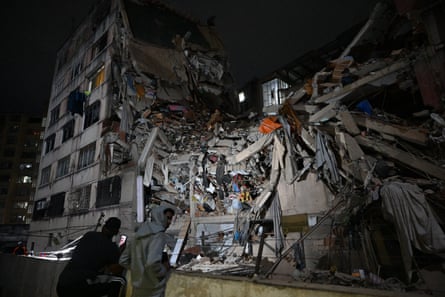
As night fell, emergency workers, volunteers and the relatives of victims rushed to the scene hoping to find survivors in the wreckage of residential buildings that had been reduced to a mangle of masonry and steel.
“There is so much rubble,” gasped Jessica Galvis, 33, a critical care physician who was waiting for news outside one fallen six-floor building where she believed a female friend had been buried.
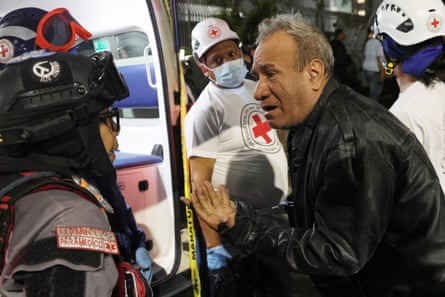
José Morillo, 61, said he had raced across town on his motorbike, praying that his trapped family members would all be found alive. “My brother, my son and nephews are all inside,” Morillo said, before a female relative was pulled from the building’s ruins, seemingly still alive.
At the foot of the spectacular Ávila mountain, Altamira and Los Palos Grandes are home to some of the South American city’s wealthiest residents and the location of numerous upmarket hotels, restaurants and foreign missions, including the British, German and Brazilian embassies.
But working-class areas such as Catia, whose residents were already struggling with the effects of one of the worst peacetime economic crises in modern history, were also devastated.
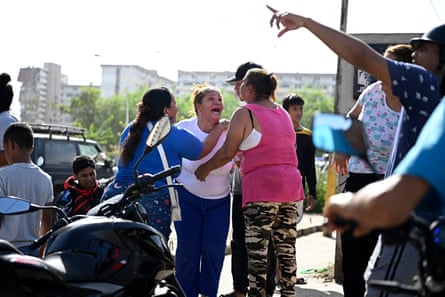
“My walls have crumbled. There’s water coming in through the roof. The quake lasted so long and it smashed everything,” said José Luis, a PE teacher who lives in Catia and was one of many people to lose his home.
Luis said he was too frightened to go back indoors and, like many caraqueños, planned to spend the night sleeping rough, on mattresses, pieces of cardboard or in tents. “The government needs to send people, firefighters … if there’s another quake like that one, this building will collapse,” he pleaded. “This is what we all fear.”
Isra Colmenares, a 58-year-old from the same region, recalled how her building had started violently swaying as the ground shook during the second earthquake, Venezuela’s worst since a 7.7 earthquake in 1900. “It was a truly hideous experience … It was the first time in my life that I’ve experienced anything like this – it was just so, so powerful,” Colmenares said.
If the devastation was dramatic in Venezuela’s capital, about a 45-minute drive north the situation appeared to be even worse.
The international airport, located in a port city called La Guaira, was closed after sustaining severe damage that is likely to hamper the humanitarian response. Social media videos showed panicked travellers sprinting for cover as the terminal’s roof began to cave in, coating them in dust.
Nearby, dozens of tower blocks and buildings– including at least one beachfront hotel – collapsed.
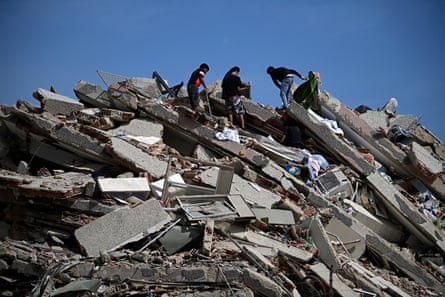
When the earthquakes struck, the coastal region was still reeling from Donald Trump’s decision to launch a lightning-fast invasion to abduct Venezuela’s president, Nicolás Maduro, on 3 January this year.
Several buildings in Catia La Mar, a seaside town west of La Guaira, were badly damaged when US air-to-surface missiles rained down on defence and radar systems along the coast, clearing the way for helicopter-borne special forces teams to fly south to Caracas to grab Maduro.
On Wednesday, those communities again found themselves in the eye of the storm. With phone lines down, attempts to contact residents were unsuccessful. Their fate remained unclear. The official death toll on Thursday morning stood at 164 but is expected to rise. Writing on social media, Trump warned of “a devastating number of deaths”, adding: “We will be there for our new and great friends.”
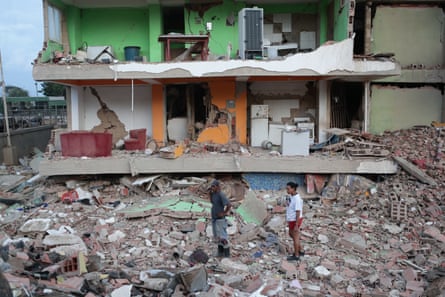
Social media filled with photographs of the missing, many of them from the stretch of shoreline between the airport and Catia La Mar. One was an eight-year-old boy called Brayne; another a five-year-old girl, Miranda.
In one dwelling, at least five members of the same family had disappeared: Luisa, Ángel, Carmen, Yepxalit and Andrea.
Amid the despair, there were rays of light. At about 1.30am, rescue workers were filmed freeing three siblings who had been buried under a pancaked building in La Guaira. “God, you are great!” one local man can be heard proclaiming as the children are pulled from a jumble of concrete, shaken but alive.