Amazon forest fires fell to all-time low in 2025 but could a super El Niño halt progress?
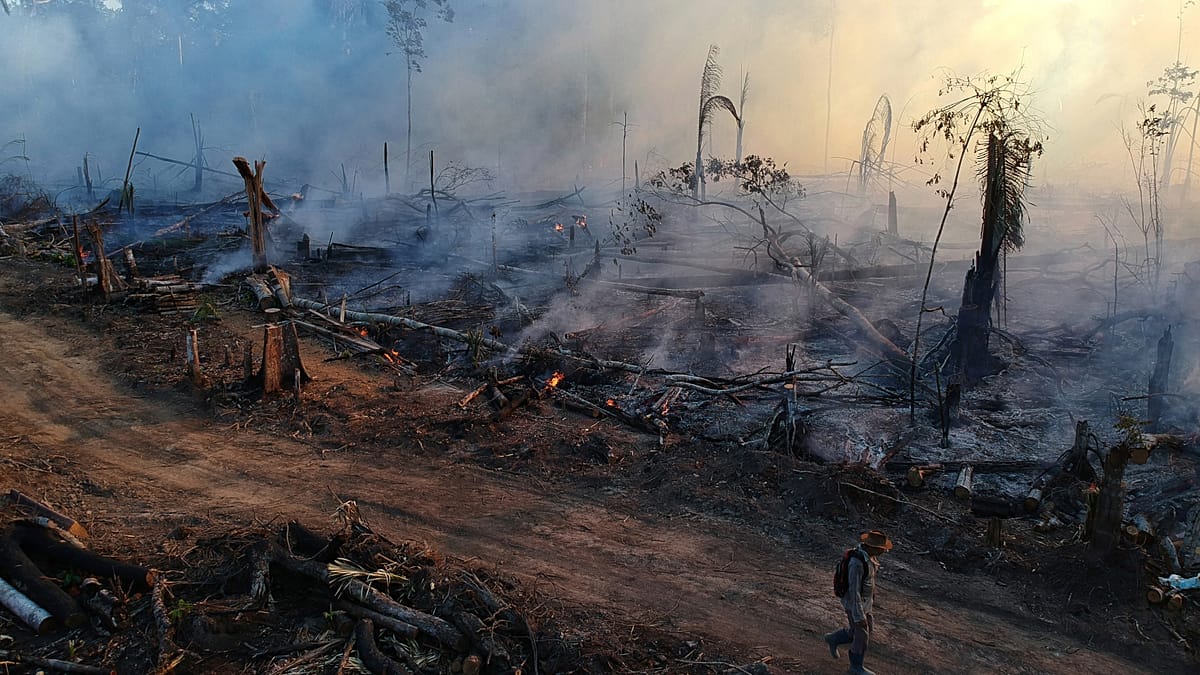
Forest fires in the Brazilian Amazon fell to a historic low in 2025 after peaking the previous year, according to a new report. Deforestation in the world’s largest rainforest also eased off last year, the...
Forest fires in the Brazilian Amazon fell to a historic low in 2025 after peaking the previous year, according to a new report.
Deforestation in the world’s largest rainforest also eased off last year, the report from environmental monitoring network MapBiomas says, which drastically reduces the amount of fuel available to start fires.
Using satellite images, MapBiomas found that 3.1 million hectares were burned last year - the smallest area since records began in 1985.
The progress will come as good news for leftist President Luiz Inacio Lula da Silva who vowed to end deforestation when he was elected in 2022.
Protecting the Amazon is crucial in the fight against the worst effects of climate change, since its dense vegetation absorbs the greenhouse gases that cause global warming.
Drought in 2024 may have led Amazon communities to protect their land
Forest fires in the Amazon peaked in 2024 when an unprecedented drought triggered the spread of fires, the majority of which were human-made. Flames engulfed the world's largest tropical rainforest, leading to untold losses of carbon-sucking trees, plants and rare wildlife.
The new data shows that 2025 saw a reversal of the critical situation. The decline was "out of the ordinary", geographer and report coordinator Ane Alencar told news agency AFP.
While disrupted weather patterns are wreaking havoc in many parts of the world, in the Amazon they were a gift on one front. A delayed rainy season between 2024 and 2025 blocked the emergence of the "ideal window for burning in certain areas" where fire is used to clear agricultural land, Alencar said.
Poorly managed fires of this type are exacerbated by illicit practices such as deforestation, which is common in areas where illegal mining occurs.
The report highlighted the "psychological factor" among communities who feared a fire season like 2024 and therefore helped control any outbreaks. Fewer fires, it said, "interrupts a sequence of years of fire expansion and returns the country to a historically lower level of burned area".
Fires eased off across the whole country in 2025, with burned areas nationwide at their smallest since 2018. Central Brazil's vast Cerrado savanna, however, "kept burning" at similar rates, Alencar said.
Why a Super El Niño could lead to more fires
Alencar flagged the potential arrival of a "super El Niño" as a risk factor for more forest fires.
In March this year, the US National Oceanic and Atmospheric Administration (NOAA) forecast a 62 per cent chance of El Niño forming this summer. “If El Niño forms, the potential strength remains very uncertain, with a one-in-three chance that it would be ‘strong’ during October to December 2026,” the NOAA’s Climate Prediction Center says.
Although not an official term, this strong weather phenomenon has been dubbed a "super El Niño". In the Amazon, this could bring "an extended dry season and a greater risk of forest fires" according to report coordinator Ane Alencar.
El Niño can be triggered by a series of tropical wind bursts from the west that weaken or even reverse these trade winds. When this occurs, warm surface water sloshes back towards South America, where the warming of surface water prevents the colder deepwater from upwelling.
El Niño, which occurs irregularly and typically lasts for about a year, tends to increase global temperatures, which in turn can result in more extreme weather such as flooding.
This is because for every 1℃ rise in air temperature, the atmosphere can hold around seven per cent more moisture, leading to more intense and heavy rainfall. El Niño can also intensify heatwaves in the tropics, which is why El Niño years are often among the warmest on record.
President Lula: “Let’s fight for zero deforestation”
When Brazil’s President Luiz Inacio Lula da Silva came to power in 2022, he had a long environmental to-do list to tackle.
Under his predecessor, Jair Bolsonaro, deforestation in the Amazon hit an all-time high. In 2019 alone, the first year of the Bolsonaro administration, 9,762 square kilometres of land was deforested - a 30 per cent increase from the previous year. “Jair Bolsonaro’s reign as Brazil’s president has seen the greatest reversal of social and environmental protections in our nation’s history,” Adriana Ramos of Instituto Socioambiental said at the time.
“Let’s fight for zero deforestation,” Lula said in his victory speech in 2022, pledging to end the practice by 2030. This pledge has featured heavily in Lula’s policies since, saying at COP27: "There is no climate security for the world without a protected Amazon," adding that Brazil will "do whatever it takes to have zero deforestation and degradation of our biomes".
His promises seem to be paying off: deforestation in the Amazon dropped by a third during the first six months of his term. By April 2023 it had fallen by 68 per cent compared to the previous year. Data from the first quarter of 2026 shows that deforestation is at its lowest-ever rate this decade.
The leftist leader is looking to nab a fourth non-consecutive term in office in October elections, partly by championing environmental causes. But his decision to endorse a major offshore oil exploration project off the coast of the Amazon has garnered virulent criticism from activists.