Portuguese scientists study Martian clouds to help future landings
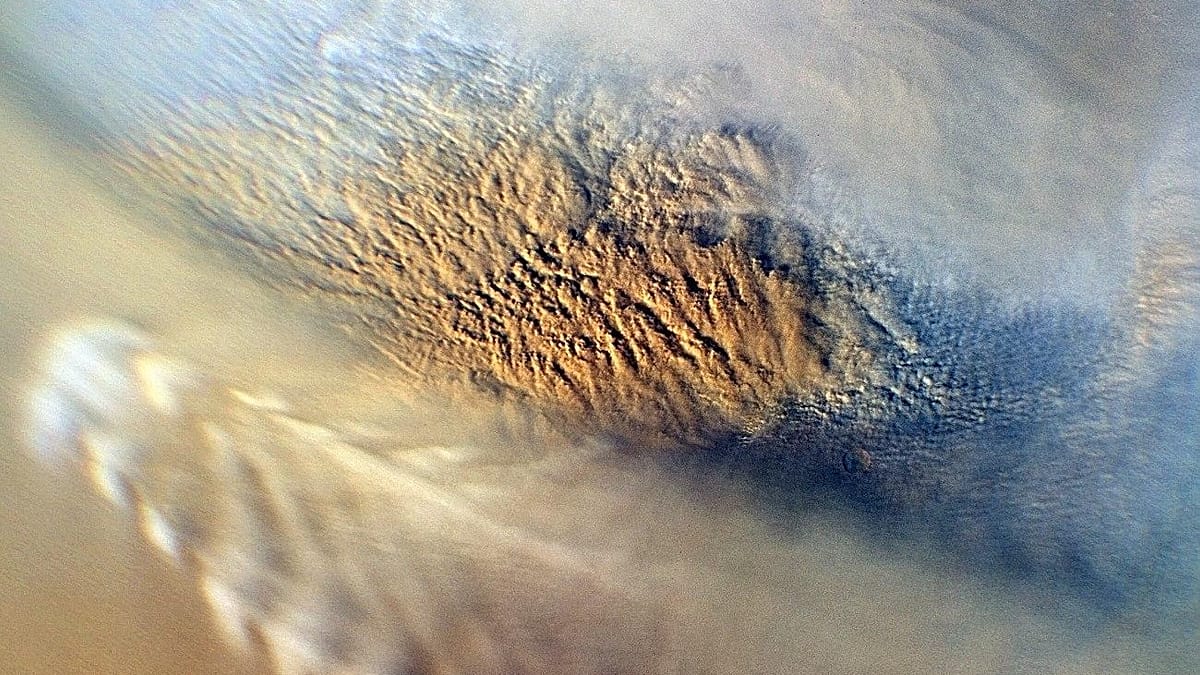
As plans for crewed missions to Mars advance, a study led by two Portuguese scientists at Lisbon University's Faculty of Sciences is helping make landings on the Red Planet smoother.
Two Portuguese scientists were the lead authors of a study, published in the scientific journal Journal of Geophysical Research: Planets, (source in Portuguese) which set out to “hunt” and analyse clouds on Mars, in a breakthrough designed to make future missions to the Red Planet easier.
As part of this research, the aim was to measure simultaneously the altitude and propagation speed of Martian atmospheric waves, which are a key element in understanding how energy is transported in the planet’s atmosphere.
As scientist Francisco Brasil, who led the study alongside Pedro Machado, both from the Faculty of Sciences of the University of Lisbon (CIÊNCIAS ULisboa) and the Institute of Astrophysics and Space Sciences (IA), explained to Euronews, this was achieved essentially on the basis of data from the Mars Express mission.
The work draws on “one of the European Space Agency’s longest missions”, which has been in orbit for 23 years and has since been extended “until 2029” — with key elements of this unmanned initiative having been used in the study.
Outlining why the research matters, Francisco Brasil noted that “to land on a planet, just as we land on Earth, we need to know, more or less, how that atmosphere is distributed in terms of layers”.
By characterising the atmospheric waves of the planet in question, it is possible to understand “how the dynamics of its atmosphere work at those specific altitudes”. This work, in this particular case, relied on “measuring the altitude of the clouds and the winds” as “essential techniques”.
All of this was made possible thanks to a high‑resolution camera on board the European Mars Express spacecraft, “which made it possible to observe the same location from different angles”.
According to Francisco Brasil, the discovery “will be important in future, when humanity reaches Mars”, because it will help us understand “what optimisations need to be made” to the spacecraft that aim to reach the Martian “surface”. The goal is to “control the friction or differences that exist in the atmosphere” of the planet so that “everything goes well at landing”.
A “very thin atmosphere compared with Earth’s”
But why could this analysis have such a significant impact on future missions to Mars? Because the planet’s “atmosphere”, “compared with Earth’s, is very thin”, meaning “it has few molecules”. As a result, “the frictional force that exists” on the Red Planet ends up being far lower. “It is as if we were almost in free fall,” the astrophysicist illustrates. That is very different from what happens on Earth, where “it is very difficult to put a rocket into space”.
And the challenges at this level have been very evident over recent decades. “It has been very difficult to send rovers to the surface of Mars,” Francisco Brasil said. The fact is that, since 1960, roughly half of Mars exploration missions have not gone as planned, including crashes on the planet’s surface by these robotic vehicles, as well as launch and orbit failures.
He went on to explain the reason behind the difficulties with landing, looking ahead to a possible crewed mission to the Martian surface, something that has never yet happened: “Because we did not have much information about how the atmosphere was structured, they [the rovers] ended up nearly in free fall and crashed onto the surface of Mars. And we do not want that to happen to humans.”
However, this reality has started to change “in recent years”, during which the “success rate for landings” on Mars has already been considerably higher than in previous periods, the researcher noted.
This is also due to the investments that have been made in equipment. “In recent years, all the rovers have greatly improved their ability to cushion that free fall that occurs on Mars,” reducing the impact at the moment of touchdown on the surface through different mechanisms, such as “very specific parachutes” and “shock‑absorbing systems” similar to airbags.
Clouds on Mars are rare and “seasonal”
As on Earth, there are “several seasons of the year” on the Red Planet, because both have an “inclined axis”, the expert from the Institute of Astrophysics and Space Sciences pointed out.
And this influences the formation of clouds on Mars. “Throughout the year they are very sparse”, and are marked in particular by a certain seasonality.
This is because the planet “has polar caps made up of carbon dioxide ice and water ice which start to evaporate as the northern hemisphere summer approaches”, forming what is known as the Aphelion Cloud Belt, “a region in the northern hemisphere with many clouds”. Consequently, “only at that time” in the Martian year “can we observe more clouds”, because they then “evolve over time” and respond “to the various dynamics of the atmosphere”.
For this reason too, clouds on Mars are only identifiable “in a few places on the planet”. And that is why, when “most people look at a picture of Mars, they see its surface and almost never see clouds”.
Thus, the data from this new study led by Francisco Brasil and Pedro Machado could, hypothetically, influence the timing chosen for a mission to the surface of Mars from the planet’s orbit. Knowing “in advance” which season Mars is in, the choice could be to try to carry out the mission “for example, at a time when there is less turbulence in the atmosphere, so that a smoother landing can be achieved”.
Mars is a “natural laboratory for some Earth phenomena”
Asked about the relevance that the study of the Martian atmosphere has for the scientific community in the 21st century, researcher Francisco Brasil noted that “one very interesting thing about Mars” is that the planet “ends up being a natural laboratory for some of the phenomena we see on Earth”, albeit at an “extremely exaggerated” level.
He gave an example, stressing that the reasons behind these occurrences are still not clear: “We have a phenomenon that is well known, global dust storms on Mars, which completely cover the planet, and we still do not quite understand what trigger sets off these storms.”
The astrophysicist added that these “typically occur during the spring and summer of the southern hemisphere, when Mars is closer to the Sun and the heating of the atmosphere is at its maximum, generating great turbulence”. The academic community is currently studying the causes of these global storms on Mars, which often arise from the merging of smaller storms, many of them local or regional in nature.