EU countries insist on unity to avoid falling into Russia's special envoy 'trap'
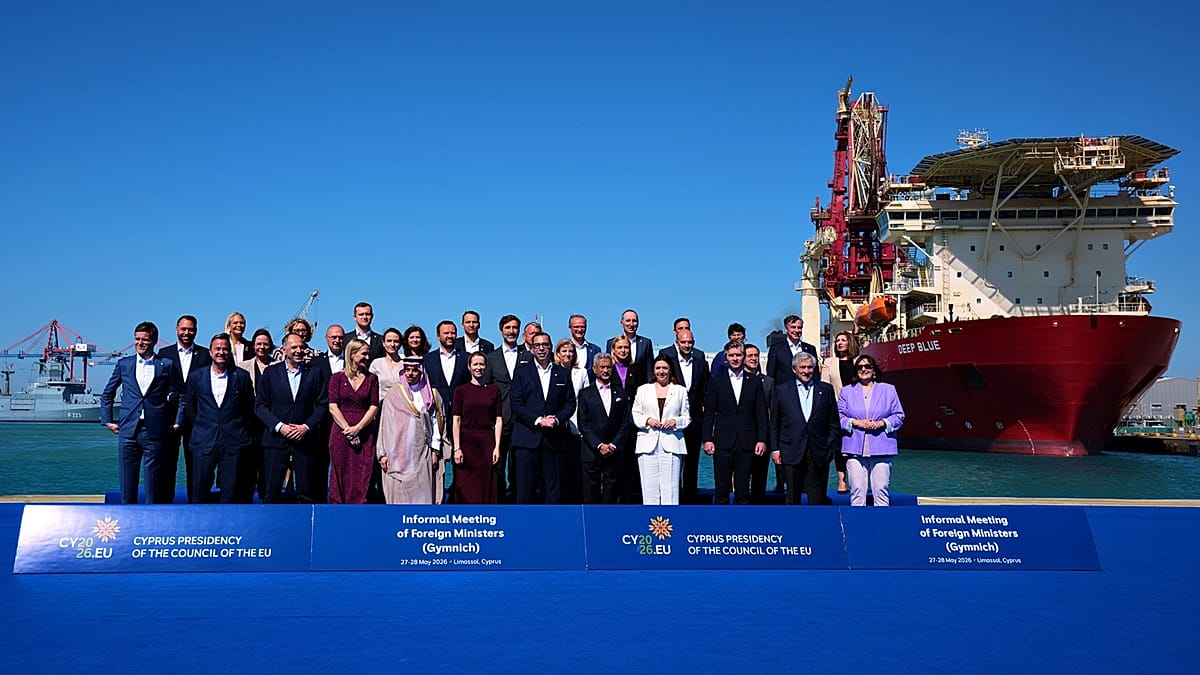
The debate on who should be the special EU envoy for negotiations with the Kremlin is "a trap that Russia wants us to walk into", High Representative Kaja Kallas said on Thursday at an informal meeting of foreign ministers in Cyprus.
For the European Union to engage in direct talks with Russia, the mandate matters more than the person, foreign ministers said as they gathered in Cyprus for an informal meeting, where the hot-button issue was top of the agenda.
Disunity, they warned, would only play into Moscow's hands and undermine Ukraine.
"I find that it is a trap that Russia wants us to walk into, that we discuss who talks to them, and they are already picking who is suitable and who is not. Let's not walk into that trap," High Representative Kaja Kallas said on Thursday morning.
Kallas implicitly referred to the Kremlin's far-fetched suggestion of former German Chancellor Gerhard Schröder as the bloc's chief negotiator. Schröder is a pariah in mainstream European politics thanks in large part to his continued warm relations with Russian President Vladimir Putin and lobbying for several Russian energy companies.
"Negotiations are always a team effort," Kallas went on. "You have good cops, you have bad cops, you have a strategy on how you go to the table. So that is why the substance is much more important than who."
Kallas, who has circulated a confidential paper with concessions and expectations that Russia should fulfil as part of a settlement, suggested the EU approach the negotiations from a "maximalist" stance to counter Putin's own "maximalist" demands.
Asked whether she was interested in becoming the special envoy, Kallas laughed it off.
"I am the High Representative of the European Union, and you can read my job description in the treaties," she said.
"We need to be united, and that is a very important message, that we need to work together as Europe, not as individual members separately. Because individually we are all much, much weaker than we are all together."
Sweden's Foreign Minister Maria Malmer Stenergard echoed her message of caution, saying the EU should avoid being "distracted by men who want to make history".
"We should not run to the negotiation table and let Russia decide the conditions," Stenergard told reporters.
"Instead, we should make sure to put more pressure on Russia and increase the support to Ukraine, and thereby change the calculus to have them really want to come to the negotiation table (and) achieve peace, because that is what we want."
The Netherlands' Tom Berendsen said "the most crucial thing" was for the EU to have a "clear mandate" before picking an envoy, while Spain's José Manuel Albares stressed the need to speak with "one voice" to prevent a cacophony of 27 member states.
"We need to seize the opportunity of the US decision to pause (its) involvement in the negotiation process between Ukraine and Russia," said Belgium's Maxime Prévot. "It is so important to be at the table and to act, not only to watch."
Italy's Antonio Tajani, whose country was among the first to advocate direct talks with Russia, said it would be "impossible to sign a (peace) agreement without Europe".
'One united European voice'
The debate on direct talks, which has been on and off the political agenda since January, gained momentum earlier this month after Ukrainian President Volodymyr Zelenskyy, frustrated by the White House's focus on the Middle East, asked Europeans to take a hands-on role in the process and select a point person for the task.
Among the names being floated for the high-risk job are Finnish President Alexander Stubb, European Council President António Costa, former Italian Prime Minister Mario Draghi and former German Chancellor Angela Merkel.
Finland's Foreign Minister Elina Valtonen said Stubb was "certainly a very qualified person to speak to many people, including Putin", but noted the discussions were still at an early stage and the priority should be on defining the common position.
"I foresee this will be a long process," Voltonen said, calming expectations of a sudden leap forward.
Despite the buzz, Europeans have so far failed to spell out in concrete terms what their involvement should look like. Thursday's informal meeting is meant to help bridge the divisions among member states and advance the conversation ahead of a summit of EU leaders in mid-June.
Looming over the debate is Russia's recent large-scale attack against Kyiv and explicit threat against foreign diplomats based there, which prompted widespread outrage.
Ukrainian Foreign Minister Andrii Shyiiba, who flew to Cyprus for the meeting, said the bloc should focus on "precise, doable steps" that can complement, rather than replace, the US-led peace process – among them the release of civilian detainees, the demilitarisation of the Zaporizhzhia nuclear power plant and the establishment of humanitarian corridors.
"We do not need to start by choosing a person or a group to lead the effort," he said. "We need to clarify the mandate, and it must represent one united European voice."