How Serbia could further complicate Ukraine's EU accession bid
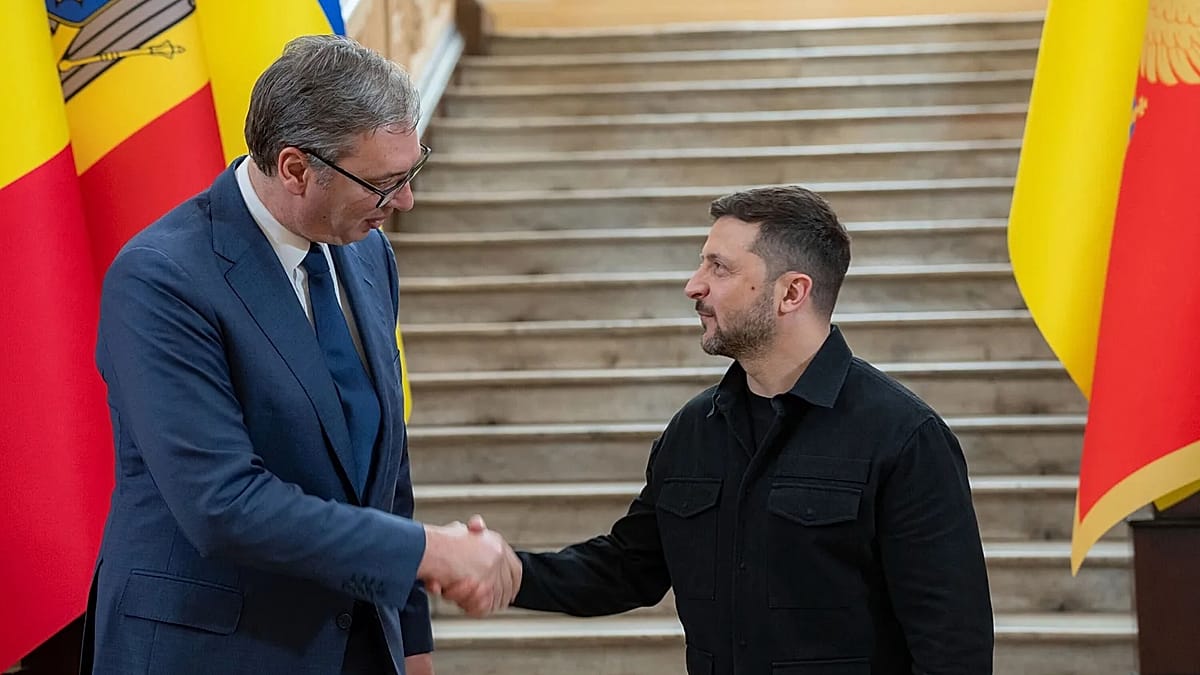
In recent weeks, Ukraine has made slow progress on its path to EU membership, opening two of the six negotiating clusters while still facing resistance to speeding up the process. But now it faces another...
In recent weeks, Ukraine has made slow progress on its path to EU membership, opening two of the six negotiating clusters while still facing resistance to speeding up the process. But now it faces another complication: Serbia.
Ukraine's progress in opening more clusters, in tandem with Moldova, became possible only after Viktor Orbán's crushing electoral defeat in April.
Hungary's new prime minister, Péter Magyar, initiated work to resolve bilateral issues with Kyiv over the treatment of the Hungarian minority in Transcarpathia, but has agreed to open the clusters on the rule of law and foreign policy.
At the same time, Budapest has resisted pressure to open all six clusters at once, preferring a step-by-step approach to make the matter easier to digest domestically after years of anti-Ukrainian propaganda under Orbán.
However, Kyiv's progress toward accession is under growing pressure from EU member states pushing for enlargement progress in the Western Balkans, and in particular for the admittance of Serbia to the bloc.
"There is a thin line between saying that all candidate countries should be treated equally, and starting to link up progress with one geographical area with another one," an EU diplomat told Euronews on condition of anonymity to speak freely.
Earlier this month, the European Commission again put forward the opening of Cluster 3 with Serbia, which has been stalled in the accession process since December 2021 – and once again, eight member states opposed the move.
According to the opponents, Serbia's track record on the rule of law falls short of EU standards, and the country has shown little alignment with sanctions against Russia, maintaining an ambiguous relationship with Moscow.
By contrast, the Commission, under pressure from France, Spain and the so-called "Friends of the Western Balkans," argues Serbia has already made significant progress on a range of reforms that justify moving its accession bid forward.
The Friends of the Western Balkans include Italy, Greece, Slovakia, Austria, Czechia, Croatia and Slovenia.
Progress towards EU membership elsewhere in the Western Balkans, with Montenegro and Albania regarded as next in line to join the bloc, puts pressure on the Serbian government to explain to its own population why its own accession bid remains apparently dead in the water.
At the same time, Serbia is widely considered the most influential country in the region, being by far the most populous and largest economy.
Meanwhile, most of the Friends of the Western Balkans – with the notable exception of Croatia – argue that geopolitical considerations are creating a double standard for Serbia on one hand and Ukraine on the other.
"There is a concern that the Friends of the Western Balkans might couple the accession process of Ukraine and Moldova with opening cluster 3 for Serbia," a second diplomat said. "Moving forward on one front creates pressure to also move on another front."
At the same time, member states broadly agree that enlargement works best when politics gets out of the way and lets the technical work proceed, aware that the more connections are drawn between files, the more complicated the picture becomes.
In the past, Orbán's government appeared to draw a link between Serbia and Ukraine, but the issue of Ukrainian accession was too ideologically charged for any exchange to take place. Now that Budapest is shifting position, that coupling could resurface.
"The Commission is saying a geographical balance should be respected, but Serbia is not helping us [with its domestic reforms]," a third diplomat told Euronews, adding that there was still hope for Cluster 3 to be opened in the autumn.
So far, the coupling has not happened. But as pressure builds to open all negotiating clusters for Ukraine and Moldova by year's end, the voices calling for equal treatment and geographical balance are only likely to grow louder.