NATO leaders to affirm record defence spending as US plans European drawdown
With Donald Trump still seething at allies' refusal to support his war with Iran, European governments hope to ease his anger with record defence spending announcements worth billions of euros.
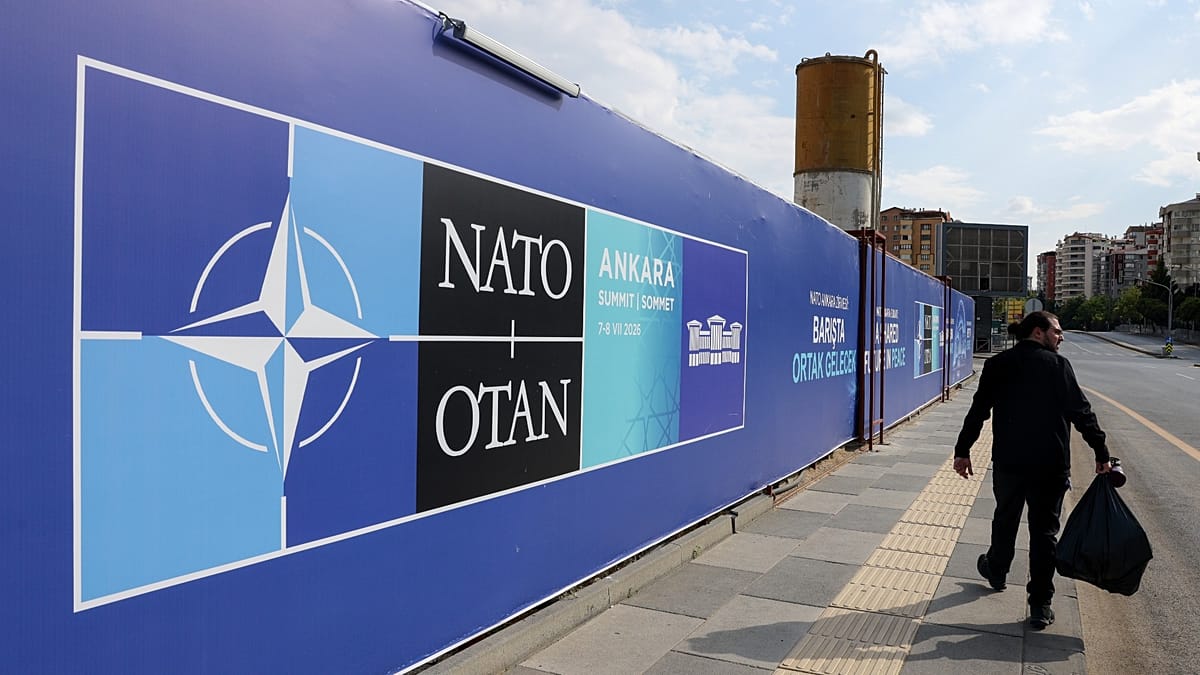
NATO Secretary General Mark Rutte is set to herald this week's summit in Ankara as one of the most consequential summits in the organisation's history by virtue of record defence spending commitments by Europe and Canada, Euronews understands.
The summit may indeed be momentous, marking as its does the beginning of the "Europeanisation of NATO". As the 32 heads of allied governments gather in the Turkish capital, the alliance's top brass are pushing for a tighter focus on the need to transform Europe's already historic spending on defence into capabilities suited to modern warfare and security.
Despite best efforts by Rutte to project unity and strength amid talk of the new age of "NATO 3.0", the spectre of US disengagement from European security looms large. As one NATO diplomat put it in conversation with Euronews, the summit will be informed by several months of "upheaval".
The Trump factor
Just 6 months ago allies took seriously Washington's threat to "take" Greenland, a semiautonomous territory of NATO ally Denmark. Since then, US President Donald Trump has made clear his outrage over what he calls allies' "abandonment" of the US in its war against Iran.
Spain and Italy denied access to military bases for US military personnel involved in the war, though Germany and eventually the UK gave the US certain basing rights. Trump has since denounced European governments as "cowards" and declared the alliance a "paper tiger".
Also at the heart of this week's discussions will be the question of how to end Russia's war in Ukraine given the new momentum Ukrainian forces are showing on the battlefield.
Ukrainian long-range strikes have been consistently effective against Russian oil and gas refineries and other military targets. Ukraine has also made unprecedented advances in both drones and anti-drone technology, both of which have proven crucial in helping its forces turn the tide of the war.
But while Russia is currently on the back foot on the battlefield, NATO countries are under huge pressure to vastly ramp up investment for the future defence of the continent – not least because of the move toward NATO 3.0, a term introduced by the Trump administration describing a transition towards a European-led alliance that does not rely on conventional military support from the US.
The process is already underway, with the US having made a series of announcements withdrawing assets available to European security architecture in recent weeks. Last month, US Secretary of War Pete Hegseth announced a review of US troops in Europe with a view to drawing down force numbers, which currently stand at around 80,000.
The Pentagon also announced significant cuts to the military capabilities it contributes to the alliance in times of war, among them long-range bombers, cruise missile-armed submarines and fighter jets. This leaves European countries working to fill the resulting gaps.
Big spenders
At Tuesday's NATO defence military forum, various allies will announce a series of deals with arms companies in response to Rutte's and the US's demands that the burden for European security shifts to Europe.
Leading the forum, Rutte will make the point that with adversaries such as Russia, China and Iran producing weapons at a fast clip, NATO-aligned industry has to match the pace with new factories, stronger supply chains and more innovation.
Euronews understands among two of the announcements expected are new contracts worth more than $1 billion (€880 million) for 200 Patriot missiles for Poland, and another $1.15 billion (€1 billion) deal for precision-guided artillery shells.
Other contracts worth $12.8 billion includes Arctic satellite communications alongside the GlobalEye, Airbus and Triton systems will also be announced.
Meanwhile, Rutte will point to the increase of $139 billion of extra core defence expenditure by Europe and Canada in the last year alone, representing a 20 percent increase.
He’ll undoubtedly point to what he calls “Trump’s trillion”: a massive injection of defence spending by Europe and Canada “since the first Trump administration”, as he frames it, implying the increase is specifically the result of Trump's pressure.
Speaking to Euronews ahead of the summit, Rasmussen Global CEO Fabrice Pothier said the problem is not cash, given allies have committed to spending 5 percent of their GDP by 2035 on defence. The point, he said, is that governments and industry alike are yet to prove they are willing to take risks or produce what is needed for today’s evolving theatres.
"You have some defence manufacturers in Germany, France and Spain “sitting comfortably with these national contracts and are not really getting out of their comfort zone," he said.
“And they are producing systems that are maybe very advanced, very sophisticated, but way too complex to actually be able to produce fast enough and respond to the need that exists now," he said.
“Can we use this famous trillion dollars to actually produce enough systems that will allow us to actually keep adversaries like Russia or Iran at bay? This is the key question."
'An unsustainable position'
Meanwhile, former US ambassador to NATO Kurt Volker told Euronews the alliance needs to take lessons from Ukraine when it comes to innovative, cost-effective solutions.
The US burned through billions of dollars of expensive Patriot air defence systems in Iran, often responding to far less expensive Shahed drones and other cheap attack systems.
“Ukraine has developed high-tech, low-cost systems that are very effective,” said Volker. “For example, if you spend a Patriot missile, it costs a million dollars to shoot down a drone that cost $30,000. That's an unsustainable position to be in."
“Even though the Patriot's a great system, you can't use it for that. You've got to find low-cost ways to do defence against drones as the Ukrainians have done,” Volker said.
Less time than usual has been allocated to this summit's political discussion, and the overall schedule of the event (including the industrial forum) has been deliberately shrunk to two shorter days. It's believed this is an attempt to keep Trump interested and perhaps make him more willing to attend.
Trump told reporters in the White House in June that he was only attending the summit because Turkish President Recep Tayyip Erdoğan is hosting.
“If the summit was not taking place in Turkey, I don't think I would have gone to it,” he said on the sidelines of a meeting with Rutte.
The truncation is also an attempt to minimise the risk of awkward confrontations or statements by Trump that would damage and undermine the alliance further.
Nonetheless, the US appears to have signed up to an "iron-clad commitment" to Article 5, NATO's cornerstone mutual defence clause. The final draft of the summit's declaration, seen by Euronews, includes a statement to that effect signed off by all 32 allies.
However, the draft declaration is subject to change and will require endorsement from leaders present in Ankara – and Trump has frequently put his commitment to mutual defence in doubt.