Fight for water: Dried-up lakes and mass fish deaths at one of Hungary's largest fish farms
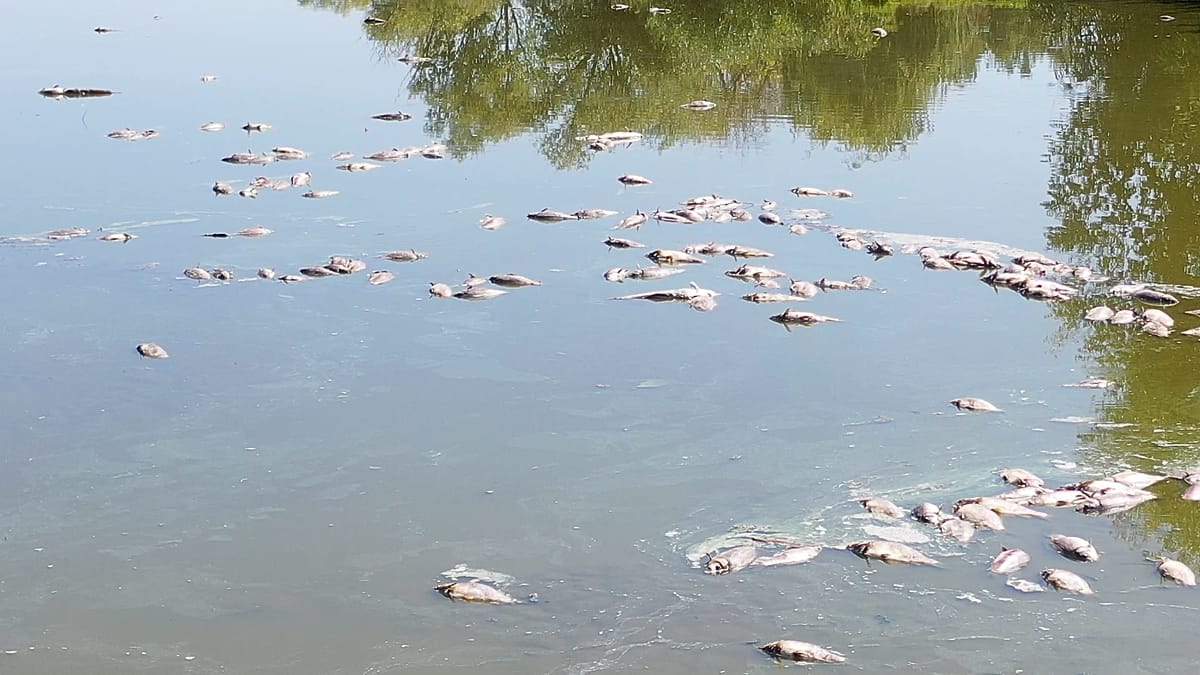
Several hundred tonnes of fish died in August in one of Hungary's largest fish farm complexes at Rétimajor, south of Budapest. This fishpond system, with a water surface of around 800 hectares, is what...
Several hundred tonnes of fish died in August in one of Hungary's largest fish farm complexes at Rétimajor, south of Budapest.
This fishpond system, with a water surface of around 800 hectares, is what remains of the former Sárrét marshlands.
Its current owner, Ferenc Lévai, privatised it in 1994 and has since been running it as a continuously developed, integrated agri-tourism estate, although its main source of income is still fish farming.
The fishpond system, made up of shallow, nutrient-rich lakes of varying depth, reedbeds, islands and muddy shorelines, provides a uniquely concentrated and hard-to-replace habitat for water birds.
The Rétszilasi Lakes and their surroundings are among the most strictly protected areas in Europe. In addition to their Natura 2000 status they are, under the Ramsar Convention, a wetland of international importance.
Fish living in just 30 centimetres of water
The owner and chief executive of Aranyponty Zrt., Ferenc Lévai, believes the problem stems from the water management authorities, in this case the Middle Danube Water Directorate, holding back water above the fishponds for irrigation purposes.
"In our view, because of a very poor water distribution regime, very little water reached us here; we could not even reach the water level that Hungary's most protected area would be entitled to, the ecological water level, which stipulates at least 50% water across the whole water surface," Lévai told Euronews.
"We were unable even to maintain that 50% level: the extent of evaporation and the inadequate water supply led to a catastrophe."
"Around 150 hectares of our area are already dry, on another roughly 400 hectares the fish are eking out an existence in 30-40 centimetres of water, because they are not really living, and it is only on about 200-250 hectares that we have more than half the normal depth, where proper fish farming can take place," he added.
Although they did everything they could in Rétimajor to minimise the damage, 300 to 350 tonnes of fish still died, which according to Lévai's calculations means a loss of around 400 to 500 million forints (€1.1-1.4 million).
The low water level meant the water warmed up more easily, which accelerated gas formation. Gases released from the sludge then poisoned the fish.
Lévai says an even greater problem is that the drying out has put protected wildlife at risk, as the fishpond system is home to numerous rare amphibians and birds.
Authority denies witholding water
Euronews contacted the Central Transdanubian Water Directorate and they said they had prepared for the drought situation, but "the summer heat-dome phenomenon, which caused an emergency situation across the whole country, was not yet known at that time."
From 26 July they had to impose regional water restrictions, under which use of water by fishponds could be limited by at most 20% and irrigation by 60%. They said they complied with this rule and did not withhold water.
On the contrary, in August they released 1.18 million m3 of water over two weeks from the Fehérvárcsurgó reservoir, which largely contains Székesfehérvár's treated sewage, to replenish the fishponds.
According to the water authority there is currently barely more water than that left in the reservoir, 1.4 million m3.
The authority estimates that in the extreme heat as much as 100,000 m3 of water a day may have evaporated from the 800-hectare water surface and alongside this the water use of upstream irrigation, restricted under the rules, is negligible.
"In our view, meeting (restricted) irrigation demands does not materially affect the very substantial volume of water requested to compensate for evaporation losses from fish-farming water use," the Central Transdanubian Water Directorate told Euronews.
"The emergency situation may not have been caused by the abstraction of irrigation water, but by the oxygen-depleted state of water heated up by the heat."
Looking for solutions
Ferenc Lévai has previously told Euronews that he is not looking for someone to blame, but for solutions.
He believes the answer lies in crop-growing businesses building their own reservoirs, storing water during wetter periods and, in times of scarcity, not having to compete for supplies, so that livestock farming and wildlife can come first.
The local water authority also concluded its letter by saying that "the Central Transdanubian Water Directorate is examining the hydrological status of the water system in a study, with particular regard to water reserves committed by users holding water-management operating licences within the system."
"The aim of the study is to determine how water demands can be met in future. It is expected that permits and operating practices will need to be reviewed."