Tuesday briefing: Inside the right’s heated climate-denial debate
In today’s newsletter: A small chorus of right-leaning critics are trying to convince politicians that climate action is deeply unpopular, downplaying its seriousness in the process
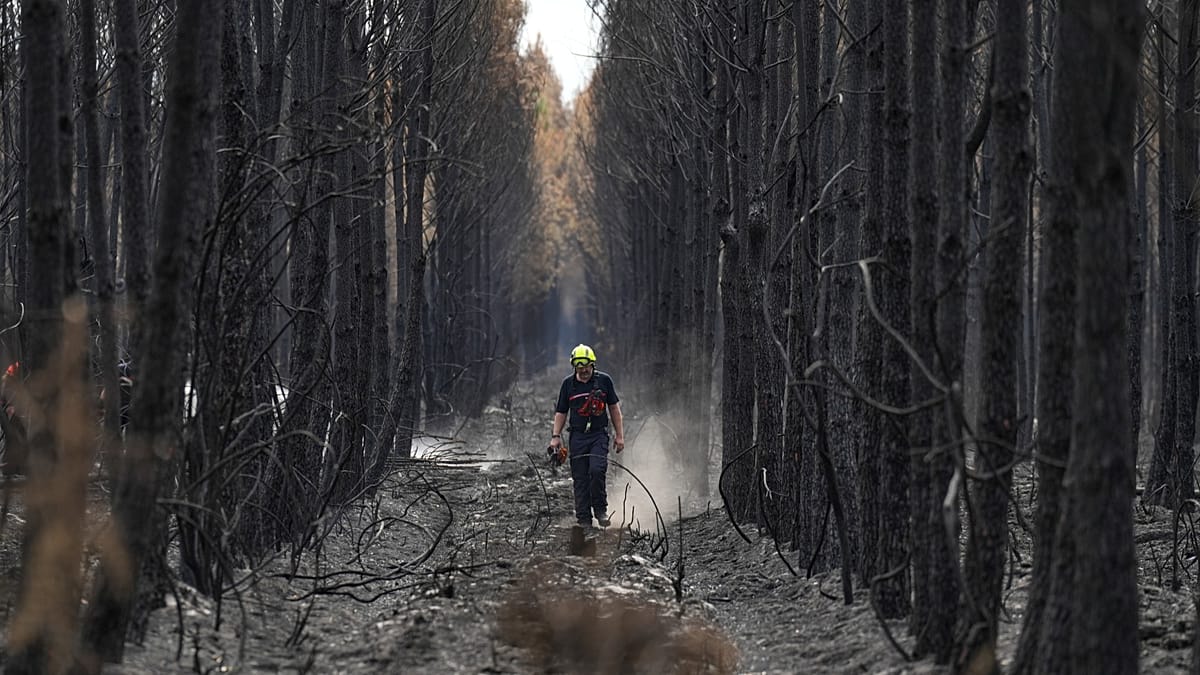
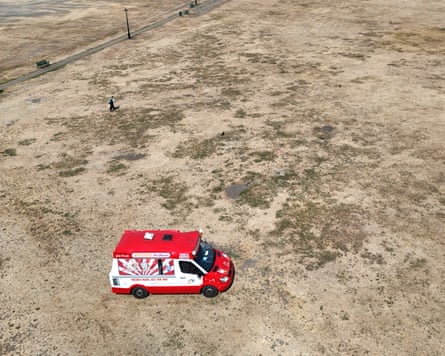
Good morning. Half of England and all of Wales are officially in drought, wildfires have burned through parts of the Cairngorms, Suffolk and the Isle of Wight, and reservoirs are running low. Farmers have warned that there could soon be food shortages, and the Royal Horticultural Society is considering moving its hydrangeas to cope with the heat. Many people are now asking a question rarely associated with British summertime: when will it rain?
The Guardian has been covering how the climate crisis is supercharging wildfires in Europe, the impossible choices firefighters face about which places to save, the number of people who have died in England due to heat, and the air conditioning haves and have-nots. Had you been reading another newspaper, you may have come away with a very different impression of this extreme weather.
Over the last week, a string of articles, mostly in the Telegraph, suggested that Britain should give up on net zero and learn to live with its newly Mediterranean climate; that wildfires had been exacerbated by environmental groups; and, rather grandiosely, that climate “catastrophism” is a “leftist weapon” designed to “destroy capitalism”.
In a week when England entered its fourth heatwave of 2026, this line of argument might have seemed more than a little out of touch. But it reflects how climate deniers are reconfiguring their narratives in the face of an indisputable crisis. I spoke to Bob Ward, policy and communications director at the Grantham Research Institute on Climate Change, about how a minority is shaping the political debate and trying to thwart the transition, even while most people want to see more action on climate. First, here are the headlines.
Five big stories
-
UK news | Rapists, child sexual abusers and groomers will be excluded from early release plans to ease critical prison overcrowding in a major intervention by Andy Burnham.
-
UK politics | Nigel Farage has made his clearest admission that he was in talks to return to lead Reform UK months before the 2024 general election, casting fresh doubt on previous claims that he was not involved in politics when he received a £5m gift.
-
Spain | A growing chorus of voices has accused Morocco of helping to fuel the crisis in Ceuta, with the leader of the Spanish enclave describing last week’s border crossings as an attack on Spain’s territorial integrity that was seen as being “if not orchestrated, at least encouraged or permitted by Morocco”.
-
Middle East | New talks between Washington and Tehran are the “last chance” for Iran to forge a deal and avoid an escalation of US strikes on the country, Donald Trump said on Monday.
-
Environment | A plastic manufacturer in the north of England is facing potential legal action over emissions of benzene, a carcinogenic chemical with no safe level, the Guardian can reveal.
In depth: From ‘lukewarmers’ to ‘daft’ arguments – how climate deniers are reshaping political discourse
As the world heats up, denying the reality of climate change has become implausible. “This is no longer a matter of speculation: the wildfires of Europe, pitiless and persistent, are the way we live now,” the Telegraph’s Tim Stanley wrote recently in an article persuading the right to “get serious” about the subject.
Instead, a tendency to downplay the seriousness of the crisis has emerged. In this week’s issue of the Spectator, Matt Ridley, a former Conservative peer whose ancestral estate features two coalmines, suggested that a “cult of rewilding” – whose converts allegedly include the RSPB and National Trust – is connected to the risk of wildfires in England (this suggestion was repeated in another Spectator piece on Saturday, £). The Spanish far-right party Vox recently made a similar argument about wildfires in Spain, blaming them on a failure to clear rural areas and invest in firefighting services, rather than on the climate crisis (read Sam Jones’s piece on Spain’s climate deniers here).
Another line of argument is to acknowledge that the climate crisis is real, but insist that nothing can be done to address it. “The war against global warming has been lost, with only grievous collateral damage to show for it,” Allister Heath, the Sunday editor of the Telegraph, wrote last week (£) in a piece arguing that people in Britain should learn to love their new Mediterranean climate, and take inspiration from other “blossoming” hot regions, such as Dubai and Israel.
Who are the ‘lukewarmers’?
“All of this commentary reflects a battle on the right between climate sceptics – people often referred to as ‘lukewarmers’ – versus the Conservative voters who actually care about conservation, nature and so on,” Ward told me. The term “lukewarmer” was popularised by Ridley, who is affiliated with the Global Warming Policy Foundation, a campaigning body that has spent decades undermining climate science, and its campaigning arm, Net Zero Watch. “Lukewarmers accept the reality of human-made climate change, but believe the impact of it won’t be as big as people argue, and that policies involved in mitigating these impacts will be expensive and difficult,” Ward says.
Net zero has become a particular focus for them. Basic physics dictates that reaching net zero is necessary to stop global temperatures rising even further. Although it was Theresa May, a Tory, who committed Britain to reaching net zero emissions by 2050, voices in the rightwing press have sought to paint the target as a bureaucratic conspiracy devised by lanyard-toting Labour wonks and enforced on an unsuspecting population, spreading “desolation across the loveliest countryside in the world”, as one writer recently put it (£).
If Britain doesn’t contribute that much to global emissions, does net zero even matter?
Another common refrain (I counted at least five articles about the climate crisis published in the Telegraph last week that made variations of this argument) is that, since other countries emit far more carbon than Britain, striving for net zero in the UK is, at best, an irrelevance and, at worst, a decision that will make the country much poorer than other industrialising nations. As the “anti-woke” libertarian podcaster Konstantin Kisin said in a speech to the Oxford Union in 2023, the future of climate change will be decided by “poor people in Asia and Latin America who could not give a crap about saving the planet … because they are poor”.
People who make this argument often point to China, which produces about 35% of global carbon dioxide emissions. Since the UK produces less than 1%, why should the UK bother decarbonising when it’s not even responsible for that much damage? “That’s a totally daft argument,” says Ward. “If more than 99% of the emissions damaging the UK come from other countries, then we have a vested interest in persuading those countries to accelerate their transition. And we’re not going to persuade them by dragging our feet.”
In fact, China has massively expanded its renewables sector, and has a far higher proportion of electric cars on the road than in Britain. Meanwhile, commentators in Britain are trying to forestall the transition by making misleading arguments about China.
How is this shaping politics?
The 2024 Conservative manifesto committed to reaching net zero by 2050, but Kemi Badenoch ditched the target, perhaps hoping to win back Reform voters (a month before U-turning on the pledge, Badenoch spent a week on a “retreat” hosted by the Tory donor and chair of Net Zero Watch). And among the reported reasons why Ed Miliband didn’t get the role of chancellor were his commitment to net zero and his opposition to new exploration licences in the North Sea.
Most British voters are in favour of net zero. Despite this, media coverage of it is more than twice as likely to be negative than positive. This could be helping to drive a false perception that climate action is overwhelmingly unpopular with voters, encouraging MPs to significantly underestimate public support for these policies, and overestimate opposition.
In other words, a small chorus of climate sceptics aren’t trying to represent public opinion or persuade us to embrace Mediterranean summers, so much as convince politicians that climate action is deeply unpopular.
For more on extreme weather and the climate crisis, sign up to our free (and very good) weekly email Down to Earth. Click here to subscribe. It features an exclusive weekly piece from our top climate crisis correspondents, as well as a digest of the biggest environment stories.
What else we’ve been enjoying

-
I’ve had a sneak peek at the Guardian’s new This Is India newsletter, which launches this morning (you’ll be able to read it online imminently), and Niha Masih’s dispatch from the frontline of the Cockroach movement is essential reading. Sign up for This Is India here to read future editions first. Sam Coare, newsletters team
-
I have fond memories of visiting Blockbuster and arguing with my brother over which VHS our parents would rent us for the weekend, so I loved this piece about the lost civic life of video rental shops. Hettie
-
Audacious when they come off, humiliating when they don’t … this celebration of 50 years of the Panenka shows how thin the line is between footballing genius and stupidity. Sam
-
It’s worth listening to this morning’s episode of Today in Focus with Anna Isaac about her latest story on Nigel Farage’s funding scandals. Her reporting on this has been unmissable. Hettie
-
The Guardian’s annual invertebrate of the year competition is back! Can the reigning champion Milnesium tardigradum defend its spineless crown? The reveal of the 10-strong shortlist is under way, with today’s spotlight turning on the common woodlouse. Sam
after newsletter promotion
Sport
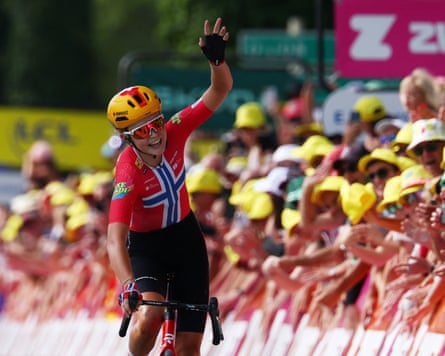
Tour de France Femmes | Sigrid Haugset, the Norwegian national champion, shocked the established order in the Tour de France Femmes by breaking away to take the overall lead.
Fifa | The English FA and Serbia’s have followed Wales’s and Finland’s in dropping support for Gianni Infantino’s re-election bid as Fifa president.
Tennis | Emma Raducanu will miss the US Open because of the stress fracture in her right leg that she sustained during the grass-court season and forced her to pull out of Wimbledon.
The front pages
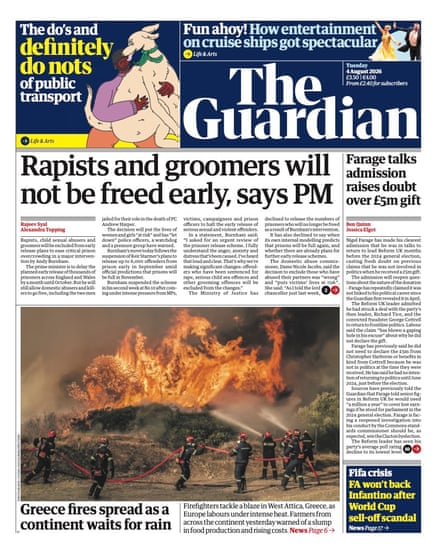
“Rapists and groomers will not be freed early, says PM”, is the Guardian’s front page today, while the Telegraph writes “Pc Harper killers will still be freed early” and the Times says “Killers but not rapists to be given early release”.
The Mail has “Athens suitcase murder suspect”, the i Paper leads on “Driest July in 190 years”, the FT leads on “Apple launches legal challenge to new demand for data access”, and the Mirror splashes “Farage’s sinking ship”.
Elsewhere, the Express goes with “Two jabs a year to target ‘silent killer’” and Metro has “15st lighter … and jabs are just the job”.
The Latest

How Ceuta migrant crisis exposes divisions within Europe
Dozens of people died attempting to reach the Spanish enclave of Ceuta after an estimated 50,000 crossed from Morocco last week. The incident has led to a political crisis in Spain and criticism from EU countries.
Lucy Hough speaks to the Guardian’s European community affairs correspondent, Ashifa Kassam – watch on YouTube.
Cartoon of the day | Rebecca Hendin

The Upside
A bit of good news to remind you that the world’s not all bad

When she was a teenager, Amy Annette spent summers wrapped up in a black cardigan and was often asked: “Aren’t you hot in that?” She wasn’t hiding from the heat, but from years of feeling ashamed and insecure about her arms. Last month, after decades of avoiding sleeveless tops, the heatwave pushed Annette to bare her arms in public for the first time, at 37 – prompting her to rethink the body standards that had shaped her wardrobe, and her confidence, for decades. “And if it gets any hotter,” she says, “I’m wondering what other internalised standards I can sweat out.”
Sign up here for a weekly roundup of The Upside, sent to you every Sunday
Bored at work?
And finally, the Guardian’s puzzles are here to keep you entertained throughout the day. Until tomorrow.