Explosive drone: Why Leipzig/Halle airport keeps becoming a target for sabotage
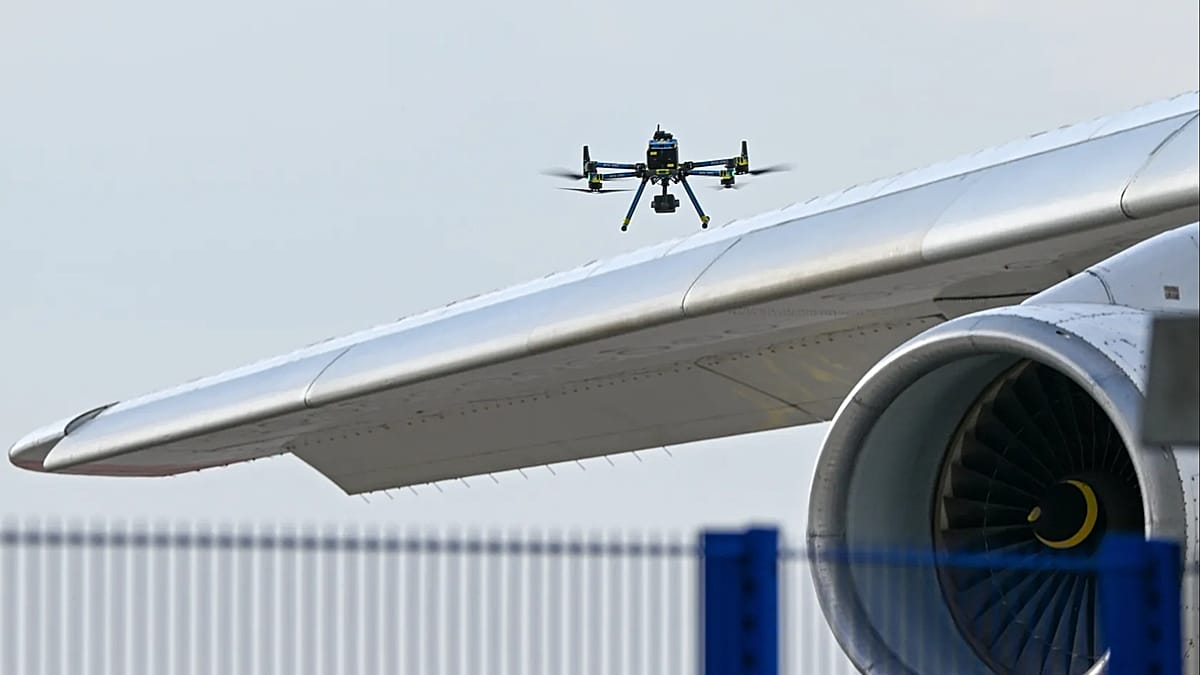
Leipzig/Halle is one of Europe’s most important cargo airports and a key hub for military transport. After the latest incident, the question arises again: why does this site repeatedly become a focus of suspected sabotage?
After a drone rigged with explosives was found at Leipzig/Halle Airport, Federal Interior Minister Alexander Dobrindt spoke of a "hybrid attack scenario." Following a situation briefing with the investigating authorities, he said: "This is a new level of threat."
Drones have already been spotted several times in the vicinity of sensitive facilities in Germany. In the interior minister's assessment, however, a drone equipped with explosives represents a new stage of escalation.
According to media reports, the drone contained a highly explosive mixture of explosives. The fact that it did not detonate was apparently only because the detonator had torn off.
Dobrindt assumes that amateurs were not behind the incident. He also said that "foreign powers" could be involved, without naming a specific country.
Drone incidents over several years
The latest incident is part of a series of security breaches at Leipzig/Halle Airport. In recent months there have repeatedly been unauthorised drone flights in the area. The site has for some time been among the airports most affected in Germany.
Figures from German air traffic control show that 151 drone incidents were recorded nationwide in 2023. With 21 cases each, the airports in Frankfurt and Leipzig/Halle were among the locations most targeted. Time and again, flight operations had to be temporarily suspended for safety reasons.
Attempts at sabotage have already occurred there as well. In July 2024, according to investigators, suspected perpetrators are believed to have sent four parcels fitted with incendiary devices via the parcel services DHL and DPD.
The consignments were intended to catch fire during the flight. In Leipzig, however, one of the parcels ignited in a sorting centre before departure. The then president of the Federal Office for the Protection of the Constitution, Thomas Haldenwang, later stated that the consignment could have caused a plane crash.
So why is Leipzig in particular repeatedly targeted? There are several reasons.
Critical infrastructure and military hub
Leipzig/Halle Airport is one of Europe's largest cargo hubs and forms part of Germany's critical infrastructure. Its role as an international air freight centre is especially important. DHL itself describes the site as the "heart of a global logistics chain".
According to the company, more than 2,500 tonnes of freight are handled there every day. Each year the airport records around 23,600 flight movements in cargo traffic. Night after night, thousands of tonnes of consignments are unloaded, sorted and reloaded.
The airport also has military significance dating back to the early 2000s.
During the Afghanistan mission, Leipzig/Halle at times developed into an important military hub.
Hundreds of thousands of US soldiers used the airport for stopovers. The Bundeswehr also transported tanks, helicopters and other military equipment from there.
NATO and EU use Antonov aircraft based in Leipzig
Russia's full-scale invasion of Ukraine in 2022 has further increased the site's strategic importance. Leipzig/Halle Airport is where the Strategic Airlift International Solution (SALIS) airlift programme, managed by the NATO Support and Procurement Agency (NSPA), is operated.
Through this cooperation, nine NATO countries currently secure access to Antonov AN-124-100 transport aircraft for particularly heavy or oversized cargo that cannot be carried by smaller military transporters such as the Airbus A400M.
The basis is a five-year contract signed in 2021 between the NATO Support and Procurement Agency (NSPA) and the company Antonov Logistics SALIS, which is headquartered at Leipzig/Halle Airport.
The agreement guarantees the participating countries access to several Antonov aircraft which, depending on urgency, can be ready for deployment within a few days. The planes are used for NATO, EU and national missions, regularly transporting military hardware and other large-scale cargo.
Leipzig/Halle is therefore not only home to one of Europe's most important freight hubs, but also a key node for strategic heavy-lift transports by the participating NATO states.
Since the start of Russia's war of aggression against Ukraine, Leipzig has gained additional importance. Because regular operations of the Antonov fleet in Ukraine are severely restricted, the airport has become one of the most important bases of Antonov Airlines outside Ukraine. Maintenance facilities are located there, and a new large maintenance hangar is also being built.
Security expert Nico Lange therefore places the latest incident, in an interview with the Germany broadcaster ZDF, in the broader context of Russia's hybrid warfare against Germany. In addition to drone overflights, this includes sabotage, arson and cyberattacks. A concrete link to the current incident has not yet been officially confirmed.
Germany steps up drone defence
The growing number of drone incidents is now occupying numerous European states. Above all in the Baltic region, more incidents have been recorded in recent months. At the end of May, during a visit to Vilnius, European Commission President Ursula von der Leyen stated that Russia was deliberately using drones to test the security of the European Union's airspace. This, she said, was part of a strategy to destabilise democratic societies.
Germany has therefore gradually expanded its defensive measures in recent months. Federal Interior Minister Dobrindt had already demanded that drones be detected, intercepted and, if necessary, shot down more consistently in future. Since October 2025, the federal police have been allowed to shoot down drones under certain conditions.
A specialised drone defence system has now also been installed at Leipzig/Halle Airport. Nevertheless, Saxony's Interior Minister Armin Schuster speaks of an "arms race" between attackers and security authorities.
Despite the new powers, experts still see a need to catch up. Drone expert Christian Kaiser explained on ZDFheute that actually shooting down a drone is only the final step. First, a drone has to be detected at all – for example with frequency scanners, cameras or radar systems.
Only then can it be assessed whether there is indeed a threat and which measures need to be taken.