
Inside Germany's beer obsession, from a 5,000-metre beer pipeline to home-brewing championships
Temperatures are slowly climbing, the days are getting longer, and summer is just around the corner. For an evening with friends or a barbecue with the World Cup, the right drink is key. Germany prides itself...
Temperatures are slowly climbing, the days are getting longer, and summer is just around the corner. For an evening with friends or a barbecue with the World Cup, the right drink is key.
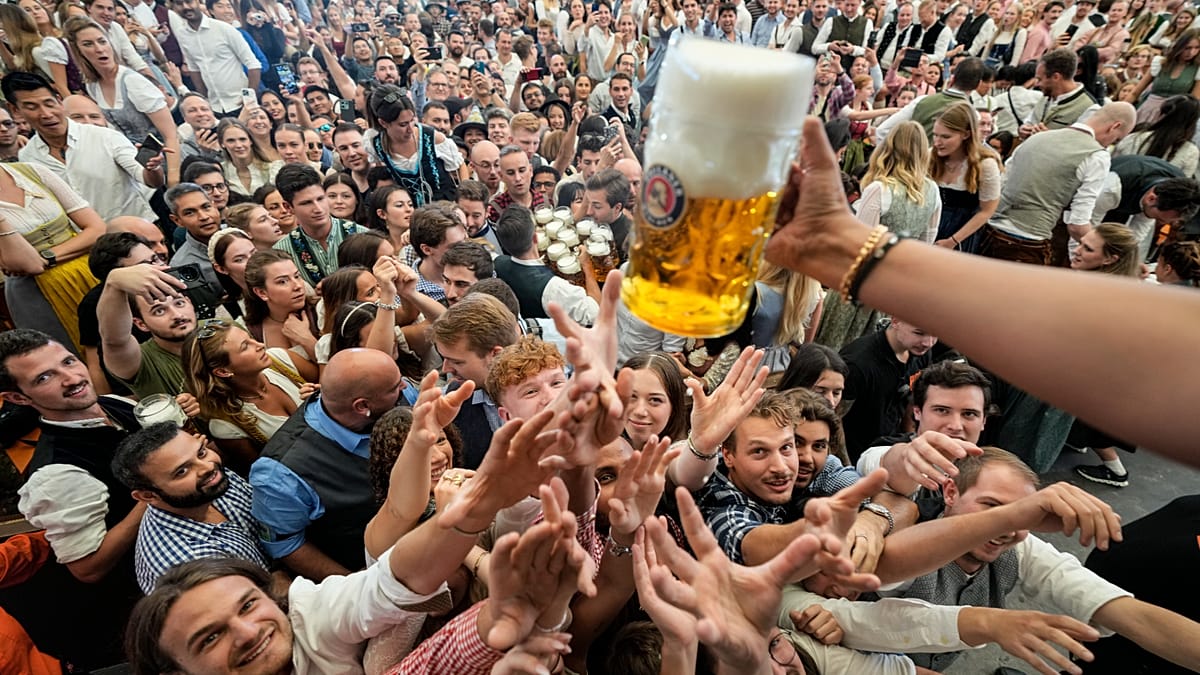
Germany prides itself on being a nation of beer. Oktoberfest attracts millions of visitors annually, and last year around 6.5 million maß (a large glass mug containing exactly 1 litre of beer) were served at the counters.
To dig a bit deeper into Germany's love affair with beer, Euronews has taken a look at some of the country's most interesting beer ideas.
Home-brewing championships
Germany even has its own home-brewing championship.
Last year's winner was Jan Mordhorst, who beat out around 200 other competitors to claim the title.
"Altbier is a demanding style," the 2025 winner said at the award ceremony. The recipe is now freely available online so other home brewers can recreate it.
Mordhorst also had some tips for anyone thinking of following in his footsteps.
"Ideally, the wort should be fermented in a cask or pressure fermentation tank," he said. "Once maturation is complete, the beer is carefully drawn off from the top using a floating dip tube and then bottled under counter-pressure. This produces an especially clear beer."
His prize: 400 litres of his own beer and a non-cash prize of his choice, such as an upgrade to his brewing kit or his own dispensing system worth 2,500 euros, donated by the competition organiser, Störtebeker Braumanufaktur. The beer will go on sale in spring.
In 2026, to mark the 10th-anniversary edition, the competition will be on beers in the wheat bock style.
Microbreweries
Craft beer originally refers to artisanal brewing rather than large-scale industrial production.
These days, however, the term also often covers unconventional blends of hop and malt varieties.
It is a trend that has come over from across the Atlantic, but since the 2010s, the craft beer scene has been booming in Germany as well.
Craft beer is meant to go beyond the confines of pilsner, Helles and wheat beer, and to try to reinvent beer as we know it.
It is therefore often brewed in smaller batches with comparatively more hops, often pushing up the price of the final product.
Limited-edition beers can fetch especially high prices. The Japanese brewery Sapporo, for example, offers beer brewed from the offshoots of seedlings of very special barley grains: they had orbited the Earth on the International Space Station ISS.
Only 250 six-packs of "Sapporo Space Barley" were produced, selling for 110 US dollars each (around 95 euros). That works out at about 12 euros per bottle.
From Germany, there is also Gänstaller Bräu from Hallerndorf in Bavaria, whose Gänstaller Onyx – Imperial Stout comes in at a hefty 20 euros per litre.
On the BeerTasting app, where users can rate particular beers, it is described as particularly full-bodied, bitter, opulent, and almost oily.
Traditional monastic beer
Early beer brewing often took place in monasteries, where it became a part of everyday life, as the Andechs monastery explains on its website.
It is assumed that the Benedictine monks who moved to Andechs in 1455 to establish the monastery already brought extensive knowledge of brewing.
According to the Andechs monastery, one of the later Benedictines, Willibald Mathäser, summed up the importance of the drink as follows: "Here in Bavaria, beer is not a luxury but a staple food. It is made from grain, yeast and water, just like bread."
Even though most breweries are now run as secular businesses, there was a time when beer was handed out free of charge to pilgrims passing through.
Today, monastic beers such as those from the Andechs monastery or, for example, Weltenburg Abbey, are somewhat more expensive than standard industrial pilsners and often marketed as premium products.
Many monasteries offer tours and guided visits, and you can often still stop off there for a drink or a meal.
A 5,000-metre beer pipeline
For many, football without beer would be only half as enjoyable. So luckily for those people, the Veltins brewery came up with something special for the 2006 World Cup.
A 5,000-metre beer pipeline that ran from the Veltins-Arena in Gelsenkirchen to supply the stadium with freshly poured beer.
According to the stadium, four cooling centres below the arena stored 52,000 litres of beer. Instead of transporting thousands of individual kegs through the stadium, the beer flowed directly through underground pipes to the taps in the stands.
From docking points, it was fed into the dispensing systems before ending up in fans' glasses, allowing tens of thousands of litres of beer to be served on each match day.
In 2006, this was still somewhat of an unusual idea in Europe. But nowadays, many modern large stadiums use central tanks and pipe systems.
Germany's most expensive bottled beer
One of the most exclusive and expensive bottled beers is the so-called "Schorschbock 57."
The brewery behind it, Schorschbräu, unsurprisingly hails from Bavaria, the federal state with the highest density of breweries.
What makes this beer special is the Eisbock process.
Here, it is not hops, as is often the case with beer, that take centre stage, but malt aromas.
Eisbock beers are also notable for their very high alcohol content – Schorschbock 57, for example, contains 57% alcohol. "Small sips are advisable," the Schorschbräu website recommends. Thanks to its liqueur-like strength, opened bottles will keep for several weeks.
Online, it's sold for around 747.50 euros per litre. Miniature bottles containing 0.04 litres are available to buy for 30 euros.
Editor's note: This article contains information about alcoholic beverages. Consuming alcohol can pose health risks. Responsible drinking is recommended.