Drone attack on UAE's Barakah more dangerous than Zaporizhzhia, IAEA chief tells Euronews
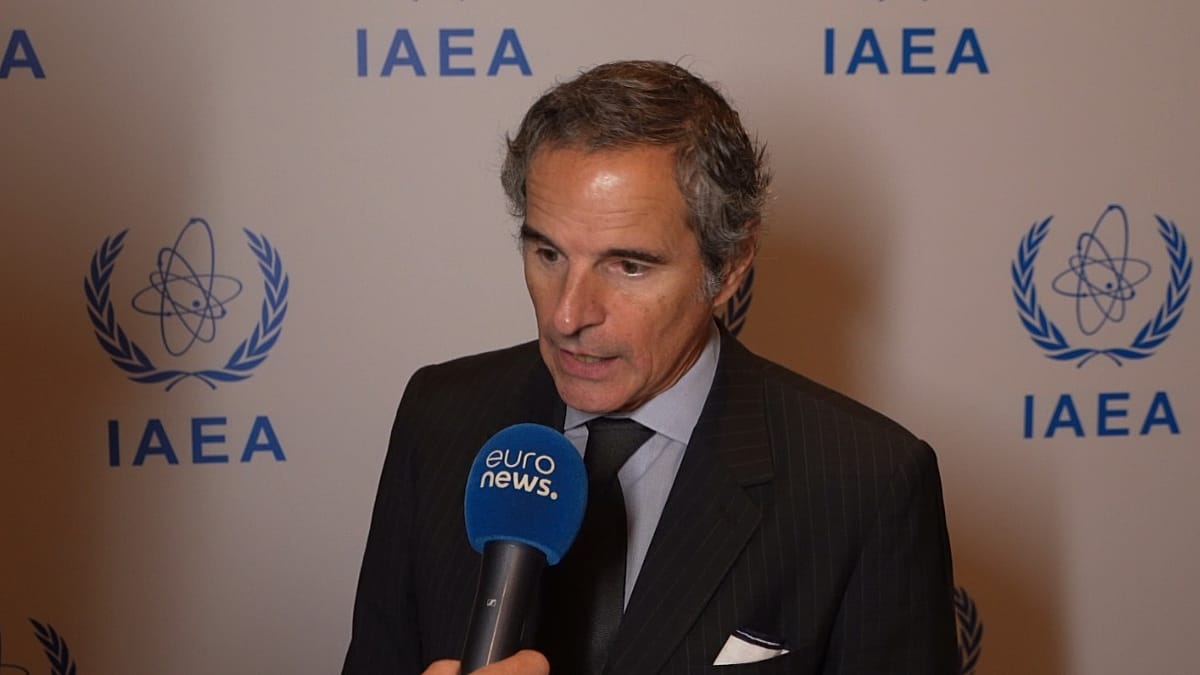
Rafael Grossi told Euronews the drone strike on the operating UAE nuclear plant posed greater risks than Zaporizhzhia because its reactors were live at the time of the attack, warning that tonnes of nuclear material could have triggered a radiological accident with "very, very serious consequences".
Last month's drone attack on the UAE's Barakah nuclear power plant was potentially more dangerous than the situation at Ukraine's Zaporizhzhia facility because the reactors were operating at the time, International Atomic Energy Agency (IAEA) Director General Rafael Grossi said.
Speaking to Euronews after visiting the plant in the western part of the Gulf country, the head of the IAEA described the attack as an "extremely serious and irresponsible act" and warned of the risks posed by targeting civilian nuclear infrastructure.
"A nuclear power plant, apart from being a very important part of the energy infrastructure of a country, is a place where you have thousands, tonnes of kilograms of nuclear material which could trigger a radiological accident with very, very serious consequences," Grossi said.
Grossi said the incident could be compared to the situation at Zaporizhzhia, Europe's largest nuclear power plant, with one major difference.
"Although it's a very serious situation, the IAEA is working there, and it's a very delicate problem in our hands, the reactors are in what we call a 'shutdown'," Grossi explained.
"So, they are not running, they are not operating. Barakah is operating. So, this makes it potentially even more dangerous."
Russian forces occupied Zaporizhzhia NPP in March 2022, shortly after Moscow launched its full-scale invasion of Ukraine, and have controlled it since.
The IAEA established a permanent monitoring presence at the site in September 2022 after repeated incidents involving shelling near the facility and interruptions to its external power supply, which is required to keep the cooling systems running.
All six of Zaporizhzhia's reactors have been in cold shutdown since late 2022. The IAEA has repeatedly warned that the safety margins at the plant are being eroded and that the risk of a nuclear accident, while not imminent, cannot be ruled out.
The comments place the drone attack — which UAE authorities previously said was determined to have come from Iraq — among the most significant nuclear safety concerns currently facing the international community.
UAE Deputy Chairman of the Board of Management of the Federal Authority for Nuclear Regulation Hamad Alkaabi described the attack as a serious escalation and a violation of international law.
"Obviously, attacking a nuclear power plant is a serious escalation. It is something that is taboo internationally because of the potential consequences that come from the potential release of radiation to the public and the environment," Alkaabi said.
He added that attacks on operational nuclear facilities are prohibited under international humanitarian law and a range of international agreements governing nuclear safety and security.
"The fact that the plant's been targeted and attacked is unacceptable, and it's a clear violation of international law. Serious, yes. Escalation, yes, it is. Forbidden internationally, yes."
Response system 'prompt, very professional'
Despite the seriousness of the attack, both officials highlighted the effectiveness of the response systems in place at Barakah.
Grossi praised the actions taken by the plant operator and regulators immediately after the incident.
"What has been very, very important, and I think it has to be highlighted, is the prompt and extremely professional reaction from the operator, ENEC, and also the national regulator people there, immediately kicked the special procedures in, and so mitigation measures could be put into place," Grossi said.
Alkaabi said years of investment in safety, training and preparedness had ensured the plant remained safe throughout the incident.
"There was no radiation release, there was no failure of any systems, everybody followed the protocol, the plant maintained its safety to the public, to the operators," Alkaabi explained.
He said the response reflected years of cooperation with international partners, including the IAEA, and highlighted the importance of trained personnel and established emergency procedures.
Looking ahead, Alkaabi said the attack would provide important lessons for the nuclear industry.
"Of course, attacking a nuclear power plant is not a scenario you plan for every day in terms of potential scenarios for nuclear accidents, but it's a reality now."
Grossi also welcomed the UAE's decision to bring the matter before the international nuclear watchdog rather than respond through escalation.
"It speaks very, very highly of the statesmanship of the country, the fact that, and I was discussing today with the foreign minister, the fact that the Emirates have decided to respond in a measured way, to come to the IEA, to the institution that deals with nuclear safety worldwide," he said.
The incident will now be discussed at a special session of the IAEA Board of Governors in Vienna.
"There is going to be a special session of the board of governors of the IEA this next Friday. So, after my visit here, I will be heading back to Vienna, where we are going to have this discussion because I think this is what the international community needs, an open discussion, full disclosure of what has happened," Grossi concluded.
Barakah, located on the Gulf coast in the Al Dhafra region of Abu Dhabi, is the Arab world's first operational nuclear power plant and one of the largest in the world by output.