
Mélenchon presents party manifesto as social unrest continues across France
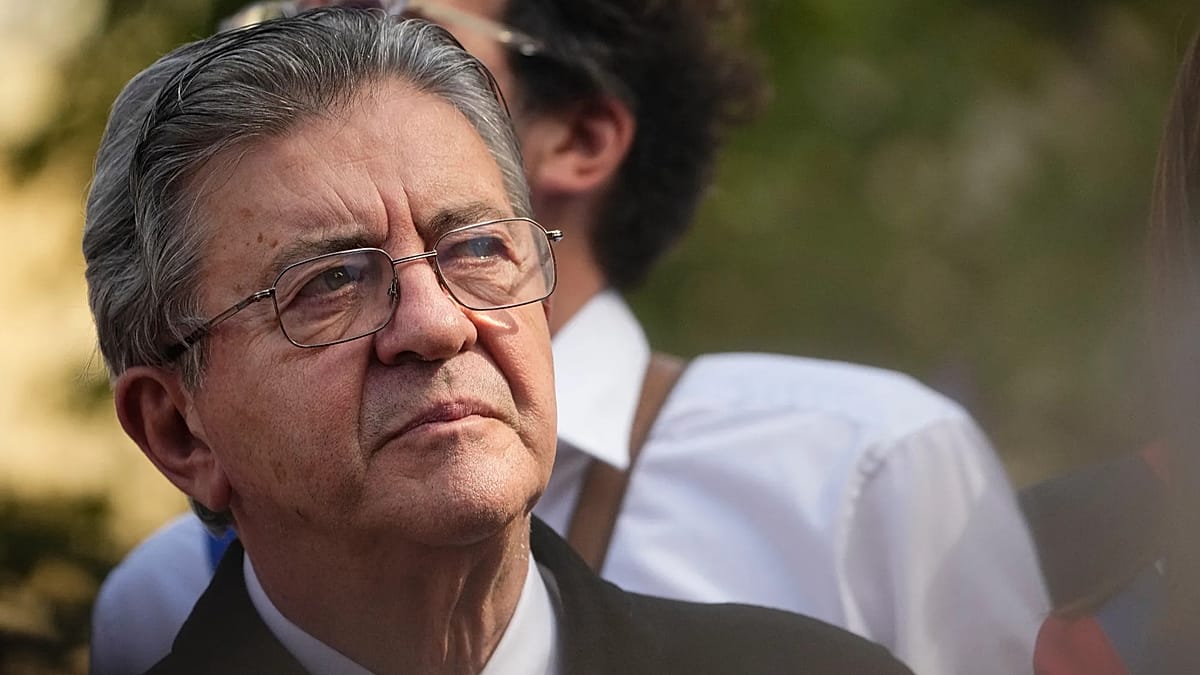
Hard left leader Jean-Luc Mélenchon has called on his supporters to gather in Le Bourget, just north of Paris, on Saturday, where he is set to present his party's new manifesto, "L'Avenir en commun" (The...
Hard left leader Jean-Luc Mélenchon has called on his supporters to gather in Le Bourget, just north of Paris, on Saturday, where he is set to present his party's new manifesto, "L'Avenir en commun" (The Future in Common).
After launching his campaign in June with a rally attended by 26,000 people outside the Basilica of Saint-Denis, he went on to hold a second major rally in Clermont-Ferrand in the Auvergne region.
That event coincided with the start of the high-school students' movement in France and was also marked by a symbolic visit to the Gergovie plateau, where the Gauls famously defeated Julius Caesar's Roman army.
His choice of venue for this latest campaign event also appears calculated.
It was in Le Bourget that François Hollande delivered his now-famous declaration during the 2012 presidential campaign: "My real opponent is the world of finance."
The statement was intended to establish his left-wing credentials before he went on, once elected, to pursue supply-side economic policies - a first for a French Socialist leader.
Nearly fifteen years later, Mélenchon is seeking to position himself as the candidate of a decisive break with the left, at a time when social unrest is spreading across the country.
Firmly in second place in the polls on around 18%, the France Unbowed (LFI) leader has picked up several endorsements in recent days.
On Thursday, most Communist and overseas-territories MPs in the National Assembly formally backed his candidacy, despite French Communist Party leader Fabien Roussel also running. The Greens, meanwhile, are expected to decide in mid-December on a possible alliance with LFI.
Despite this momentum, Mélenchon still trails well behind Marine Le Pen, who is polling at between 35% and 37%.
'Liberty, equality, solidarity'
A few hours before his rally in Le Bourget, Mélenchon unveiled his campaign poster.
It shows his portrait set against a Gergovie landscape, a backdrop that also evokes a rural France where the LFI vote remains weak, along with a reworked republican motto: "liberty, equality, solidarity."
On social media, some internet users are already comparing it with François Mitterrand's 1981 poster, which showed him in front of a Burgundy village dominated by its church, above the slogan "quiet strength."
'L'Avenir en commun'
While previous versions of the programme placed the creation of a Sixth Republic at the top of the agenda, ecological transformation has now become one of France Unbowed's main priorities.
Among its proposals, the party is proposing to replace existing administrative regions with "eco-regions" organised around the management of water resources. It also wants to enshrine stronger environmental protections in the constitution.
France Unbowed is also sticking to its commitment to a gradual phase-out of nuclear power, although the target of reaching 100% renewable energy has been pushed back from 2050 to 2060.
On the economic and social front, Mélenchon is keeping faithful to his long-standing pledges: to raise the minimum wage (SMIC) to €1,700 pcm and eventually lowering the legal retirement age to 60 for people who have paid into the pension system for 40 years.
The programme has been published without a detailed financial breakdown, but party officials stress that it is a "foundation" that will be supplemented by around 50 documents detailing the various measures.
At a press conference in mid-October, Mélenchon and Éric Coquerel, the LFI head of the National Assembly's finance committee, presented their "revised budget" for 2027 in the event of victory.
It contained roughly €100 billion in additional revenue to be generated through tax measures, as well as €80 billion in additional spending.
In foreign policy, the LFI is continuing to focus on the war in Gaza and Israeli settlement activity in the West Bank. It is also proposing to suspend the association agreement between Israel and the European Union.
On Ukraine, the document calls for a ceasefire but says little about military support for Kyiv. It also advocates setting up a new European security framework that would include Russia.
A 'plan to dismantle France'
Mélenchon's manifesto has already drawn strong reactions from his opponents.
In a post on X, Le Pen, the far-right National Rally presidential candidate, hit out at what she called a "plan to dismantle France".
"It takes the process of deconstruction initiated by Emmanuel Macron since he came to power to its logical conclusion," she wrote.
Speaking near Marseille on Saturday, former prime minister Édouard Philippe, who is also running in the presidential election, criticised what he dubbed Mélenchon's "communitarian vision" and his "administered economy".
Referring to his two rivals on the far right and the hard left, the centre-right candidate said he saw "many points in common" between Le Pen and Mélenchon, notably their "hatred of European integration" and their desire to "leave NATO."
Protests continue
Mélenchon's rally comes as demonstrations continue across France.
On Thursday, nearly 200 marches took place across the country as protesters demanded an increase in the minimum wage and wages more generally, as well as measures to tackle economic insecurity, protection of public services and more resources for schools and universities.
Organisers estimated the turnout to be around 1.6 million people, while the interior ministry put the figure at 575,000 demonstrators.