30,000 trees on 200 hectares: Europe's new mega-park is being built here
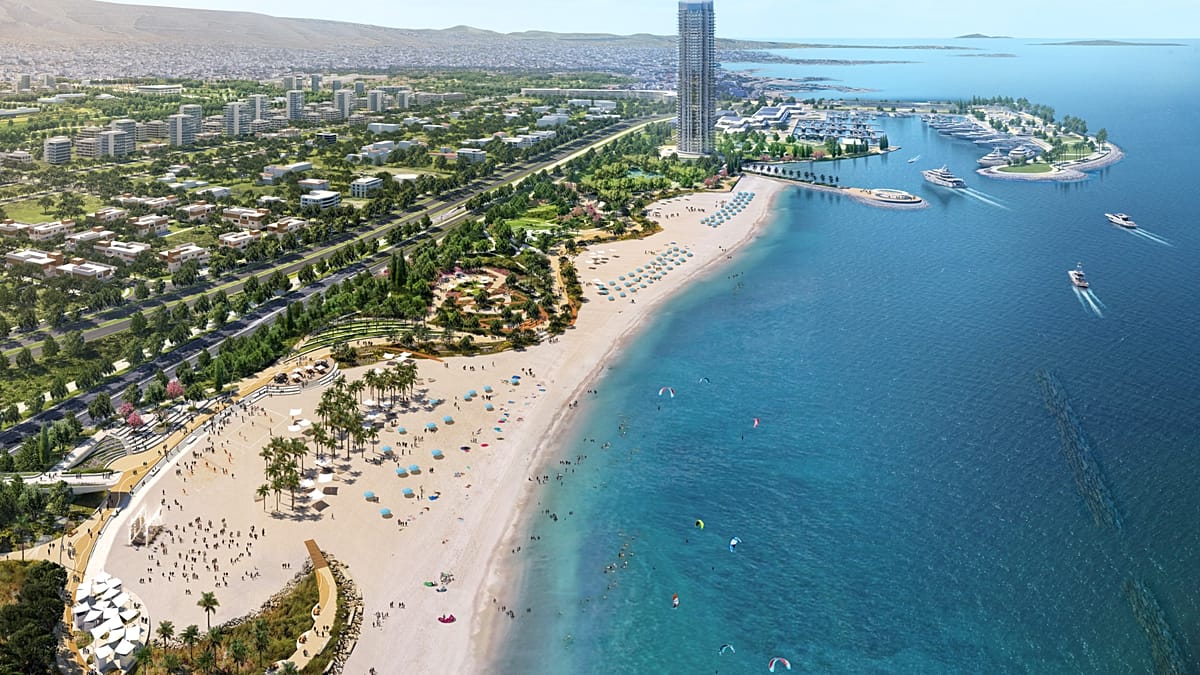
With more than 30,000 trees and around three million shrubs covering 70 per cent of its area in greenery, The Ellinikon Park in Elliniko, Greece, will transform a former airport into one of the largest urban...
With more than 30,000 trees and around three million shrubs covering 70 per cent of its area in greenery, The Ellinikon Park in Elliniko, Greece, will transform a former airport into one of the largest urban green spaces in Europe.
The 200-hectare park in the southern suburb of Athens is expected to open to the public in early 2027, with further infrastructure to be added through 2030.
This includes facilities for sustainable water management, such as a wastewater treatment unit with a capacity of 7,000 cubic metres of treated water per day, a storage tank holding 10,000 cubic metres, as well as a 'smart' irrigation system that can save up to 90 per cent of water.
At the same time, a network of "cool routes" is planned, where the temperature can be up to four degrees Celsius lower than in neighbouring asphalted areas.
A model for sustainable park design
The park is the subject of a guide to designing and operating sustainable green spaces, authored by landscape architect Dimitra Theochari and UNEP Global Chief Heat Officer Lenio Myrivili, who also acts as a Special Advisor for Climate Resilience.
The study records international practices for the design and operation of modern urban parks, using The Ellinikon Park as an example of how these principles are applied, bringing together the design and management of microclimate, water, vegetation, materials and routes.
This approach treats the park not simply as a leisure space but as an integrated piece of urban infrastructure capable of responding to the environmental challenges of the modern city.
A park with cooling comfort woven into its design
Digital simulations were used to weave microclimates into the park's design, using thermal mapping and Computational Fluid Dynamics (CFD) to plan areas around shading and air flow. The simulations led to the design of the network of "cool routes".
Rest areas are being designed with a shading ratio of more than 60 per cent, while maintaining the potential for natural air circulation. Vegetation is also being used to enhance evapotranspiration and improve thermal comfort conditions.
Water features, including channels, misting systems and low-consumption basins, are integrated into the overall composition of the park. Their presence enhances evaporative cooling and helps lower ambient temperatures.
The park's network of paths will be integrated into the natural terrain to form a unified, accessible system with continuous shading. Individual paths will be embedded in the vegetation, creating pockets of microclimatic protection and a succession of light and shade.
Smart use of water will help the park survive heatwaves
Continuous collection of data on air temperature, relative humidity, solar radiation, soil moisture and levels of shading will be used to manage the park's microclimate, irrigation and maintenance of green areas more effectively.
The park's smart irrigation system will use data from weather and soil sensors, allowing water volumes to be adjusted more precisely to the actual needs of the vegetation. According to the study, this approach can lead to water savings of up to 90 per cent.
The goal is to include more than 520 species of flora, around three-quarters of which will consist of native or suitably adapted species.
A tertiary wastewater treatment unit capable of producing up to 7,000 cubic metres of treated water per day will suppy all permitted non-potable uses, including irrigation.
Meanwhile, a storage tank with a capacity of 10,000 cubic metres is planned for irrigation water. This infrastructure will strengthen the park's water security and provide greater resilience during periods of increased heat stress.
Rainwater will be managed through green and blue infrastructure, with the aim of handling 100 per cent of it on site. At the same time, the restoration of natural flows is being pursued, such as that of the Trachones stream, which will play an important role as a flood-protection infrastructure.
The park will draw on local Greek materials
The park's surfaces and pavings will use Greek natural materials such as Kavala marble, white Dionysos-Penteli marble, Karystos slate and Mandras sandstone. They have been chosen both for their durability and contribution to thermal comfort, and to ensure the park blends harmoniously into the Attic landscape.
Materials originating from the former airport facilities will not be wasted but reintegrated into the new design. Concrete slabs are being used to build retaining walls, plinths and other structural elements, while crushed aggregates will be used in gabions and backfills, thereby reducing the construction's environmental footprint.
How the park on the Athenian Riviera compares with others abroad
The Ellinikon Park will cover a total area of 2,000,000 square metres (200 hectares). At this scale, it will be the largest coastal urban park in Europe and one of the most ambitious urban regeneration projects worldwide.
To grasp its size, Ellinikon far surpasses some of the continent's most iconic historic parks. It is 40 per cent larger than London's Hyde Park (142 hectares), and is almost on a par with Berlin's vast Tiergarten (210 hectares). Ellinikon will be almost seven times larger than Brussels' Parc du Cinquantenaire (30 hectares).
Even when set against New York's world-famous Central Park (341 hectares), which is about 1.7 times bigger, Ellinikon stands as a project of comparable global scale.
The project's defining difference, however, lies in its coastal character. Most large European parks are enclosed within the urban fabric. By contrast, Ellinikon is directly connected to a two-kilometre seafront.
Among purely seaside European parks, it will be significantly larger and more modern than Barcelona's traditional Parc de la Ciutadella (around 31 hectares) and is four times bigger than the future fully developed Faliro Bay redevelopment (around 54 hectares) in Greece.
Only non-urban protected forests, such as Parco della Sterpaia in Tuscany (296 hectares), or vast national parks like Pembrokeshire Coast in Wales (62,000 hectares), exceed it in area.