Ugly scenes in Belfast expose a broken politics | Letters
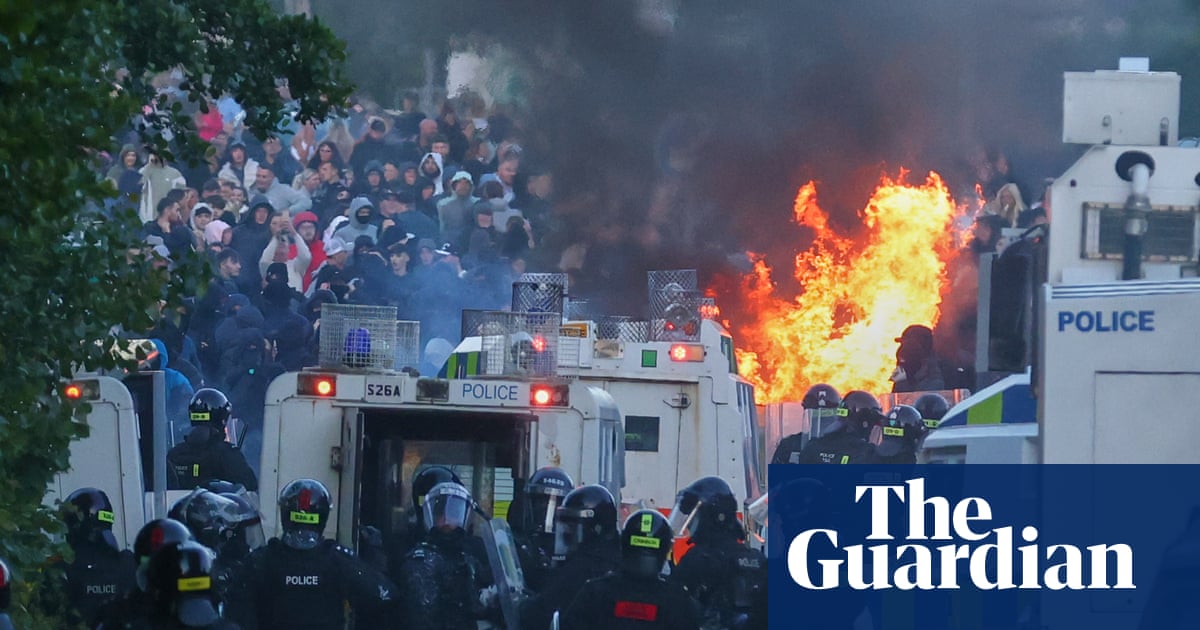
I agree with John Harris’s analysis (Cars burn in Belfast, bricks fly in Southampton – and the ubiquitous cry of ‘civil war’ goes up again, 10 June). He misses one obvious point, though. Since the election of...
I agree with John Harris’s analysis (Cars burn in Belfast, bricks fly in Southampton – and the ubiquitous cry of ‘civil war’ goes up again, 10 June). He misses one obvious point, though. Since the election of the first Thatcher government in 1979, there has been a continuous attack on the rights and living standards of working-class people, such that we are now seeing a decline in healthy life expectancy for the poorest in the UK.
We might think of this as a civil war which only one side is waging. Because the language of class has been erased from our politics, the “white working class” only hear themselves being spoken about when Nigel Farage or Stephen Yaxley-Lennon tell them how the system has failed them.
As was the case in Germany in 1933, a political class that has no answers to the problems its politics have created is considering turning to a demagogue stirring up civil war as the way out of its dead end.
When people hear talk of “civil war” or the need to make “white lives matter”, it fits with their recognition that their own lives don’t matter, and in the absence of any analysis that puts class at the forefront, race becomes the vehicle through which their lives make a kind of sense. Until we construct an alternative politics which unites fragmented communities around more than liberal pieties, the tinderbox of inequality will remain for Farage to lob matches at.
Nick Moss
London
Should not some sharp interviewer ask Richard Tice whether he and Nigel Farage not merely condemn the burning of innocent migrants from their homes, but feel a “pure cold rage” about it? And if so, whether an appropriate response would be to deport the perpetrators of this modern Kristallnacht, the original of which was a night of indiscriminate retribution against a whole defenceless population stirred up by extreme-right politicians as a response to the murder in Paris of a Nazi officer by a Jewish teenager.
I believe and hope that a majority of the voters of Makerfield will feel enough rage against Reform UK to return any candidate but theirs.
Vincent McNeany
Gateshead, Tyne and Wear
The scenes in Belfast are all too reminiscent of violent pogroms in the same areas not just a century ago but also in the 1960s and subsequently. Then the victims burned out of their houses were Catholic families; now they are people of colour; the rhetoric and the perpetrators are the same. Hatred of the “other” may be rooted in deprivation, but it is still whipped up by people whose loyalties, clouded in vaunted patriotism, are to anywhere other than these mean streets.
The parties led and funded by millionaires delude street mobs who can be found on other days chanting for Donald Trump and Benjamin Netanyahu.
The leaders smirk as the victims flee in terror and communities are further impoverished.
Kevin Donovan
Birkenhead, Merseyside
As a young imam living in Britain, I found the recent violence in Belfast deeply worrying. It is absolutely unjustifiable. There can be no excuse for violence of any kind. It comes at a time when immigration has become increasingly politicised, with negative rhetoric fuelling mistrust and a growing sense that entire communities are being blamed for the actions of a few individuals – a situation we cannot afford.
Those who come seeking a better life deserve a chance to integrate and contribute. That is a moral obligation rooted in basic humanity. However, governments must also ensure immigration is managed with great care, so integration works and communities are not left feeling overlooked.
As a Muslim, I am reminded of the Qur’anic principle: “Be always just; that is nearer to righteousness.” But when justice is not upheld, divisions grow within society, and I fear we risk moving further away from the kind of society many of us still hope to preserve in the United Kingdom.
Usama Mubarik
Farnborough, Hampshire