The secrets of the desert: Exploring Uzbekistan's ancient landscapes and living traditions
Ancient fortresses, sacred monuments and reclaimed steppe landscapes reveal how people adapted to life across Uzbekistan's deserts, where water has long determined settlement and survival.
Much of Uzbekistan is covered by arid and semi-arid landscapes. From the vast Kyzylkum Desert in the northwest to the semi-deserts surrounding Termez, these regions have influenced where people settled, how they travelled and how communities adapted to Central Asia's most challenging environments.
Although often associated with open landscapes and extreme climates, Uzbekistan's deserts also contain ancient cities, sacred monuments and settlements that continue to reflect the long relationship between people and their surroundings. From the archaeological sites of Karakalpakstan to the reclaimed lands of Jizzakh and the semi-desert of Surkhandarya, each landscape tells a different part of that story.
Ancient cities beneath the sands of Karakalpakstan
Hidden within the desert plains of Karakalpakstan, Akchakhan Kala was once part of ancient Khorezm. Archaeologists have identified defensive walls, ceremonial buildings and a palace-temple complex dating back more than two thousand years, providing new insight into one of Central Asia's earliest urban centres.
The site covers 56 hectares and has been the focus of international excavations since the 1990s. Researchers from Uzbekistan have worked alongside Australian and, more recently, Chinese archaeologists to uncover the city's layout and preserve its archaeological remains.
According to Serik Baybosinov, Head of the cultural heritage department of Karakalpakstan, the excavations have revealed the city's central square, palace and ceremonial buildings, while preparations are underway to develop the site as an open-air museum without altering its historical character.
Research has also transformed historians' understanding of ancient Khorezm's religious and artistic traditions.
During more than three decades of archaeological work, researchers uncovered well-preserved defensive walls together with a palace-temple complex containing rare wall paintings dating from the second and first centuries BC.
“The temple revealed an extraordinary collection of wall paintings,” says Vadim Yagodin, researcher at the Karakalpak Research Institute of Humanities. “Based on its layout, we believe it most likely served as an important ceremonial centre during that period.”
Although Akchakhan Kala existed centuries before the medieval Silk Road reached its peak, archaeologists say it demonstrates how organised urban life developed in the deserts of Central Asia long before the famous trade routes emerged.
Chilpyk Dakhma and the legacy of Zoroastrianism
Further across Karakalpakstan, another monument reflects a different chapter of the region's history.
Rising above the surrounding desert, Chilpyk Dakhma, also known as the Tower of Silence, is one of the best-known reminders of Zoroastrian funeral traditions in Central Asia. Archaeologists provisionally date the monument to the third century BC.
According to Vadim Yagodin, the structure was used for ritual burial practices, during which the deceased were laid out in the open before their bones were placed in specially made ossuaries.
Despite decades of research, many questions remain unanswered.
“We have never found where these ossuaries were ultimately taken,” Yagodin explains. “Here stands this enormous monument associated with an important religious cult, yet there are no settlements anywhere around it. Why? That remains an unanswered question.”
For archaeologists, those unanswered questions continue to make Chilpyk one of the region's most intriguing historical sites.
From the "Hungry steppe" to productive farmland
Several hundred kilometres to the southeast, the landscape changes again.
The Mirzachul steppe in Jizzakh region was once widely known as the "Hungry steppe" because of its dry climate and limited water resources. Large-scale irrigation projects during the twentieth century gradually transformed parts of the area into one of Uzbekistan's most important agricultural regions.
Local resident Bozorgul Xalikova remembers stories describing the steppe before those changes took place.
“People used to say that if a bird flew across this land, its wings would burn, and if someone walked across it, their feet would burn,” she says.
“Little by little, people settled here, more land was cultivated, and these empty desert areas gradually became productive.”
The nearby village of Oqtom developed around a single well that once served travellers crossing the steppe.
“Our village began with just one house and one well,” says Sherali Tillayev, Chair of the Oqtom Citizens' Assembly.
“Travellers passing through the desert would stop here to rest and drink water before continuing their journey.”
As irrigation expanded during the 1950s and 1960s, farming gradually replaced much of the surrounding open steppe, illustrating how access to water continued to shape settlement across Uzbekistan's arid landscapes.
Life in the Kattakum semi-desert
In southern Surkhandarya region, the Kattakum landscape offers another perspective on desert life.
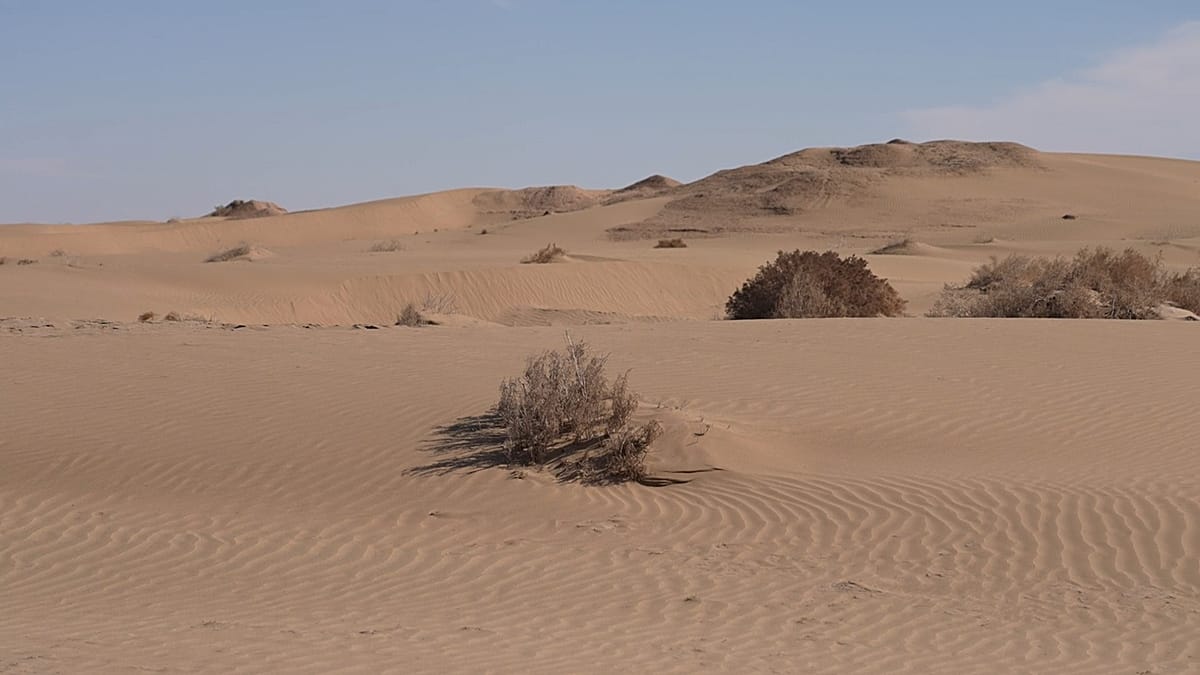
Although commonly referred to as a desert, experts describe Kattakum as a semi-desert. Seasonal rainfall, underground water and the nearby Amu Darya River support considerably more vegetation than larger deserts such as the Karakum.
“This is more accurately described as a semi-desert rather than a true desert,” says Shukhrat Ibragimov from the regional tourism department. "If there were no water here, especially the Amu Darya, the area around Termiz would probably look exactly like this.”
The landscape supports saxaul shrubs, short-lived spring plants and wild tulips, while conservation measures introduced in recent years have helped restore vegetation that had previously been cut for fuel.
At the same time, the semi-desert continues to influence daily life. Seasonal winds, known locally as the Afghan wind, regularly carry sand towards Termiz, making vegetation an important natural barrier against erosion.
Interest in the area is also growing among visitors seeking camel rides, horseback routes and opportunities to experience one of Uzbekistan's lesser-known natural landscapes.
Although each landscape has its own history, they share common characteristics. Water, climate and geography determined where people settled, what they built and how they lived. Those influences can still be seen today.