What does music look like? This British artist paints what he hears
Published on 02/10/2026 - 11:18 GMT+2 For British artist Jake Andrew, music has colour, shape and texture. His paintings capture what he sees when he hears it. Andrew has...
Published on 02/10/2026 - 11:18 GMT+2
For British artist Jake Andrew, music has colour, shape and texture. His paintings capture what he sees when he hears it.
Andrew has synaesthesia, a rare neurological condition in which one sensory experience can trigger another. For him, sounds produce an immediate visual response.
His favourite instrument to paint is the cello.
“It's dark, but it doesn't feel ominous," he says. "It's got this kind of like... and then edge of.... Does this make any sense? Like the edge of the tube itself, of where the sound comes from has these kind of like almost dust particles that come off it."
These responses extend to everyday sounds. A passing motorbike appears dark purple to Andrew, while a friend’s dog’s bark takes on a lime-green colour.
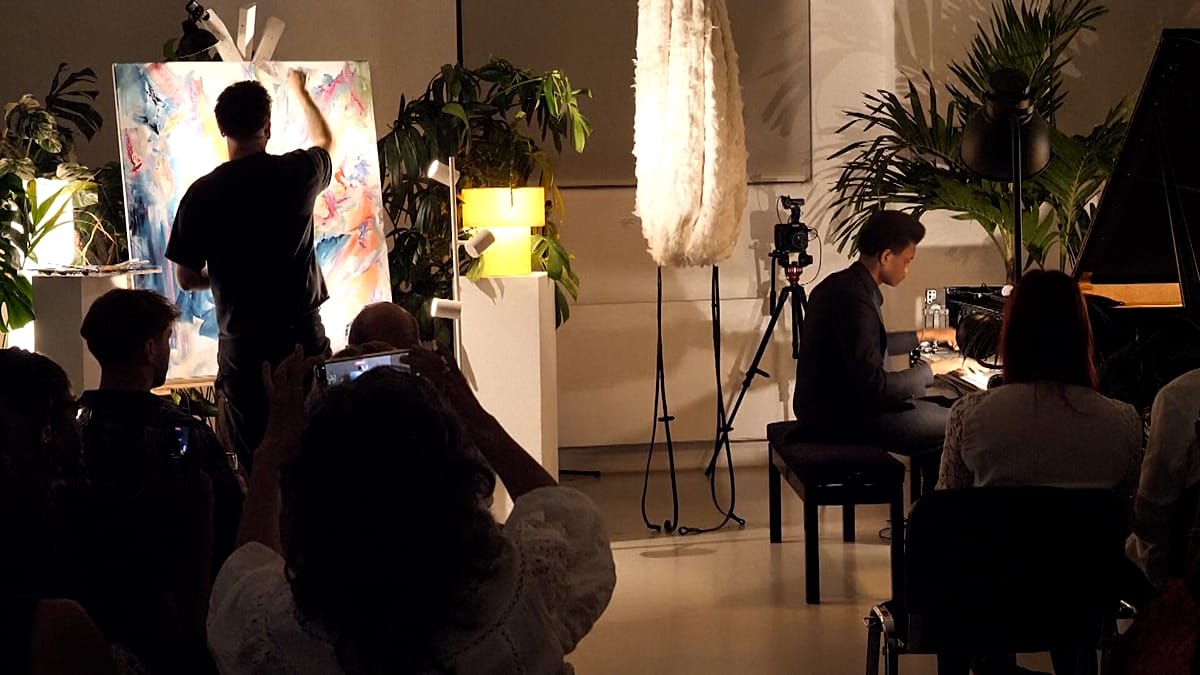
In September, he brought that way of experiencing sound to a live performance at the Handbag Factory in Vauxhall, London, United Kingdom.
Pianists Camden Stewart and Karim Kamar improvised around their original compositions as Andrew translated the music into paint.
The results do not always follow familiar associations between colour and mood. A minor key need not produce a sombre-looking painting.
“E minor, that's usually dark blue, slow legato movements where it's kind of like swirling,” he explains.
Finding the meeting point between visual and audio
Experts say sound-to-colour synaesthesia, known as chromesthesia, can also involve shapes, movement and texture.
“It's the shapes, it's the movement, it's texture and all of these things, and how it's organised in space as well,” shares Jamie Ward, professor of cognitive neuroscience at the University of Sussex.
Sounds can sometimes interrupt Andrew’s thoughts, but he sees synaesthesia as an inseparable part of his life.
“It's not a curse, though. I can't imagine what it would be like to not have it,” says Andrew.
For the musicians who are taking part in the live performance, it has been a fascinating process.
“That's like asking me 'what does a fourth dimension look like?' I can't even fathom it.”
Check out the video above for footage of Jake Andrew's performance.
Video editor • Roselyne Min