What to expect from the Trump-Xi summit, from tariffs to a possible $30 billion deal
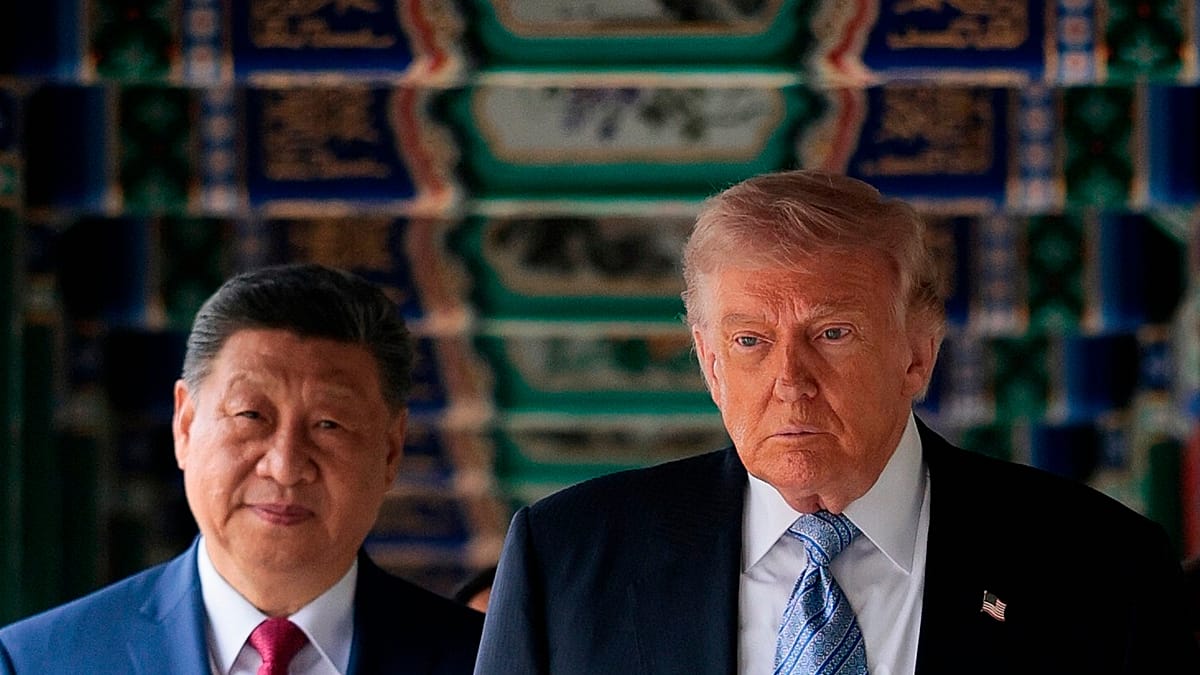
Chinese President Xi Jinping is expected to hold talks with US President Donald Trump in Washington next week, with an expiring trade truce, tens of billions in tariff relief and AI all on the table as both economies need the relationship to hold.
This is the return leg.
US President Donald Trump went to Beijing in May, and Chinese President Xi Jinping is now expected to come to him, scheduled to arrive next Wednesday and depart on Friday with his wife, Peng Liyuan, skipping the UN General Assembly entirely.
Beijing has not yet given the final confirmation, pending the meeting between US Treasury Secretary Scott Bessent and Chinese Vice Premier He Lifeng this weekend.
The expected visit to Washington is Xi's first since 2015, and two US- China state visits within five months are highly unusual. However, expectations are modest by design.
"The visit is the message," said Edgard Kagan, senior adviser in China studies at the Center for Strategic and International Studies (CSIS).
"There's been a surprising lack of signalling by either the White House or the PRC on major goals for the visit," Kagan added.
What is actually on the table
The commercial substance starts before either leader speaks.
Bessent meets Lifeng this weekend as the pair have conducted most of the practical negotiations, and their job is to have deliverables ready.
The central one is the truce struck in Busan on 30 October 2025, which suspended Washington's Affiliates Rule in exchange for continued Chinese exports of rare earths and critical minerals.
It runs for one year and is due to expire roughly five weeks after the summit. Both sides want it extended, but not by the same amount.
"The Chinese have wanted an agreement to extend the trade ceasefire through the end of the Trump administration," said Scott Kennedy, trustee chair in Chinese business and economics at CSIS.
"The Trump administration just wants to extend it for a few months to maintain leverage on China. I think they'll end up somewhere in the middle, probably at about a year," Kennedy estimated.
Beijing expects more than a rollover.
According to Kagan, the Chinese anticipate an announcement of around $30 billion (€26bn) in duty-free or low-tariff imports in return for fulfilling the purchase commitments they made in May, while Washington believes it will extract further purchases in return.
Deals on agriculture and aircraft are likely, possibly with signing ceremonies attached, and Trump has previously hinted that Boeing could feature.
Two economies under strain
Trump faces midterms in November that will be fought on the cost of living, with diesel above $6 a gallon and inflation stuck at 3.4%. He needs wins that show up in prices.
However, Xi's problem is deeper.
Retail sales grew just 0.4% in August, while fixed-asset investment contracted by 7.2% in the first eight months of 2026 compared with the same period in 2025. Beijing has also injected 360 billion yuan (€46bn) into state banks and insurers to keep credit flowing.
The official growth target of 4.5% to 5% for China is the lowest in decades, and Kennedy suggests even that flatters the reality.
"China's got a bunch of challenges," he said, adding that "it's growing very, very slowly, not 5% or anywhere close to it. It's got a massive debt problem, unemployment is growing not just for young people, but for others."
Nonetheless, Kennedy argues the summit framework favours Beijing, describing the US strategy as having failed to constrain China in any meaningful way.
Business leaders on both sides
The state dinner, held under a tent on the White House lawn because the new ballroom is unfinished, will seat an unusual guest list.
Sam Altman of OpenAI, Nvidia's Jensen Huang, Qualcomm's Cristiano Amon and Apple chairman Tim Cook are all expected, according to Politico, which cited four people familiar with the arrangements.
They arrive amid an argument the AI industry is having with itself.
Anthropic's Dario Amodei published an essay this month urging labs to slow frontier development, a position Altman and Elon Musk both endorsed. Trump rejected it flatly, saying that "whoever wins AI wins".
Huang has dismissed catastrophic scenarios as hysterical while arguing that companies should police their own pace by stating that "if it's not ready, just hold it back. You should go as fast as you can, but no faster than that."
Anthropic declined to say whether it had been invited. Altman, for his part, has suggested Trump and Xi could earn a Nobel Peace Prize if they reach an agreement on AI, which gives some measure of how much the industry has riding on the meeting.
Xi is reportedly bringing his own delegation, and Kennedy calls it one of the most interesting unknowns of the week, with BYD's leadership among the names rumoured.
Whether those executives are given any platform, he notes, is among the few genuinely unclear elements of the visit.
The geopolitics that could derail it
Outside the economic and technology issues, the two leaders have different geopolitical priorities for the meeting.
Iran is Trump's.
Washington launched Operation Economic Outcast in August to sever Tehran from the global financial system, and China remains Iran's largest trading partner.
Notably, Beijing has been buying more oil on the open market, which Kagan says reflects reduced purchases from Iran and could itself move prices.
Taiwan is Xi's.
A $14 billion (€12bn) arms package for Taiwan was pre-approved by the US Congress in January but has not been formally notified, a delay interpreted as an attempt to avoid a probable irritant before this summit and, previously, ahead of Trump's visit to China.
Beijing certainly wants the freeze extended, and perhaps the decision reconsidered.