Sacking turns former Zelenskyy loyalist into potent political opponent
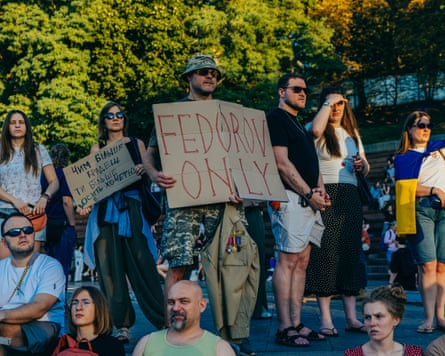
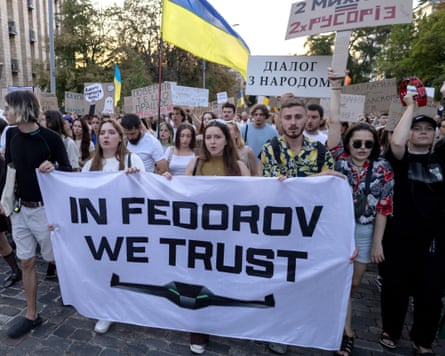
For more than a month, demonstrators have gathered in Ivan Franko Square outside Volodymyr Zelenskyy’s office. The protesters have been chanting a name – not that of Ukraine’s embattled president but that of...
For more than a month, demonstrators have gathered in Ivan Franko Square outside Volodymyr Zelenskyy’s office. The protesters have been chanting a name – not that of Ukraine’s embattled president but that of the man he recently sacked as defence minister, Mykhailo Fedorov. On Sunday evening, 2,000 people marched along Khreshchatyk, Kyiv’s main boulevard, waving cardboard banners in support of their ousted hero.
Zelenskyy has refused to reinstate Fedorov, who during his six months in the job was widely seen as an effective and reforming figure. On Wednesday, Ukraine’s parliament, the Rada, voted to approve a successor as defence minister, Yevhen Khmara. The move shows that Fedorov has been shut out from government permanently, and confirms his transition from trusted insider and Zelenskyy loyalist to a potent political opponent.
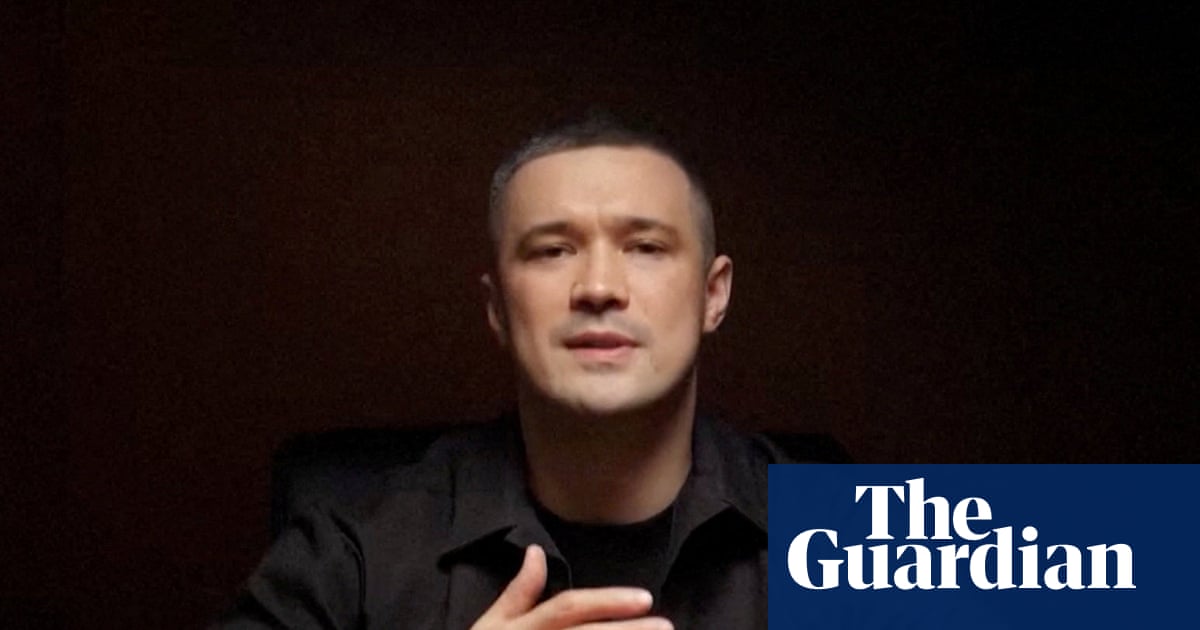
On Tuesday, Fedorov released on YouTube a bombshell nine-minute video. In it, the 35-year-old called for wartime elections and reminded Zelenskyy, his former boss, that power ultimately resided with the people.
“Democracy cannot be held hostage by Russia,” Fedorov said. “We must find a legal, safe and realistic mechanism which will allow Ukraine to renew its full democratic process even in the conditions of a long war.”
Fedorov offered a blistering critique of Zelenskyy’s administration. The country was facing a “systemic crisis of governance”, he said, in which corruption inside the defence ministry was hurting the war effort. Reforms were stymied, loyalists promoted. “The old system lives by its own rules too often. It protects itself. It is scared of change,” he said, hinting that his own attempts to root out corruption in procurement had led to his sacking.
Most civil society activists agree with this big-picture analysis. Corruption has always existed in Ukraine, in common with other countries that were once a part of the Soviet Union, including and especially Russia. During the 2010-14 presidency of Viktor Yanukovych, who was backed by the Kremlin, it reached spectacular levels. In the peaceful past, large-scale theft from the state budget left less money for schools and hospitals.
As Fedorov noted, today’s schemes have “an entirely different meaning” as full-scale war rages. They represent drones not bought, “ammunition that did not reach the front” and technology that “could have been put into production but wasn’t”. The video shows a photo of Andriy Yermak, Zelenskyy’s former chief of staff, who resigned last year amid a corruption scandal implicating other senior figures such as Timur Mindich, Zelenskyy’s former business partner. Yermak’s lawyer has dismissed the allegations as “baseless” and Mindich, who fled to Israel, also denies wrongdoing.
Orysia Lutsevych, the deputy director of the Russia and Eurasia programme and head of the Ukraine forum at Chatham House, said of Fedorov’s comments: “I think he’s right. He says the system is old-fashioned, does not run fast enough, stalls innovation and prioritises loyalty.” She said “personal and vested interests” sometimes influenced official decision making, not always in Ukraine’s interests. “This could be called corruption,” she added.
At the same time, Ukrainian society – led by students, veterans, journalists and anti-corruption bodies – is politically engaged. “The street is a check on the president. It corrects,” Lutsevych said. “Parliamentarians are active too. Ukraine is a pluralistic space. There are checks and balances even under martial law.”
However, she said “nervous exhaustion” and Zelenskyy’s failure to explain his actions had created a public crisis. “It’s a perfect powder box,” she observed.
Zelenskyy has not yet responded to Fedorov’s accusations. On Wednesday he fired his deputy chief of staff, Iryna Mudra, after the National Anti-Corruption Bureau carried out a raid on her office. The bureau said Mudra and a Rada deputy were suspected of money laundering to the tune of $3.4m. A year ago, Zelenskyy triggered protests when he tried to strip the bureau of its independence. He reversed course after criticism from activists at home and pressure from Kyiv’s European partners.
Olena Tregub, a co-founder of the Independent Defence Anti-Corruption Commission, said those “from the system” frequently occupied top posts, at the expense of talented professionals. “Corruption is the symptom. It’s not the cause. The cause of the problem is bad governance,” she said. There were “shades of grey” when it came to military contracts. Outside bodies that monitored procurement were often able to stop dubious purchases, she pointed out.
There is little prospect Zelenskyy will hold an election anytime soon, or embrace Fedorov’s idea of voting by smartphone. Under Ukraine’s constitution, polls cannot take place during wartime. Nonetheless, pressure for some form of democratic renewal is growing.
It could include consultations with government critics and a restless civil society. And when presidential elections are eventually held, Fedorov has nimbly positioned himself to challenge Zelenskyy.