Explosive drone at Leipzig airport: whose DNA trail is it?
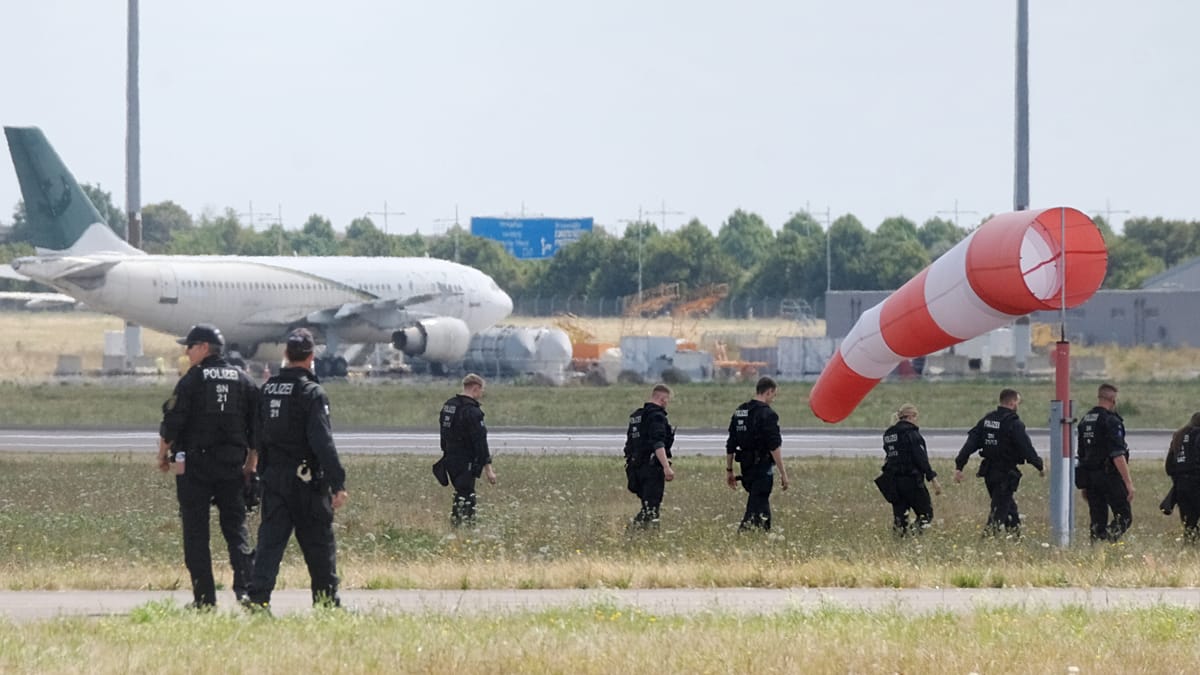
Following the discovery of an explosive drone beside Ukrainian Antonov aircraft, investigators in Leipzig have found DNA traces. According to several media outlets, there are indications of a link to a case from 2024.
By Kirsten Ripper & Euronews with ZEIT, BILD
Published on 11/08/2026 - 8:38 GMT+2
On the night of 5 August 2026, Leipzig/Halle Airport came close to disaster when a drone fitted with explosives and a detonator appeared near a cargo aircraft operated by Ukrainian Antonov Airlines. Ammunition destined for Ukraine is reported to have been on board.
According to new findings, reported by the weekly Die Zeit, CCTV footage shows that at around 7.30 p.m. the drone deliberately flew towards the Ukrainian cargo aircraft and slammed into its wing. The device packed with Semtex did not explode on impact, however, but bounced off the Antonov and fell to the ground. The explosives appear to have become detached from the drone. According to Bild, the drone struck the Antonov close to the aircraft's fuel tank.
The drone was not picked up by any security system later that evening; instead, according to the report, an airport bus driver noticed the dangerous device four hours after the collision. He stepped on the drone with his foot. The explosives were apparently lying some distance away.
DNA trace on the drone apparently leads to Lithuania
Five days after the incident at Leipzig Airport, Bild and Die Zeit report that investigators have secured DNA traces on the drone that failed to explode. No individual has yet been identified, but, according to Bild, there has been a match in the European DNA database and the trail apparently leads to Lithuania.
In addition, the DNA now secured is said to match that from an arson attack on 20 July 2024 on the DHL logistics centre at Leipzig Airport. The parcel bomb exploded on the ground rather than in the air on board the aircraft only because the DHL cargo plane was delayed.
Several suspects have been on trial in the Lithuanian capital Vilnius since the spring over the 2024 parcel bomb in Leipzig. The charge is "terrorism and sabotage on behalf of a foreign power". The Lithuanian prosecutor's office stated that the offences involving improvised explosive devices had been "organised and coordinated by citizens of the Russian Federation who are linked to the military intelligence services of the Russian Federation".
The defendants are alleged to have sent parcel bombs across Europe via freight services such as DHL and DDP. According to the Lithuanian authorities, the intended targets were Germany, Poland and the United Kingdom. The EU judicial agency Eurojust in The Hague also believes Russia's military intelligence service, the GRU, was behind the 2024 wave of attacks.
Following the discovery of the drone in Leipzig, the Federal Public Prosecutor's Office is investigating on suspicion of attempted detonation of an explosive device and of endangering air traffic. Chancellor Friedrich Merz has so far avoided any hint that Russia might be responsible for the drone incident. During a visit to Leipzig, Interior Minister Alexander Dobrindt spoke only of the possible involvement of "foreign powers".
The Kremlin denies any involvement by Russia in the drone attack on Leipzig. On Telegram, the Russian embassy in Berlin described it as a "provocation directed against Moscow" and warned of "a new wave of anti-Russian hysteria in Germany".