Guinea-Bissau votes in referendum to rewrite constitution and boost presidential powers
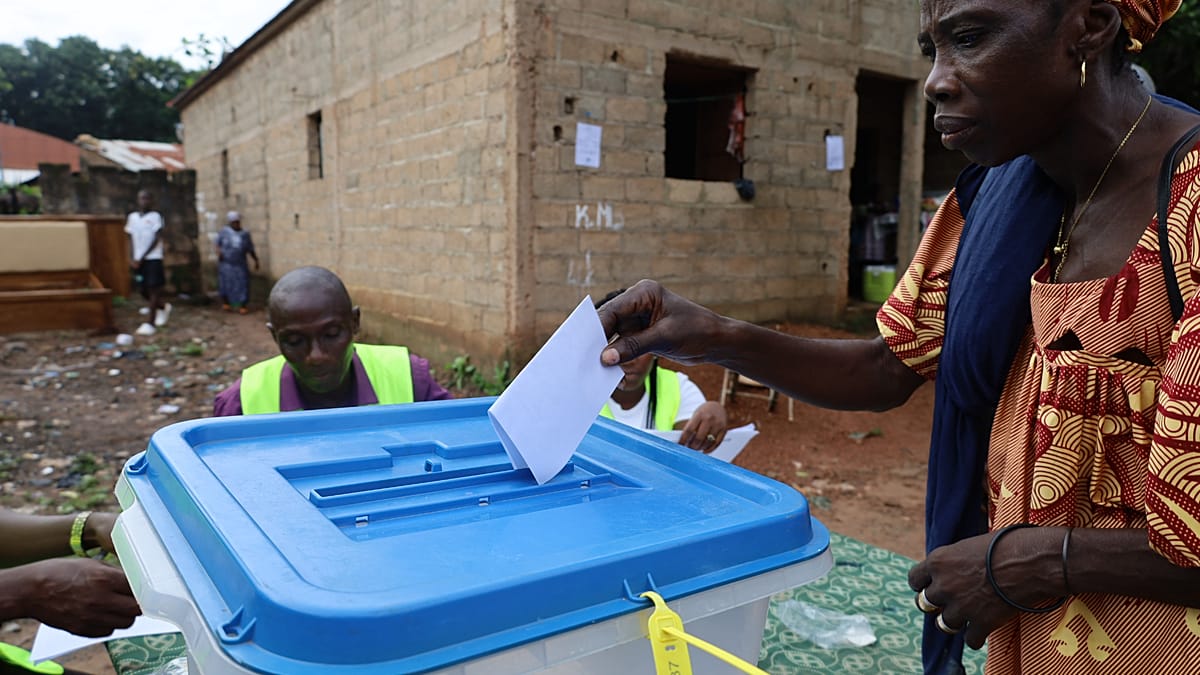
Voters in military-ruled Guinea-Bissau, after a coup, vote on Sunday in a referendum to boost presidential powers before elections to restore civilian rule, a process mired in controversy.
Voting got off to a slow start in some areas when the polling stations opened at 08:00 CET. According to media correspondents, security was stepped up at strategic points in the capital, with members of the National Guard and the police deployed at key locations.
This referendum is taking place against a backdrop of political instability and is being challenged by the opposition, not only because it has already been approved and published in the Official Gazette of the Republic -before the people had been ‘heard’- but also because it was drafted by the military junta, that is, by a transitional government without prior consultation.
"No one was consulted, neither political parties nor civil-society organisations, let alone traditional and religious leaders, and so on. So everything was done in secret," said the head of the Guinea-Bissau Human Rights League, Bubacar Turé, last week, speaking to Euronews.
Turé also stressed that campaigners for a "no" vote in the referendum were not authorised to campaign. "This is not an environment of freedom," he added, which is another reason why the opposition has called for a boycott of today’s vote.
Some analysts say the military government lacks legitimacy to change the constitution, which has fuelled discontent among citizens.
"The fundamental question is: who drafted this constitution, and on whose behalf? To protect which interests or institutions? Who stands to gain from this constitution?" said Guinea-Bissau political analyst Paulino Quadé, speaking to the Associated Press.
A military government seized power in November 2025 following disputed elections in which both the former president, Umaro Sissoco Embaló, and the opposition candidate, Fernando Dias, claimed victory.
After the military junta took power, it appointed General Horta N'Tam as transitional president under a temporary constitutional charter that bars him from standing in elections.
If it goes ahead, the new constitution drafted by the self-styled National Transitional Council will give the president more powers and reduce parliamentary representation, among other changes.
The military junta currently in power unanimously approved a constitutional amendment to shift the country from a parliamentary to a presidential system, and the public is now being asked to endorse it. The new text proposes scrapping the previous system, under which the prime minister came from the parliamentary majority, leading to complex power-sharing arrangements. It would also allow the head of state to appoint and dismiss the prime minister and cabinet members, as well as to dissolve parliament.
Measures the opposition contests, arguing that they downgrade political parties and the popular will.
"This constitution significantly weakens the prime minister and the government, subordinates the National People’s Assembly and the political parties, and undermines, or even ignores, the popular will expressed at the ballot box, bringing all the inherent risks of division and political and social tensions," said Muniro Conté, spokesperson for the African Party for the Independence of Guinea and Cape Verde (PAIGC), to the Associated Press.
The military authorities argue that a smaller parliament, reduced from 102 to 65 seats, would allow for easier and more substantive debates, while the new presidential powers would underscore the president’s higher authority over the prime minister, which they say has been a source of political instability in the country.
Coup after coup
Since winning independence from Portugal in 1973, West Africa’s only Portuguese-speaking country has been rocked by several coups and attempted coups. Indeed, last year’s coup in Guinea-Bissau deepened West Africa’s democratic crisis, adding to the growing number of countries in the region under military rule.
In November 2025, the army seized power a few days after the presidential elections, toppling then president Umaro Sissoco Embaló and suspending the electoral process as the vote count neared its end and it was becoming clear who the new president-elect would be.
Several African leaders described the situation as a "staged" power grab after the military allowed the former president to hold a press conference to announce that he was being removed from office and that he was allowed to leave the country in seemingly favourable circumstances. The most sceptical observers say Embaló handed power to the military after realising he was losing the election.
During the 2023 legislative elections, Embaló himself dissolved parliament, which was dominated by the opposition, in response to what he described as an attempted coup, and then ruled by decree until he was deposed by the army.
This referendum follows a series of similar moves in other African countries, including Zimbabwe and Chad, which have amended their constitutions in recent years to extend presidential terms, remove age limits or strengthen executive powers.
With around 2.2 million inhabitants, Guinea-Bissau has suffered five coups and a series of attempted coups since 1974. The country has the highest ratio of natural wealth per capita, according to the World Bank, yet more than half the population lives in poverty.
Of the more than 2 million inhabitants, around 915,000 are eligible to vote today.
Sunday’s voting ends at 17:00 GMT, and the first provisional results are expected on Tuesday.