Goes berry picking, finds traces of mysterious Allied plane wreck in Poland
It was meant to be a simple walk in the forest to pick berries. Instead of woodland fruit, a resident of Świnoujście found something that could help solve one of the mysteries of the war. In woodland not far...
It was meant to be a simple walk in the forest to pick berries. Instead of woodland fruit, a resident of Świnoujście found something that could help solve one of the mysteries of the war.
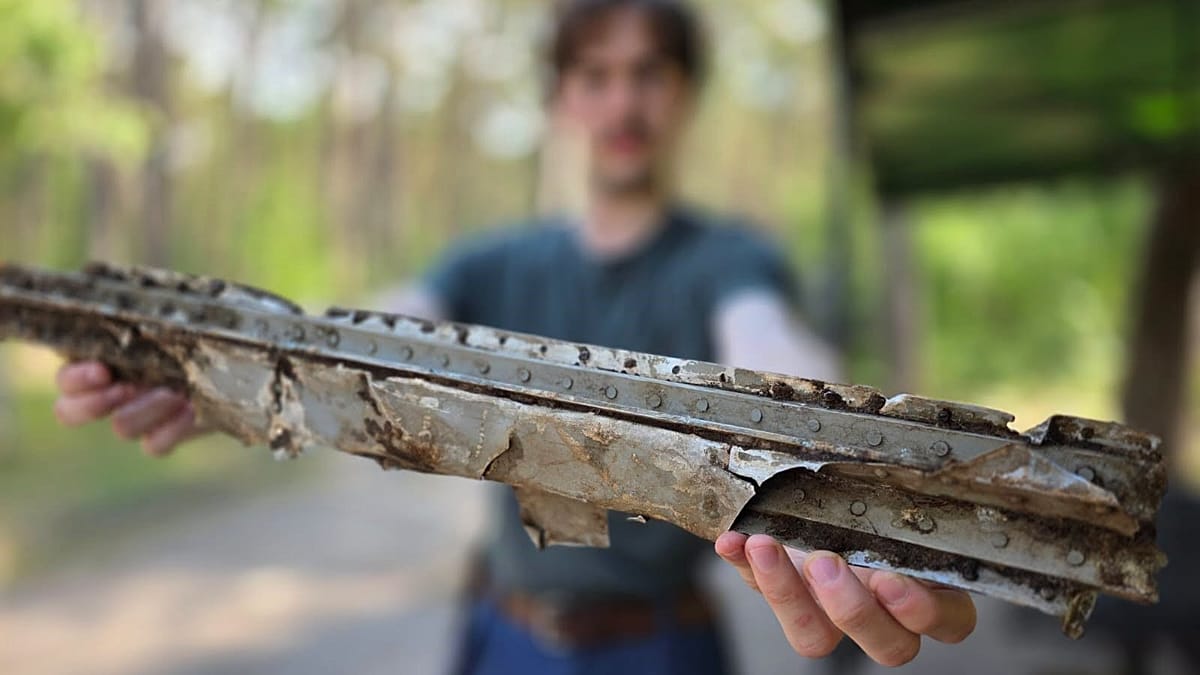
In woodland not far from facilities belonging to the Museum of Coastal Defence - Fort Gerhard, the man came across an unusual depression in the ground. Around it lay numerous fragments of a metal structure. They did not look like random scrap. Among the scattered pieces you could see sections of aluminium sheets, parts of a structure and the remains of burnt ammunition.
One of the fragments was handed over to museum staff. That was the beginning of a story that may have started more than eighty years ago, during the Second World War.
"Even a first look showed that this was not random scrap metal. The nature of the sheet metal, the way it was riveted, traces of aircraft structures and burnt ammunition all suggested we might be dealing with the remains of an aircraft," explained Wiktor Czeszewski from the Museum of Coastal Defence in Świnoujście.
The first lead pointed to the British air force
One of the most important finds turned out to be the ammunition remains. Initial identification showed it was calibre .303 British - a round used, among other things, in British Browning aircraft machine guns.
This was the first strong indication that the recovered parts might have come from a machine belonging to Allied air forces.
The real breakthrough came once the recovered pieces had been cleaned more thoroughly. On one of the small fragments - a copper tube - an alphanumeric marking was found.
The symbol T7 turned out to be the key to further research. According to British RAF technical documentation, it denoted a type of seamless copper tubing used in oil, fuel and gas systems and other on-board installations.
Even more intriguing was the end fitting of the pipe. Everything indicates that it was an Avimo-type component, a high-pressure coupling used in British aircraft, including in systems connected to the legendary Rolls-Royce Merlin engines.
These power units were installed in many of the RAF's best-known aircraft, including Lancaster bombers.
A Lancaster near Świnoujście? History may be coming full circle
For now, the museum team is being cautious about identifying the exact type of aircraft. There is still no absolute certainty as to whether the wreck that has been found is a Lancaster, a Mosquito or another aircraft using similar technical solutions.
Yet an extremely interesting lead has emerged.
The Museum of Coastal Defence already holds a large, roughly five-metre-long section of a Lancaster bomber wing. It was hauled out of the Baltic in 2009 by fishermen.
What is particularly intriguing is that the site of the current discovery lies only about a kilometre in a straight line from where the wing was found.
"It could be the same aircraft," said Piotr Piwowarczyk, director of the Museum of Coastal Defence - Fort Gerhard.
The wing section recovered years ago was thoroughly examined. Thanks to the analysis, researchers were able to establish the names of three crew members. They were airmen who, in the final phase of the war, flew over the Szczecin and Police area, home to key German industrial plants and port infrastructure.
Do the remains found in the forest belong to that same aircraft? The answer will take time.
The forest still guards its secret
The discovery site has been secured. The Voivodeship Monument Conservator, the Międzyzdroje Forest District and institutions responsible for war graves have been notified.
The area has not been specially marked so as not to attract passers-by, souvenir hunters or collectors.
The crash site itself is striking. The ground is clearly shaped in an unnatural way, and a larger piece of embedded structure can be seen in the soil.
"We expect that the main part of the aircraft came down there," said Piotr Piwowarczyk.
That means further parts of the aircraft may lie several metres below the surface. The hardest scenario cannot be ruled out either: that the remains of crew members may still be in the ground.
"The site has to be examined professionally. We cannot rule out that crew remains are buried underground," museum representatives stress.
An inconspicuous tube may open up a big story
Sometimes major discoveries begin with small objects. In this case it was a small copper tube which, once cleaned, revealed a marking pointing to British aviation technology.
Does the forest near Świnoujście conceal the wreck of an Allied Lancaster? Will it be possible to identify the names of its crew? Will the fragments found on land be linked to the wing raised years ago from the sea?
Only further archaeological work and expert assessments will answer these questions.
One thing, however, is certain: the history of this place has just begun to reveal another secret. And it all started with a man who went into the forest to pick berries and found traces of an aircraft from the time of the greatest conflict in human history.