Study of Botticelli paintings reveals muse behind 'Venus' died of tumour
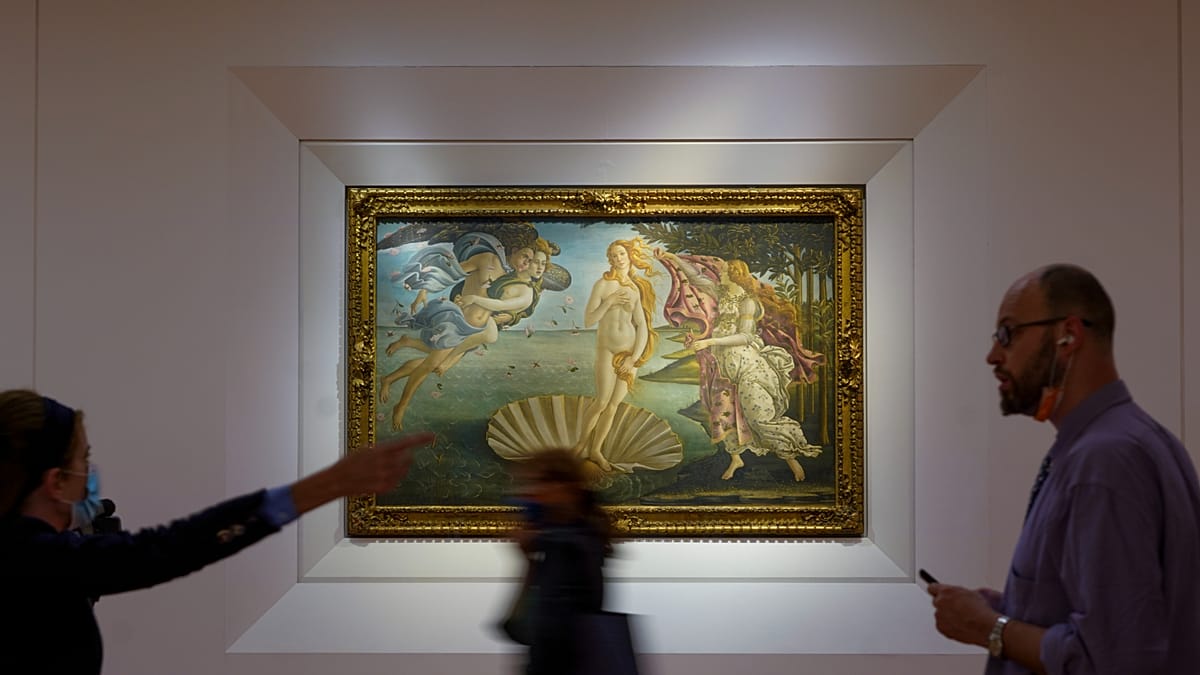
Simonetta Vespucci, the face of the Italian Renaissance as Sandro Botticelli’s muse, may actually have died at just 23 from complications of a tumour rather than tuberculosis. This is the conclusion of a...
Simonetta Vespucci, the face of the Italian Renaissance as Sandro Botticelli’s muse, may actually have died at just 23 from complications of a tumour rather than tuberculosis.
This is the conclusion of a recent study (source in Italian), which challenges the widespread view that the young woman, who died in 1476, succumbed to tuberculosis, a common and deadly disease at the time.
An international team of scholars from Queen Mary University of London, the Campus Bio-Medico University of Rome and the University of California had already put forward a different explanation back in 2019.
Using a facial-recognition algorithm applied to paintings, the researchers examined portraits of the woman, depicted by Botticelli in numerous works including the famous "Birth of Venus", and studied changes in her features. They also analysed various contemporary documents.
The study, published in the journal Endocrinology, Diabetes & Metabolism, highlighted "a gradual change in her somatic features". These are "changes typical of patients with pituitary adenoma, a tumour of the small gland at the base of the brain that controls hormone production", noted endocrinologist Paolo Pozzilli, one of the study’s authors.
"We suspected the presence of a tumour secreting both growth hormone and prolactin. An excess of these hormones can gradually alter the contours of the face and, in some cases, cause unexpected lactation," as portrayed in Botticelli’s work.
Simonetta’s adenoma may have grown over several years, eventually becoming a large mass that triggered her sudden death.
The clues supporting the new diagnosis
According to the new study, the woman’s sudden death is thought to have been caused by pituitary tumour apoplexy, a specific medical condition that occurs "when a pituitary tumour bleeds or suddenly swells, causing symptoms such as severe headache, loss of vision, confusion and a rapid decline due to the collapse of hormonal regulation", Pozzilli stressed.
This unprecedented diagnostic hypothesis, made at a distance of 550 years, is backed by three strands of evidence.
First, there are the physical changes in the paintings from the 1470s through to the posthumous "Birth of Venus", such as subtle variations in the jaw, forehead and facial tissues that can be seen from one work to the next and suggest the tumour’s growth over time.
Then there are accounts of her illness, which mention headaches, hallucinations, vomiting and fever. All symptoms that match the clinical picture of apoplexy more closely than that of tuberculosis, which causes a slower and more obvious physical decline.
To this are added two documented events in the months before her death, consistent with the same picture. Letters exchanged between Piero Vespucci and Lorenzo de’ Medici describe her collapsing during a rather lively dance.
There is also testimony of an alleged assault by Alfonso II of Aragon, Duke of Calabria. Both events could plausibly have triggered a haemorrhage or sudden expansion of the tumour.
Nothing can be established with absolute certainty, but the rapid and sudden death of the young woman, previously in good health, points to a new diagnosis that reshapes long-established historical beliefs and could open the way to reinterpreting numerous historical events through the lens of modern medical knowledge.