Sydney man Nava flew to Nepal thinking his wife had been found. Crushingly, ‘the search goes on’

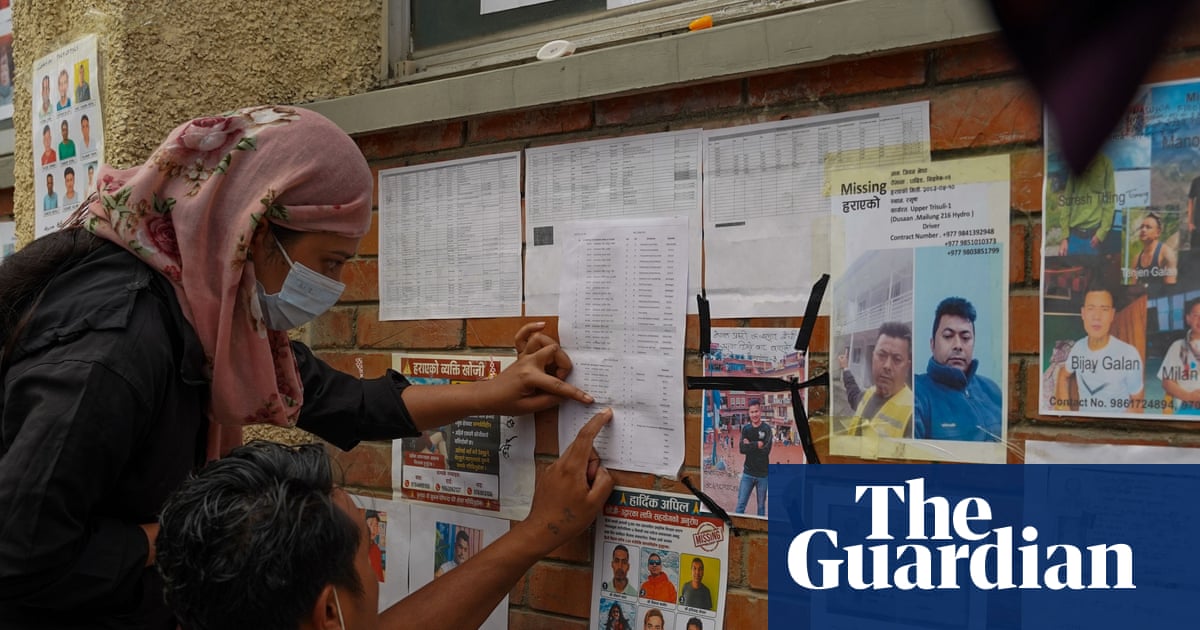
Nava Pandey had hoped the search for his wife was over.Nepal’s disaster management agency had been releasing names of people it had found in stages. One of them was almost identical to his wife, Sumi...
Nava Pandey had hoped the search for his wife was over.
Nepal’s disaster management agency had been releasing names of people it had found in stages. One of them was almost identical to his wife, Sumi Adhikari, who, along with 40 other Australians, went missing in the catastrophic Nepal-Tibet flood disaster on Wednesday.
“The last name matched,” Pandey says. “But they hadn’t disclosed the address of the person or the nationality. And it was very hard to figure out where exactly this person was. So we have called a few people, and someone drove there.”
On Friday night, a family friend drove more than two hours out of Kathmandu, where Pandey was waiting with family for news, to the Nuwakot district, where the main emergency holding and rescue centre is located, near the flood zone.
Adhikari, 41, is one of about 130 pilgrims who were near the Gyirong border crossing between Nepal and China when the floods struck. The area was one of the hardest hit – CCTV footage showed a huge wall of water and debris smashing through buildings as people tried to flee on foot.
It was about 7am on Wednesday morning in Nepal when Pandey, who was at their home in Sydney, spoke to his wife, who had finished a pilgrimage to Mount Kailash with the Isha Foundation the day before. The pair have two children, who she was longing to see.
“She was probably one and a half hours away from [the Gyirong border crossing],” he says.
“She was really happy. She had done what she had gone to do; she really wanted to do this. But she was excited to come back.”
Adhikari was finishing the trek with a sore throat and slight fever, but that did not affect her good mood, Pandey says. She told him she wanted to come back in 10 years and do it again.

At 9am, the last location tracker data on her iPhone was recorded near the border about 10 minutes after impact. She was standing with the Isha Foundation group in the immigration centre when the flood hit. The building was completely washed away. On Thursday, Pandey got on a flight from Sydney to Nepal to be closer to the search.
Late on Friday night, the family friend called – it was not Adhikari on the list of survivors.
“It was a different person, a local,” Pandey says. “The search goes on.”
The rescue effort up the river has been hampered by the remoteness of the location and the destruction wreaked by the flood. Roads have disappeared and bridges have been completely washed away. Satellite images show the area has been flattened to mud.
Getting to the Gyirong border crossing has been impossible by car, with rescuers only able to helicopter in. On Friday, rescue teams from China and Nepal had to stop after a barrier lake began to overflow.
On Saturday, the Nepali army was expected to enter the area and begin a ground search. Chinese rescuers who had rappelled down the wooded mountain slopes to get into the area reported that it had been obliterated.
“As far as the eye could see, there was nothing but ruins,” rescue worker Zou Mingqi said.
Pandey was hopeful ground crews could begin searching the area by Saturday afternoon, but said families have not received enough information – especially from the Chinese side. He says the Chinese government may have information that would help locate some of the missing Australians.
“We respectfully call upon the Chinese government and local authorities to release all available verified information, provide regular updates about the search efforts and establish direct communication with the affected families,” he says. “Families should not be left without answers during such a critical time.”

Newcastle woman Reshma Patel, 46, was also in the Isha Foundation group. She didn’t know Adhikari beforehand, but the pair had become friends on the pilgrimage, Patel’s family friend Chin Valsan says.
“They were talking to each other, and they were supposed to come back on the same flight on Thursday,” he says.
He describes Patel, who has two children aged 10 and 14, and works casually for Canterbury-Bankstown council, as “full of life” and a “kind soul” who loves her family and friends.
As of Saturday, nearly 3,000 people are missing, including at least 777 foreigners. Nepal’s disaster agency on Saturday said 2,426 people were missing on its side of the border, while China’s Xinhua news agency reported the total number of missing in Tibet is now 554.
Many of the missing foreigners in the area are believed to be pilgrims like Patel and Adhikari, who were there to walk around Mount Kailash – one of the two mountains in the Himalayas that cannot be climbed because of its spiritual significance.
The peak is sacred to Hindus, Buddhists, Jains and those belonging to the pre-Buddhist Bon religion, and attracts thousands of tourists each year. Hindus believe that Mount Kailash is the spiritual home of Shiva, the god of destruction and transformation.
Going on this pilgrimage was a once-in-a-lifetime opportunity for Patel, Valsan says.
“She was getting spiritual,” he says. “She wanted to do this trip solo, and said she was attracted to the place.”
Like Pandey, Valsan says the families need more information – he wants the Australian government to make sure rescuers have a database of Australians’ details.
While they wait, they’re torn between hope and despair. In Kathmandu, Pandey spends his waking hours hoping he will be able to bring his wife home with him.
“I’m just keeping my fingers crossed … hopefully, you know, we get some positive news.”