A little known greenhouse gas is quietly harming half of Europeans. This Italian city is hit hardest
Half of Europeans were exposed to a little-known greenhouse gas during this summer’s record breaking heatwaves and wildfires. Ground-level ozone is an air pollutant that can “penetrate deep into the...
Half of Europeans were exposed to a little-known greenhouse gas during this summer’s record breaking heatwaves and wildfires.
Ground-level ozone is an air pollutant that can “penetrate deep into the respiratory system and enter the bloodstream, allowing it to reach almost all organs within the body.” People who suffer from asthma are the most at risk.
Ozone forms from thousands of chemical reactions, triggered by sunlight and high temperatures. So the record-breaking heatwaves that gripped Europe from June to August this year led to ozone levels dangerous to human health. During this period, 50 per cent of Europe’s population was exposed to poor, very poor or extremely poor ozone levels, according to the European Commission’s Copernicus Atmosphere Monitoring Service (CAMS).
“Ozone pollution is a stark reminder of how interconnected our atmosphere, climate, health, and livelihoods really are, with pollution and our changing climate impacting the chemistry of the air we breathe, determining the health of our ecosystems, and even governing our ability to grow food,” says Laurence Rouil, Director of CAMS.
The good news is that EU efforts to combat other air pollutants are making a difference, so it is hoped that ozone levels can also be brought down with sustained effort.
Ozone illustrates the close relationship between air pollution and climate change
Air pollution, often called an invisible killer, causes more than four million premature deaths worldwide, according to the World Health Organization. In 2025, 56 deaths per 100,000 people in Europe and Central Asia were attributable to air pollution.
It is made up of many different gases. Ground-level ozone, not to be confused with upper atmospheric ozone which protects us from UV, is not as well known as others but it is especially concerning because of its close links with climate change.
“Ground-level ozone illustrates the close relationship between air pollution and climate change – a key societal challenge – due to its formation under high temperatures,” according to Atmosphere Watch, the first edition of a new report from CAMS on air quality.
Global temperatures are increasing and heatwaves are becoming more frequent and more extreme due to human-caused climate change. As ozone formation is triggered by high temperatures, the increase in heatwaves means more ozone.
Nitrogen oxides are part of the chemical reactions which lead to the formation of ozone and these, the report explains, are “mainly produced by the combustion of fossil fuels”. It names industry, solvents and road transport as sources of ozone, as well as biomass burning “further compounding the influence of climate change, with more extreme fires occurring under hotter and drier conditions”.
As a greenhouse gas, ozone is responsible for approximately 0.23°C of present-day warming, according to UK charity Clean Air Fund. It calls ground-level ozone a “super pollutant”.
How the EU has reduced levels of other air pollutants
Atmosphere Watch highlights that “air quality in Europe improved significantly regarding all pollutants regulated by the European Air Quality Directive.” Known as one of the most progressive air quality laws in the world, the 2024 directive requires EU countries to monitor pollutant limits and act when safe levels are exceeded.
A 2025 Copernicus report said: “Over the past decade, emissions of sulphur oxides and nitrogen oxides have fallen by approximately three-to-five per cent per year across the European Union. The most significant reductions have been achieved in industry and road transport. Since 2015, industrial emissions of sulphur oxides have fallen by 59 per cent, while nitrogen oxide emissions from industry have declined by 39 per cent. Road transport emissions have also fallen substantially, with reductions of 40 per cent for nitrogen oxides and 34 per cent for fine particulate matter (PM2.5).”
Improving public transport, implementing low or zero emission zones for traffic, switching from fossil fuels to clean energy sources and consuming less meat are seen as some of the most successful ways to reduce air pollutants.
But, Atmosphere Watch says, “ozone shows no clear downward trend and remains an issue.”
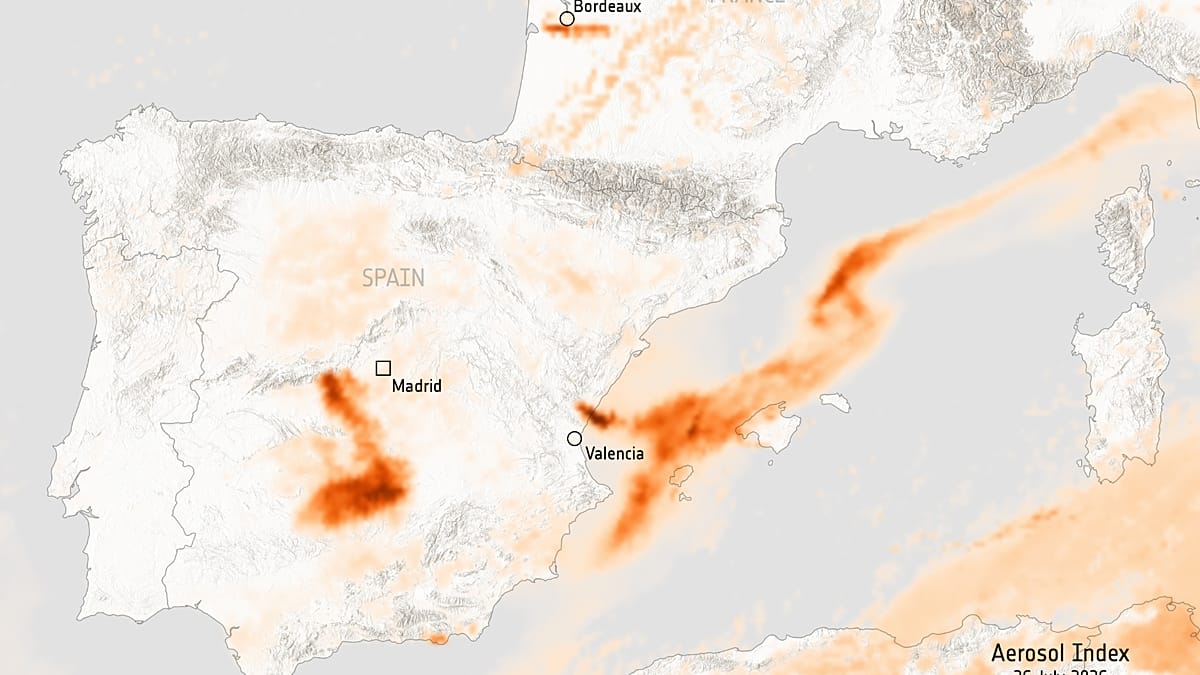
Under the EU Ambient Air Quality Directive, the maximum eight-hour daily average ozone concentration should not exceed 120 μg/ m3 more than 18 days per year, with a long-term objective of 100 μg/m3 compliant with the WHO guidelines. The map above shows how much of Europe exceeded these levels during 2026 so far. It shows how levels get worse the further south you go on the continent – the areas where heatwaves were the hottest and most prolonged.
The extreme weather and unprecedented wildfires led to worse air pollution across the whole continent, not just in directly affected areas.
“Atmosphere Watch shows that air pollution knows no border. Wildfire smoke, ozone and dust can travel thousands of kilometres, affecting communities far from their source,” says Florian Pappenberger, Director-General of the European Centre for Medium-Range Weather Forecasts.
As an example, in August 2026 Belgium experienced its worst wildfire in 100 years. “The intense smoke columns travelled all the way through Germany, reaching Poland.”
Milan has some of the worst ozone levels in the world
While 50 per cent of Europeans were exposed to unsafe levels of ozone during the summer months, the exposure levels are even higher in other parts of the world.
So far in 2026, almost 40 per cent of the world’s total population has been exposed to extremely high levels of ozone, including 60 per cent of Asian citizens. Oceania was the least affected continent during the first eight months of the year – this is partly because the Northern Hemisphere is more sensitive to ground-level ozone pollution due to the higher landmass and population.
Roughly 50 per cent of the global population was exposed to very or extremely poor air quality due to ozone concentrations in 2026. Milan, Rio de Janeiro, Mexico City, Delhi and Cairo are the cities with some of the highest exposures. Only five per cent of the global population was exposed to ‘good’ long-term ozone levels and 15 per cent to ‘fair’ levels during 2026, according to the analysis.
“Ozone concentrations in all continents are likely to be affected by climate change: ground-level, and more generally, tropospheric ozone formation, is triggered by warm temperatures and sunlight. Therefore, in areas experiencing more heatwaves, local ozone concentrations will increase, partly offsetting the benefits of the mitigation strategies designed to reduce precursor pollutant emissions.”
How can ozone levels be reduced?
Ultimately responsibility for and power over ozone levels rests with governments. Experts recommend much better monitoring and reporting of ozone levels, as is done for other air pollutants. At the moment in the EU, only Croatia, France and Spain have developed or implemented air quality plans explicitly focused on ozone.
Countries and cities that are doing the best on limiting ozone are focused on improving forecasting for ozone concentration and understanding how ozone forms and its main sources, according to the European Environment Agency.
Making the public more aware of ozone and how it forms can also be helpful. On an individual level, we can all help to reduce ozone levels by walking or cycling rather than driving. If you must drive, adjust your habits so as to reduce emissions by lowering your speed and avoiding hard braking or rapid acceleration. Use environmentally safe paints and cleaning products whenever possible.