‘Very worried’: Rome airports could suspend new EES border checks over fears of summer travel chaos
Published on 26/06/2026 - 18:16 GMT+2 Rome’s airports could be forced to suspend the EU’s new Entry/Exit System (EES) border checks to prevent travel chaos this summer, the...
Published on 26/06/2026 - 18:16 GMT+2
Rome’s airports could be forced to suspend the EU’s new Entry/Exit System (EES) border checks to prevent travel chaos this summer, the director of the city’s airport operator has warned.
Marco Troncone, CEO of Aeroporti di Roma, said that Fiumicino and Ciampino airports may be forced to allow passengers to skip the biometric controls to avoid “disaster”, in an interview with UK newspaper The Financial Times.
The EES became fully operational as of 10 April, but has had a rocky rollout with calls to put the system on hold and airports requiring extra security to manage queues.
The new controls mean passport stamps are replaced with digitally recorded entries and exits, along with refusals of entry for non-EU short stay travellers.
Biometric information such as facial images and fingerprints, along with personal data from the travel document being used, is also recorded.
‘Incompatible with peak volumes’
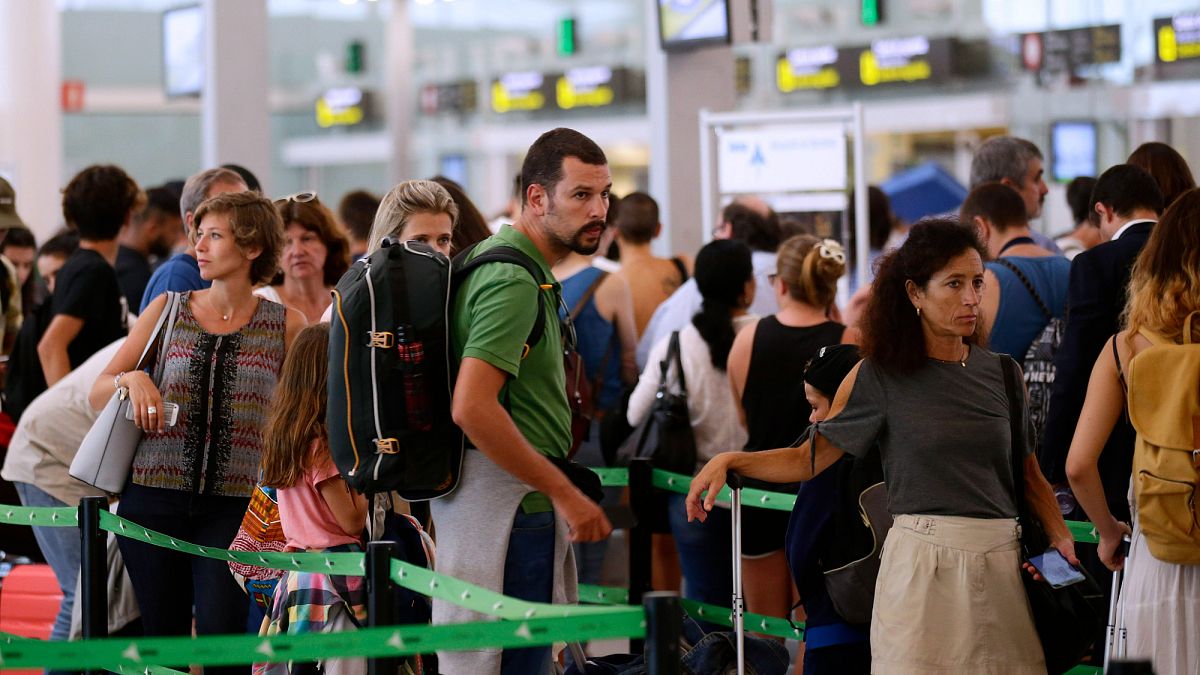
Fears are mounting over a summer of travel chaos as passenger numbers using the EES ramp up.
“The process proves to be incompatible with the peak volumes that we are going to face. So the only way is to open up the valve. There is no way that we can deliver 100% of the enrolment,” Troncone said.
He added that Rome’s airports are “very worried for the summer”, describing his level of concern at an “eight or nine” on a scale of one to 10.
‘What keeps airport CEOs across Europe awake at night’
Rome is not the only destination apprehensive about the summer.
Portugal has said it will deploy hundreds of public security police (PSP) officers at national airports at the beginning of July to help streamline border control procedures.
Greece announced it had all but suspended the checks for British citizens, although it later scrapped the plan, with the foreign ministry saying it had no information that “specific nationalities are temporarily exempt from the relevant procedure.”
Stefan Schulte, President of Airports Council International Europe (ACI Europe) and head of the company that owns Frankfurt airport, said that the EES is “what keeps me and many other airport CEOs across Europe awake at night”.
The concerns appear to be valid, considering a recent acknowledgement by the EU that it could take up to two years for the system to fully settle down.
Frontex, the European Border and Coast Guard Agency, has admitted that the collection of biometric data is one of the main issues causing teething problems with the scheme.
Uku Särekanno, a deputy executive director at Frontex, said that getting fingerprints from non-EU travellers on their first entry to the Schengen Area was “probably the most challenging part” of the rollout.
“We expect the situation will stabilise in one or two years because the most challenging part is the first enrolment,” Särekanno said, speaking at an event held by ABTA, a UK-based association of travel agents and tour operators, in London.
In response, ABTA chief executive Mark Tanzer called the warning “very painful”.