What time will the eclipse be visible in my city? Solar eclipse times for 12 August in Spain
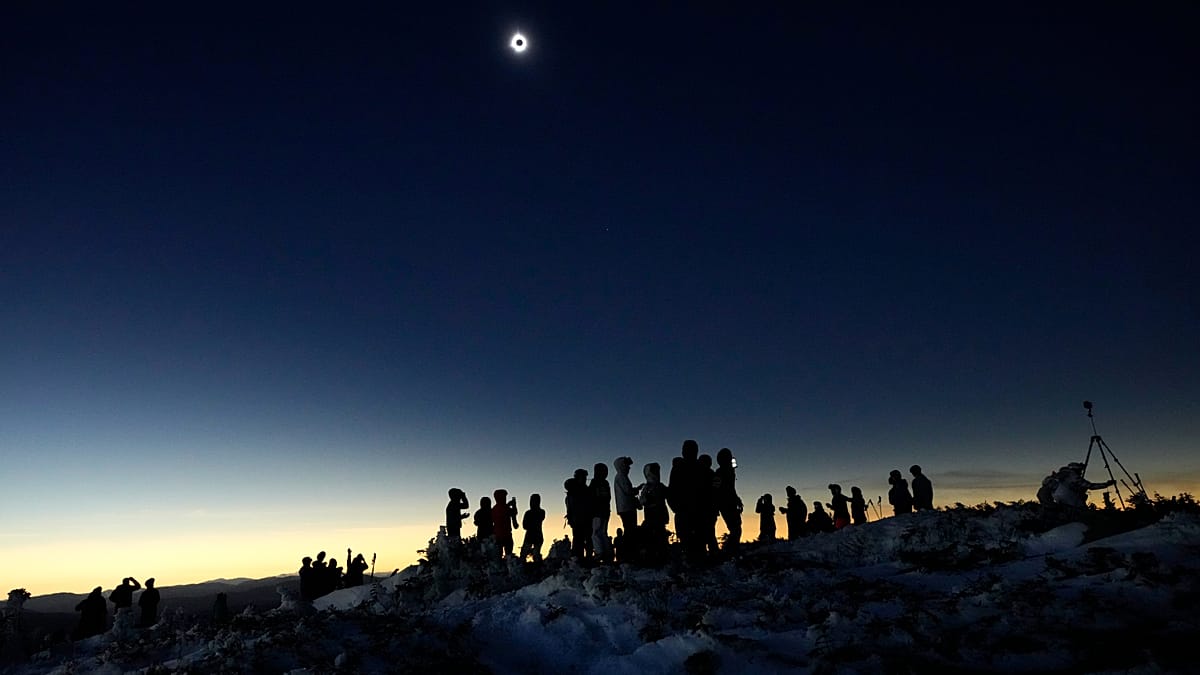
The total solar eclipse will sweep across Spain this Wednesday at sunset, peaking at about 8.30 pm. Check when it will be visible in each city, where it will be total and when it will reach its maximum in Madrid and Barcelona.
Spain has a date with the sky this Wednesday, 12 August. The total solar eclipse will sweep across much of the country in the last hours of the afternoon, and millions of people will be able to watch one of the most eagerly awaited astronomical events of recent years.
But there is one key question before heading out to find a place to watch it: What time will the eclipse be visible in my city?
There is no single answer that applies to the whole of Spain. The Moon's shadow will move from west to east and the moment of maximum darkness will change slightly depending on the locality. Broadly speaking, the most eagerly awaited moment will arrive at around 20:30, although in some cities it will happen a few minutes earlier and in others, a little later.
And not all of Spain will be able to witness a total eclipse. The band of totality will cross parts of the northern and eastern mainland before reaching the Balearic Islands. Outside that band, the eclipse will be partial, although in many places the Sun will be almost completely covered.
What time will the eclipse be in each city?
These are the approximate times of the phase of totality in the main Spanish provincial capitals that will lie within the track of the lunar shadow:
- A Coruña: from 20:27 to 20:28. Totality will last approximately 1 minute and 18 seconds.
- Oviedo: between 20:27 and 20:28, with nearly 1 minute and 48 seconds of totality.
- Santander: between 20:26 and 20:28. Total darkness will last for around 1 minute and 2 seconds.
- Bilbao: at around 20:27, although totality will be much shorter: about 27 seconds.
- Vitoria-Gasteiz: between 20:27 and 20:28, for approximately 1 minute.
- Lugo: between 20:28 and 20:29, with 1 minute and 25 seconds of totality.
- León: between 20:28 and 20:30. Totality will last for around 1 minute and 45 seconds.
- Burgos: between 20:28 and 20:30, for approximately 1 minute and 43 seconds.
- Logroño: between 20:28 and 20:29, with around 1 minute and 19 seconds of totality.
- Palencia: between 20:29 and 20:30, for approximately 1 minute and 42 seconds.
- Soria: between 20:29 and 20:30, with 1 minute and 41 seconds of totality.
- Zaragoza: between 20:29 and 20:30, for approximately 1 minute and 23 seconds.
- Lérida: at around 20:29, with a totality of barely 24 seconds.
- Tarragona: between 20:29 and 20:30, for about 58 seconds.
- Zamora: between 20:30 and 20:31, with about 24 seconds of totality.
- Segovia: between 20:31 and 20:32. Totality will last approximately 1 minute.
- Guadalajara: between 20:31 and 20:32, for approximately 1 minute and 8 seconds.
- Teruel: between 20:31 and 20:32, with around 1 minute and 35 seconds of totality.
- Castellón: between 20:31 and 20:32, for approximately 1 minute and 34 seconds.
- Palma de Mallorca: between 20:31 and 20:32, with around 1 minute and 36 seconds of totality.
- Cuenca: between 20:32 and 20:33, for about 57 seconds.
- Valencia: between 20:32 and 20:33, with approximately 1 minute of totality.
What time will the eclipse be in Madrid and Barcelona?
Two of Spain's most populous cities will lie outside the main band of totality.
In Madrid, the eclipse will be partial and will reach its maximum at around 20:32. The situation is particularly unusual because the edge of the band of totality passes very close to the capital and reaches areas of the municipal boundary near Barajas.
In Barcelona there will also be no totality. The moment of maximum obscuration of the Sun will be at approximately 20:29.
That does not mean the event will go unnoticed. From both cities a very deep partial eclipse will be visible, although there will be no brief period of darkness experienced by locations lying within the band of totality.
The shadow will cross Spain in just a few minutes
The time differences between cities are explained by the route of the Moon's shadow. The zone of total darkness will enter from the west and will cross Spain heading towards the Balearic Islands.
That is why, while in places such as Santander, Oviedo or A Coruña the decisive moment will arrive at around 20:27, in eastern areas such as Valencia, Castellón or Palma it will take place several minutes later.
Everything will also happen with the Sun very close to the horizon. The eclipse will coincide with sunset, a circumstance that makes it especially important to choose a place with good visibility towards the west, without buildings, mountains or trees blocking the Sun in those crucial minutes.
An eclipse that will be visible throughout Spain
Those outside the band of totality will also be able to follow the event. The eclipse will be visible, at least partially, from all Spanish territory, including the Canary Islands.
The big difference will be those seconds in which the Moon manages to cover the solar disc completely. Within the band of totality, the sky will darken rapidly and it will be possible to observe the solar corona for a brief interval.
Outside it, a small part of the Sun will remain visible even at the maximum, so the sky will not take on the characteristic appearance of a total eclipse.
And one final warning will be crucial regardless of the city from which it is observed: you must not look directly at the Sun without certified protection during the partial phases of the eclipse. Ordinary sunglasses are not suitable for observing the event safely.