‘You need to be brave’: Venezuela’s ‘moles’ search for earthquake victims
As the sun rose above Venezuela’s shattered northern coast, a motorbike mechanic nicknamed Culebrita (Little Snake) lowered himself into a chaotic mesh of concrete and steel and began crawling towards his...
As the sun rose above Venezuela’s shattered northern coast, a motorbike mechanic nicknamed Culebrita (Little Snake) lowered himself into a chaotic mesh of concrete and steel and began crawling towards his objective.
“I’m not afraid – but you need to be brave to do this,” said Darwin Rodríguez, a slender 32-year-old who earned the serpentine moniker because of his ability to slither in and out of minuscule spaces.
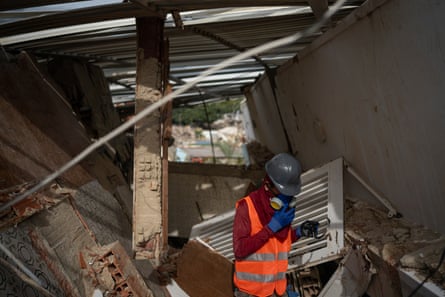
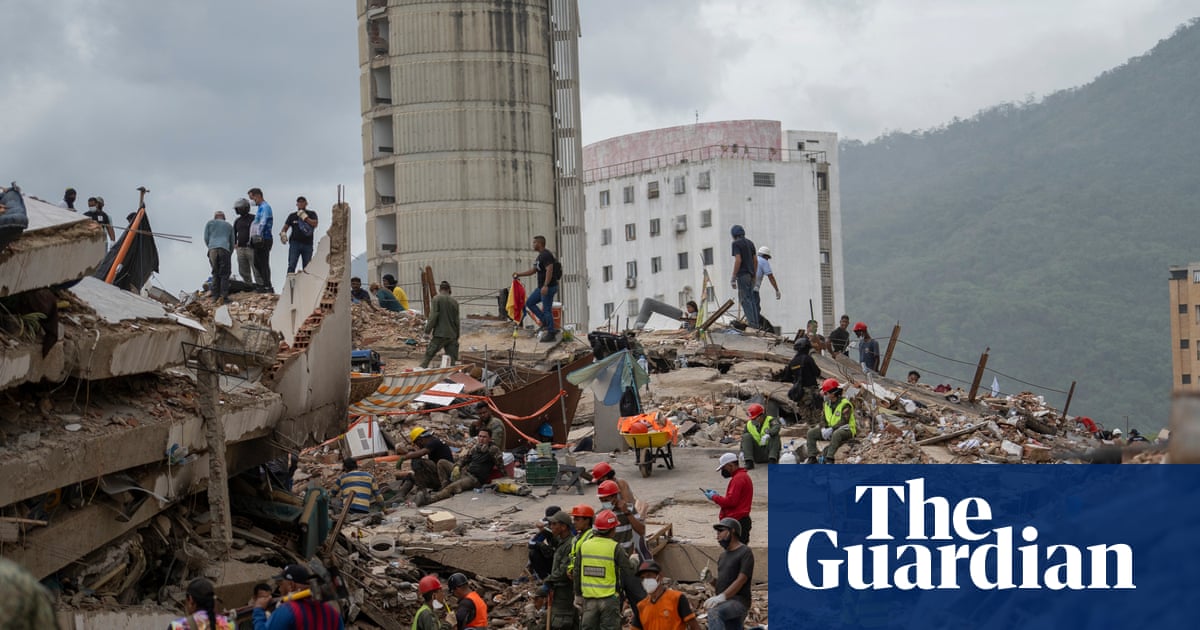
Rodríguez and his comrades were trying to reach the first floor of Residencia Costa Brava, a collapsed 14-storey apartment building that was flattened when the region was hit by a brace of powerful earthquakes on 24 June. More than a week later, 3,342 people have been confirmed dead but volunteer searchers such as Rodríguez hope survivors can still be found.
“This isn’t about money. It’s about saving lives,” said Esnaider Meléndez, 35, another unpaid rescuer who was trying to penetrate the obliterated building having left his wife and four young children at home in the capital, Caracas, to join the search.
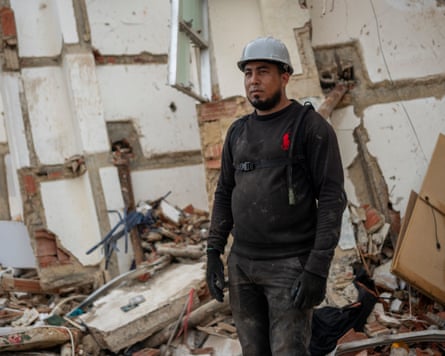
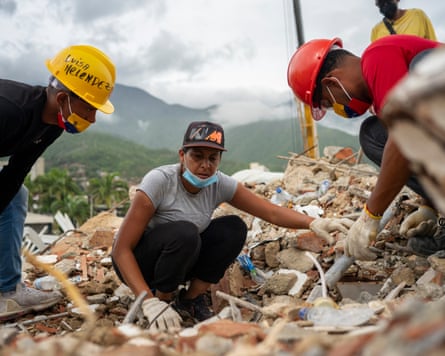
Rodríguez and Meléndez are known as topos (moles) – amateur Venezuelan rescue workers who have spent recent days burrowing deep into crevices and crannies to locate the thousands of people feared to have been trapped when their homes came crashing down.
The term topo was coined 40 years ago in Mexico after a 8.1-magnitude earthquake devastated that country’s capital in 1985, killing more than 20,000 people. The disaster spawned a now famous civilian search and rescue (SAR) team popularly known as the Mexican Moles which went on to become a highly trained group that pioneered SAR techniques and played a key role after major catastrophes including 9/11, the 2004 Indian Ocean earthquake and tsunami, and Haiti’s 2010 earthquake.
Now, after last week’s calamity, Venezuela has its own company of moles who, day and night, are digging and delving in the hope of saving lives – or at least offering closure to the relatives of those missing.
Adolfo Guedes, whose daughter lies somewhere under Costa Brava’s rubble, wept as he spoke of his gratitude to the intrepid moles battling to find her. “I want you to tell this story so the world knows what we Venezuelans are made of, brother,” he said as the group donned protective gloves and masks and prepared to infiltrate the wreckage of his child’s home.
The moles had travelled six hours from Poblado Uno, a village in Venezuela’s agricultural heartlands by truck and motorbike to reach the disaster zone in Caraballeda, a beach town in La Guaira, the worst-hit region. “They are tirelessly helping. They go inside without any kind of fear,” Guedes said.
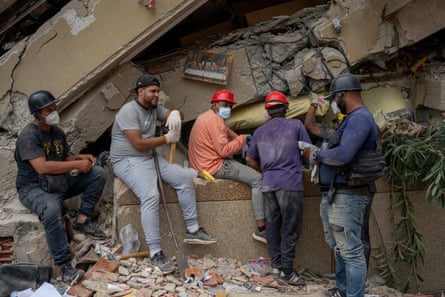
Before the earthquakes, these men were mostly small-scale cattle ranchers or cassava and banana growers. “Now, they are moles. They’ve gone from being farmers to being moles because of the love they feel for my daughter,” added Guedes.
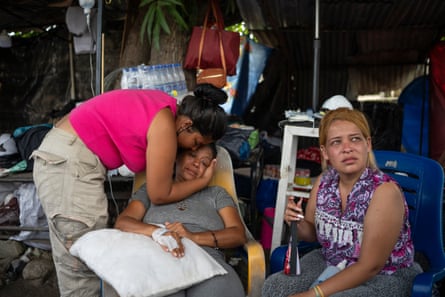
“We are a united people, so very united. Poor, humble, uneducated and rough-hewn – but united. And that is so valuable,” he said of his farmer friends. His wife, Yaritza, sat nearby with a drip in her arm because she can no longer bear to eat.
As Little Snake crept through a tangle of steel rods and slabs, his peers used buckets and spades to clear shards from the top of the pile of wreckage, which they believed was the building’s sixth floor. The other eight floors had pitched forwards towards the swimming pool at the beachfront condo’s entrance.
The wife of a man who lived on the fifth floor, Eduardo Rosal, joined efforts to clear the debris so they could tunnel deeper inside and, hopefully, find her husband a few metres below. “I think there’s a chance [he’s still alive] because there is a pretty big column here [that could be protecting him],” said Luzmar Olivares who had popped out three hours before the first quake.
Olivares crouched down and began removing brick and tile fragments with her bare hands. The ruins around her were sprinkled with her neighbours’ belongings: pots of rosemary, thyme and cloves, remote controls, Christmas tree baubles, and a collection of rock LPs.
A few kilometres east, past dozens of annihilated homes and businesses, another team of moles had dug a 15-metre tunnel into Residencia Perlamar, a 10-storey construction that had keeled over into the road, trapping two brothers, Jesús and Moisés, 15 and 20. One digger lay flat on his back and slid into a tiny crack between two of the building’s reinforced concrete slabs – once the ceiling and floor of an apartment, now only a few inches apart. A portrait of the Last Supper hung from the wall above him.
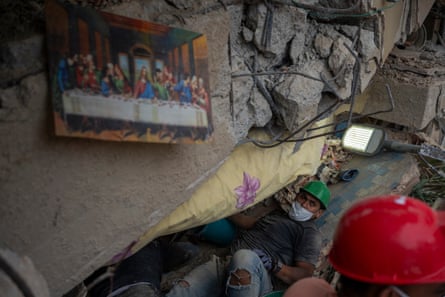
“We don’t have any training,” said Kevin Pérez, 21, a cousin of the siblings inside. “But we are keen to help.”
A mole’s work is dirty and dangerous – and not just because of the constant risk of being crushed by one of these unstable structures. Last week, a searcher known as El Topo de La Guaira (The Mole of La Guaira) reportedly vanished into custody after criticising the government’s sluggish response to the disaster in a viral social media video. He was released after a public outcry.
Around the corner from Perlamar, a government housing project called OPPE 26 – a cluster of 12-storey towers built on the orders of the former president Hugo Chávez – had been almost completely razed, reduced to a mangle of crushed concrete and household appliances. Only two of the complex’s towers were still standing, with one so badly damaged it appeared close to collapse. A basketball backboard protruded from the debris but the court had been swallowed up by a sea of bricks.
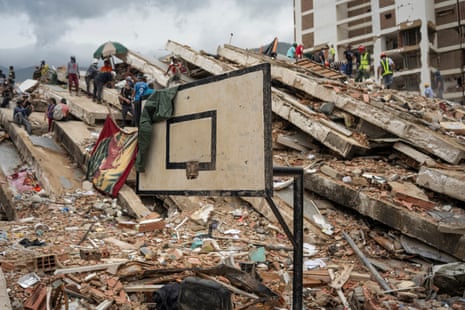
At the heart of the chaos, dozens of dust-caked moles could be seen wriggling in and out of holes they had hammered out of concrete slabs, or climbing into fissures in the pancaked structure to access tunnels they were busy carving out of the remains of the towers.
The bustling landscape was reminiscent of a scene from one of Sebastião Salgado’s iconic photographs of Brazil’s Serra Pelada mining pits, with volunteers scrambling over huge mounds of rubble with torches, helmets and hand tools. Others took a pause from their back-breaking task, smoking cigarettes or collapsing on the sofas and mattresses of residents who were almost certainly dead.
“My family’s in there – two uncles and a six-year-old cousin,” said Yason Torres, 21, as he sat in the dirt. “We need help, but the Venezuelan authorities aren’t doing anything.”
As the moles toiled in the Caribbean humidity, family members hoisted themselves on to the dustheap to ask if their loved ones had been found. “We’re at our wit’s end. I just want God to give me a sign,” said one man who believed his 29-year-old daughter and four grandchildren were buried there.
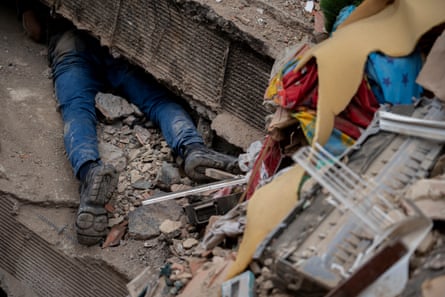
Another man, Neimi Jáuregui, 54, was searching for his sister and her four children, aged 17, 16, 12 and 10. “My heart is in pieces,” Jáuregui said. By his feet, trapped between two slabs, were several decomposing bodies that local people had doused in quicklime to mask the stench. The arms of one victim were frozen above their head, like a Pompeii victim, as if they had instinctively tried to protect themselves in the seconds before the building came down.
Around the corner, two black body bags lay near the project’s entrance containing the bodies of an 11-year-old girl called Sofía and her 16-year-old brother, Samuel. Minutes earlier, they had been found in their living room with their 36-year-old mother, a preschool teacher called Gabriela Carolina Arangure Suárez, and their 60-year-old grandmother, Lucía.
“We were the ones who found our dead. We received no help from the state at all,” said the grandfather, Víctor Arangure, who dug his four relatives out himself with his hands.
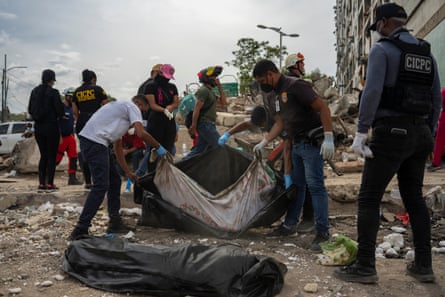
More than a week after the earthquakes, the moles clawing their way through Residencia Costa Brava’s skeleton were also finding bodies, including a three-year-old child, as hopes for survivors began to fade and professional search efforts wound down.
“[I found] a corpse – a man. But you can’t get to him because he’s trapped between two slabs,” Little Snake told his team after emerging from the burrow he had used to access the first floor. There was still no sign of Guedes’s daughter but he hoped for news before nightfall.
The group’s leader, Silvio Sivira, praised the international search and rescue crews who have flocked to La Guaira with search dogs and a wealth of sophisticated technology. But he believed volunteer moles – many of whom are friends and relatives of the missing – could also do their bit with their hammers and their hearts.
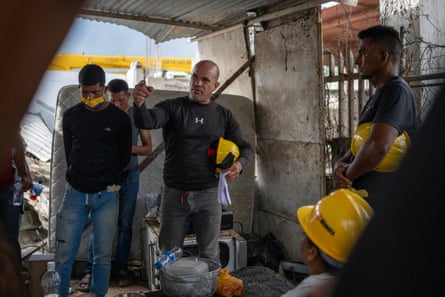
“They are a bit more objective than us,” he said of those highly skilled foreign responders. “[But] we are moved by feelings and by something that runs through our veins.”